TREVIERES

Joli bourg, well built on the left bank of the Lower Aure Trévières is 16 kilometers west of Bayeux, 44 kilometers from Caen, 8 kilometers from the Molay-Littry station where the railway line from Paris to Cherbourg passes. A large trade in butter and eggs, poultry and fruit, Trévières is 8 kilometers from the sea, via Formigny, offering the graceful beaches of Vierville and Saint-Laurent with golden sands.
The origin of the name Trévières is very controversial, some attribute it to the three rivers that surround it, the Aure-Inférieure, the Tortonne and the Esque, which would have given the word three by abbreviation tre and rivers, vières, which would have formed "Trévières". On the other hand, Abbé Guérin, dean of Trévières, President of the Société Historique, in an article in the magazine Le Sol de France, gives another definition of this word, which would be taken from the Latin trium viarum, and which would mean three roads, which were those of Paris, Cherbourg and Saint-Lô; the word Trêves was also offered as a nominal source, this city having, it is said, once sent a colony on the banks of our A vire.
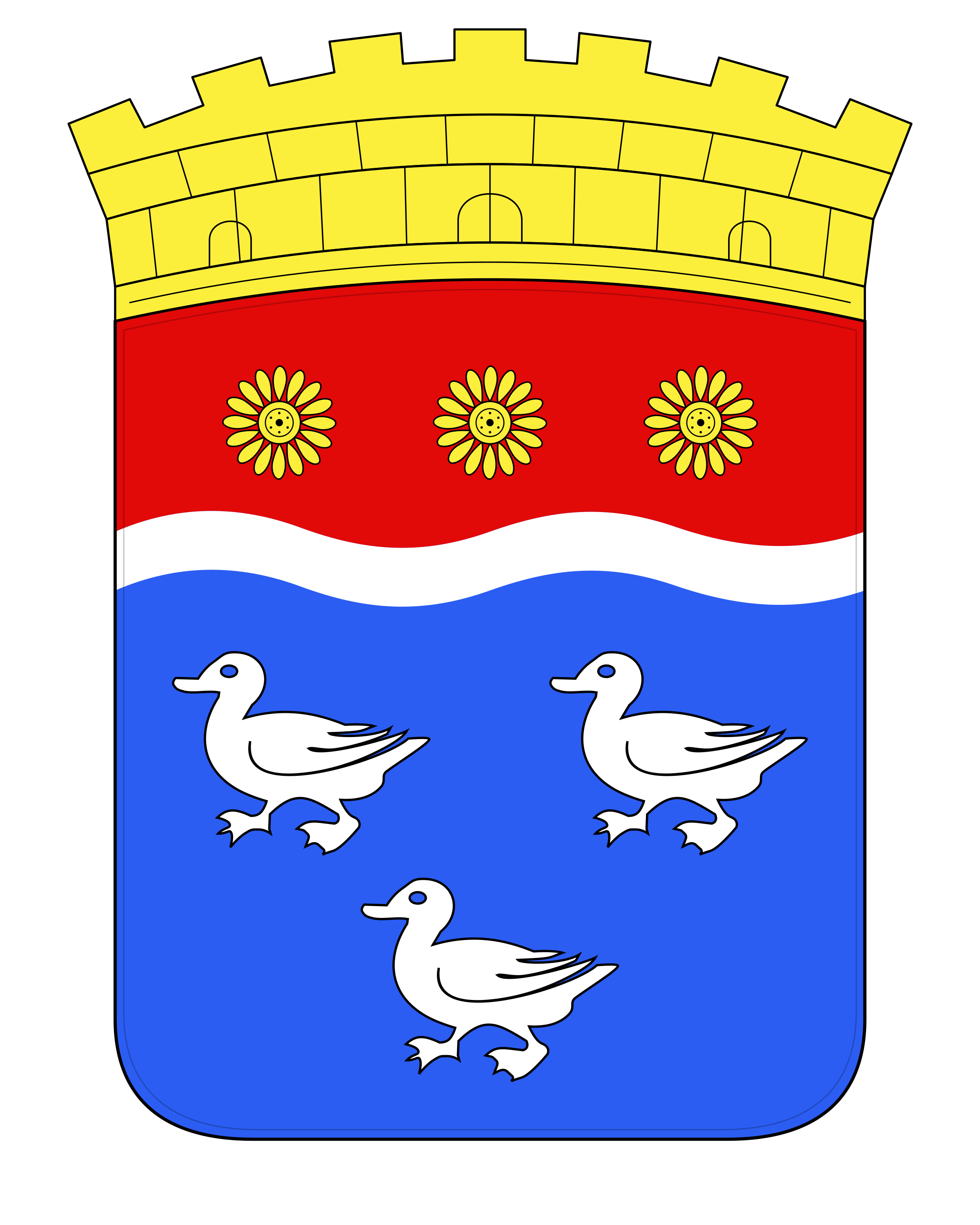
This town had great prosperity during the 16th century with Claude Pellot, Advisor to the King, President of the Parliament of Normandy, Lord of Port-David and Galapran, who owned many surrounding lands and domains; he had as a coat of arms the current coat of arms which are "sand with three golden cotices", that is to say on a black background, three yellow or golden stripes. He obtained, as Lord of Trévières, from King Louis XIV the creation of fairs and markets that were very important - we came from all corners of France - and one of his descendants, Claude IV Pellot, enlarged the roads crossing this country.
Leaving the village to climb the hill towards Formigny, we leave aside, on the right, the coast of Engranville, after the legend "Côte des Deux-Amants", at the top of which is one of the oldest churches in the country, dating from about the year 1100, today disused and in ruins, near which we show, in a courtyard, the stone (called the raised stone), where the unfortunate suitor after climbing the coast, carrying the object of his love, came to fracture his skull and die.
Continuing the path, we enjoy the most beautiful panorama: the most fertile meadows watered by the three rivers frame the ancient village and its monumental bell tower: its base built in the 11th century has walls of 1 m.60 thick, its first floor is magnificently decorated in the style of the 12th century, its second and its spire are from the 13th". Very nice triumphal arch inside.
In the Church, rebuilt at the end of the 19th century, very beautiful white marble high altar, including the columns and the counter table framing the tabernacle whose door is in gilded bronze, masterful work of the sculptor of Laheudrie, child of Trévières, author of the great statues of the Sacred Heart, Saint-Michel and Saint-Gabriel that surmount the altar and also of Christ buried by his Holy Mother, under the table of sacrifice.
To be noted still in the Church the fourteen stations of the Way of the Cross, in white marble, and on the outside, the very old sculpture of the small door of the bell tower representing the Christian hero master of his passions, represented by the monsters who try to devour him.
On the esplanade, opposite the large portal of the church is the Monument erected in honor of the War Dead, a very remarkable statue of France victorious over its enemies by relying on the Cross and Sword, the work of Mr. de Laheudrie, as well as three other statues to be seen in the new cemetery with magnificent alleys, planted with rare trees and carefully trimmed, under the skilful direction of Dr. Brée, Mayor of the country; if you make a pious visit to this place accessed by the Bayeux road, you see, leaving the village, on the right, an admirably flowered garden, with alleys of impeccable alignment and an elegant newly restored house, in a genre taken from the old style, this is his residence. A hundred meters away is the agglomeration of houses, called cheap, for large families.
In the center of the village is a vast building with a monumental appearance, surrounded by a square and two streets, it is the City Hall: built in 1850, it houses the municipal services and the Justice of Peace Hall; in the middle of this building there is the old butcher's hall with its huge stone pillars and in which, a few twenty years ago, about fifteen butchers sold retail twice a week. Today it is rather a subject of curiosity.
Around this building there are very old houses and first a 16th century house that was modernized by its current owner, Me Guernier, bailiff, which is located in Place du Marché and surpasses the others of its entire roof, which rests on a cornice with models.
Some staircase towers dating from the fifteenth century, very well preserved in the courtyard of the Jumelière, in that of Mr. Charles Dérobert and next to our printing house. The appearance of the latter is very curious: on the outside it is a square tower, with openings widening as it is raised, at the top are visors that once allowed to be watched; the first floor has its grilled opening with iron bars crossed and welded to each other; in the masonry at the bottom of this tower, openings are made and precious objects could be put in the shelter of looters, one could even have hidden a medium-sized man; the interior of the tower is round and the screw staircase composed of hard stone steps, on which the best scissors are blunt, they are more than 1 m 60 long, mostly made of a single block, their width reaches about 60 centimeters, they are superimposed on top of each other, a part sealed in the wall and the other end forming a column, up to the second floor; at this height is a wooden floor, which was once supposed to be made of earth, from where a wooden staircase This seems to be a real fortification of the Middle Ages.
In the outbuildings of the Twinelière operated by Mr. Goubot, there is an old Protestant temple, rue des Bretons, which had some vogue around the year 1650 and now serves as an attic and stable for this operation. Opposite is: the "Le Prêche" grass where was the cemetery of this cult.

Trévières is one of the most important shopping centers, you can find everything like in a big city, every Friday, market day, its three squares see the graceful Normans who contribute to the wealth of the country by bringing the best products taken from their farms in Bessin.
The market is very important: pigs, egg butters, poultry abound. The market place is covered with fabric merchants, primeurs, glassware, etc., while the fresh fish landed from the cars is sold on that of the Poissonnerie, and business often ends up being treated with a scoop of the good juice so sung in the Cloches de Corneville, which the graceful hotelier serves you with her most charming smile.
If on Friday there is overabundance, on weekdays the country is also best supplied by the country's traders, there are up to 7 grocers, many butchers, bakers, butchers, pastry chefs, etc., some of whom supply our beaches by their own means. There are also two doctors, Dr. Brée, route de Bayeux, tel. 11 Mr. Lehoux, rue du Marais, tel. 15, a pharmacist, M. Mériel, place de la poissonnerie, tel. ,7 a veterinarian, Mr. Ancelin; rue de la Gare, tel. 6, two excellent garage owners, Mr. Le Sueur "place de la Poissonnerie", M, Lahaye, route du Calvaire, deposits of gasoline and oil in almost all houses, in short, there is also the printer who publishes for you Les Plages du canton de Trévières
The Public Administration is represented by the gendarmerie, a Justice of Peace Registry, Perception, Registration, etc. Three ministerial officers, including a Notary and two Bailiffs, have their studies there.
The means of communication are provided between Grandcamp, Trévjères and Baveux by four trips, two round trips each day throughout the year, by the Société des Autobus Départementaux. In the direction of our beaches, the SATOS buses have replaced the Tramways that have been running for about thirty years. In winter, these buses corresponded between Le Molay, Trévières, Saint-Laurent and Vierville, once a day round trip; during the season these services were doubled, a round trip in the morning and a round trip in the evening, allowed tourists, coming from the beaches, to stay in Trévières, about two hours, between these two trips.
A few hundred meters from the village on the road from Trévières to Bernesq, there is the hamlet of Beau-Moulin, in front of its name to the monumental construction that has existed there since 1684 and classified as a historical monument for a few years. At that time it was called "Le Moulin du Bosq", because of the existence of old woods in this region. Its majestic facade and Mansard roofs make it one of the most curious buildings in Normandy. In the courtyard two old millstones in polished and yellowish stone serve as paving. Many mills existed at that time in our region, some water, others wind. We cultivated 432 hectares of land in our municipality.