Detailed historical notes on successive former owners of Vierville Castle
See the genealogical table Summary of the history of the castle of Vierville
The Vierville - The family that owned the castle of Vierville-sur-Mer from the origins to 1523.
From the middle of the Middle Ages lived in Vierville a family that seems to have had no other name than that of this locality. The seigneury of the parish was divided in 1165, between Raoul d'Aigneaux, Robert de Ver and Guillaume de Vierville, son ofEdouard de Vierville.
Nicolas de Vierville, seignor of Vierville and Louvières, lived in 1173 and 1181, his grandson was called Richard de Vierville, whose son Guillaume de Vierville fought with Philippe le Bardi in Foix in 1272.
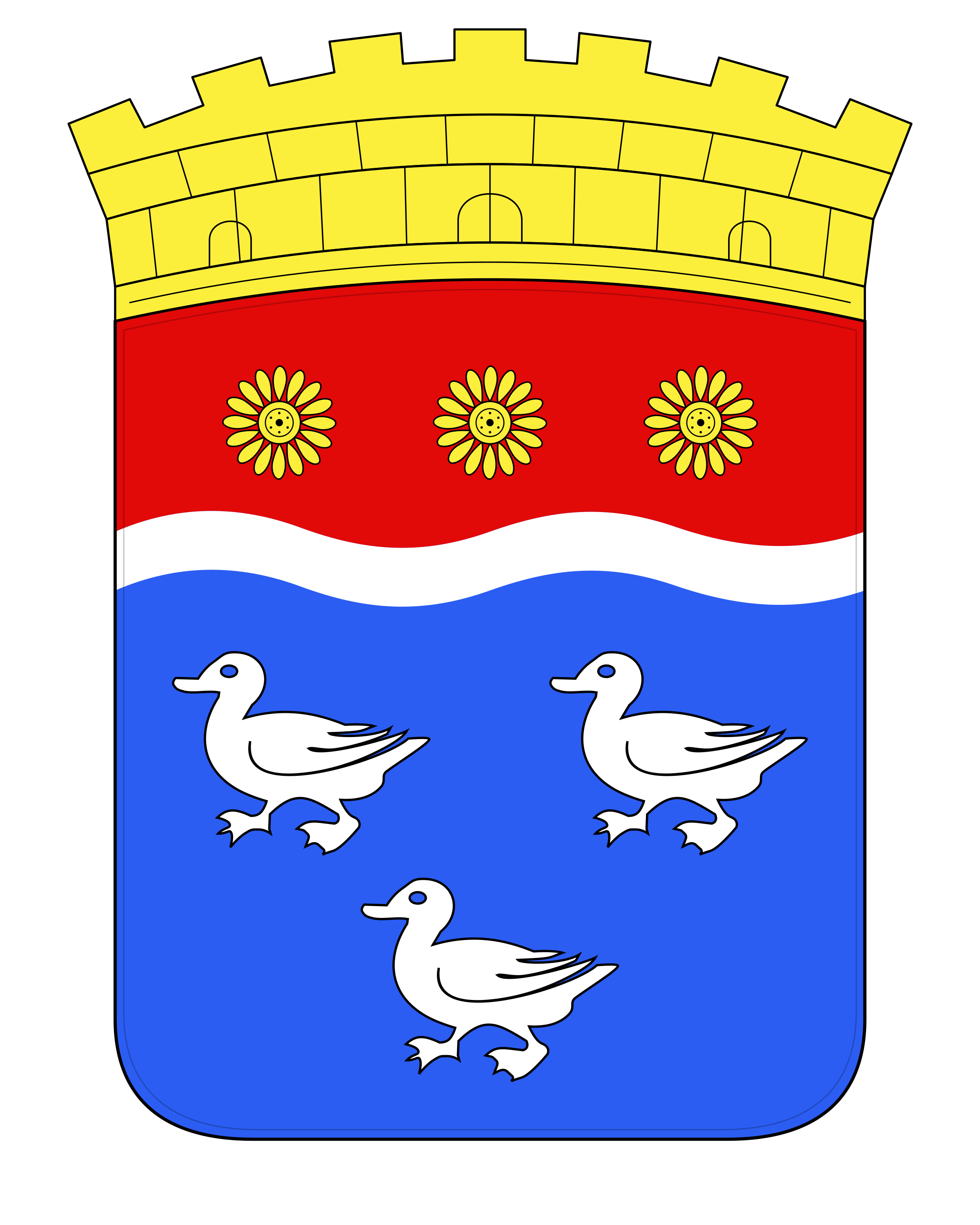
In 1340, the guard of the sea borders included the knights Richard, Guillaume and Jean de Vierville. The crest of those of Vierville was "silver with three sides of azure, with the band of mouths broaching on the whole"
Richard de Vierville lived in 1354 and in 1374, married to Isabelle, (Isabeau) de Tillères, he had 2 sons including Guillaume de Vierville who became Baron de Creully (in 1397) after his marriage in 1392 to Marie de Creully. During the Hundred Years' War, he was loyal to the King of France (in 1411, he was described as "King's Chamberlain") and was dispossessed of his property for the benefit of the Englishman Hortant de Vanox.

A manuscript from 1366, which quotes the Lord of Vierville (undeciphered)


Guillaume de Vierville had several children: 1 - Jean de Vierville
2 - Philippe, sire de Vierville, baron de Creully, qualified in 1451 as an advisor and chamberlain of the King, married on January 22, 1433 to Marie de Montauban (daughter of Robert de Montauban and Marie de Saint Deurnal - Brittany), and in second marriage to Miss Suhart.
3 - Jeannette de Vierville, married in 1412
4 -? Thomine de Vierville, married around 1451?
The domain of Vierville, including that of the Vast, near Saint-Pierre-Eglise (where the other commune called Vierville is currently located, in the Cotentin), was the prerogative of Philippe de Vierville. At the beginning of the 15th century, during the resumption of the War, this domain was again confiscated and given to Jean de Heyne, in charge of paying one hundred francs a year and offering a spearhead to the King of England in tribute.
The victory of Formigny (in 1450) made give back their lands to those of Vierville, but their castles had suffered a lot. From that of Vierville only then remained the very elegant turret (destroyed in 1944) of which we can see the base near the current castle, some elements of the East perimeter wall, and perhaps the dovecote located in the castle's farm courtyard. It no longer has its roof, but keeps inside all its boulins, holes where pigeons nest. There would be at least 365, a figure proportional to the area exploited in the area, probably very important.
Philippe de Vierville had a son Arthur de Vierville, qualified in 1477, squire of the King's stable, married to Jacqueline de Bricqueville
As M. de La Heudrie says in his 1st volume, (Histoire du Bessin, page 279) "Philippe and Arthur de Vierville made a great impression during the 15th century".
Arthur de Vierville (married to Jacqueline de Bricqueville) having left only daughters, two of whom became nuns, the other two shared their paternal property in 1502:
Jacqueline de Vierville, married to Charles d'Harcourt, Baron de Beaufour and Beuvron, who had the lands of Creullet, Vienne and the Manoir. Their succession was divided between 3 sons of Harcourt.
And Marie de Vierville, Baroness of Creully, married to Jean de Sillans, Chevalier, Lord of Hermanville, who had the main part of the barony of Creully, including the domain of Vierville-sur-la-Mer
The Bailleul - owners from 1523 to 1569
2 data complement each other:
1 - "In 1516, transfer by Jean de Sillans and Marie de Vierville, of a lineage claim made by them of the land and lordship of Vierville, decreed and awarded to Gaston de Sérocourt, squire, sieur de la Tour", an event difficult to interpret.
2 - Marie de Vierville sold, in 1523, her fief of Vierville ("on the sea") to the Bailleul family, who gave at least two priests in this 16th century, including Michel de Bailleul, who died on May 24, 1536 "on the day of the Rouaisons fair (rogations)". Jehan Canivet, by giving this clarification, tells us that the other priest," Guillaume de Bailleul, in his lifetime escuuyer, priest priest of Vierville and lord of this place, of Louvières and other noble lands, went from life to death on August 1, 1569."
Shortly after, Pierre Le Bailleul was qualified sieur of Vierville and Engranville; he gave the hand of his daughter Françoise to Guillaume Canivet, ennobled by François 1er in March 1543 and qualified sieur du Vaumicel in 1551. Ten years later, the Canivets were lords of Vierville (at the death of the priest-lord Guillaume de Bailleul in 1569).
As for those of Vierville, here is what Mr. de la Heudrie says:
"More modest is François de Vierville, lord of Tour, Vierville (du Cotentin) and Louvières in 1540"
Of course the Viervilles no longer owned their fief of the Vierville-sur-la-mer of Bessin sold to the Bailleul at that time.
The year 1598 saw the succession of François de Vierville divided between his three children: François (2nd of the first name) to the barony of Creully, Isambart the seigneury of Vast (the Vierville de la Manche) and Gislette the fief of the Motte. Nicolas de Vierville, son of Isambart, dies without children and his nephew, Pierre, died on September 17, 1665 after selling his property to build up a life annuity. He had married, Marguerite de Mons, who survived him until 1675 and was buried on January 25 in the church of Vast. But remember that Pierre de Vierville had nothing left in Vierville-sur-Mer in the Bessin.

The castle of Vierville, built in Vierville in the Cotentin, towards the end of the 17th century, like the one rebuilt in Vierville in the Bessin

The descendants of Pierre de Vierville, who were Protestants, left France during the Revocation of the Edict of Nantes by Louis XIV in 1685. At least several branches have remained to this day.
A first branch had to go to Germany, and would have Germanized its name into Wierwille (in German the W is pronounced like the V in French). There is a trace of Wierwille in Westphalia, Lautbergen and Ladbergen.
A branch apparently emigrated to the United States, perhaps as early as 1793 (Heinrich H. Wierwille). This branch has as its descendants a Sophia Wierwille married to a Katter, then a Katter married to an Armstrong from which Neil Armstrong, the one who walked on the Moon, would come.
In another American branch we noted a Nathan Benjamin Wierwille parents of a Jonathan P. Wierville from Cincinnatti (Ohio).
More recently, Wierwille returned to Vierville sur Mer to visit the estate of their ancestors of the Middle Ages.
A other branch would have left in Switzerland and would have retained the spelling Vierville in German-speaking Switzerland: Marcel Vierville-Roth, father of Angélique Vierville-Roth (in Rein by Brügg) and Frau Renata Fehner, born Vierville-Roth, in Rifferswill (Zürich).
Finally, a 3rd branch would have been identified, from Pierre de Vierville's daughter, Marie de Vierville, married to Claude Champion de Crespigny (an estate located not far from the Château de Vierville). This branch emigrated to London and its descendants visited Vierville in the 1930s. (see the history of the Crespigny estate)

Jonathan-Paul de Wierwille married in Vierville-sur-Mer in 1972Read the rewritten text
This reading version has been rewritten from the newspaper clipping. Connecting phrases and any reconstructed words are not a verbatim quotation.
Jonathan-Paul de Wierwille and Angela Ladas, his American compatriot, got married at the town hall of Vierville-sur-Mer. The article presents the husband as a descendant of the sieurs de la Fleurière and Crespigny, to whom he attributes services rendered to the Dukes of Normandy and a participation in the first crusade of 1096. He recalls the presence, in Vierville, of the manor farm where Claude de Crespigny would have lived until the revocation of the Edict of Nantes in 1685. These genealogical links are those advanced by the newspaper.
The mayor, Mr. de Bellaigue de Bughas, celebrated the wedding in a room decorated in French and American colors, in the presence of many residents. The witnesses represented both countries: Mr. Neel, deputy to Mr. Deker, superintendent of the American military cemetery of Saint-Laurent-sur-Mer, and Pierre Le Gallois, deputy mayor of Vierville.
Miss Le Bastard translated the texts of the ceremony; the spouses expressed their consent in French. In his congratulations, the mayor mentioned the ancient friendship between the American branch of this family and Vierville, as well as the sacrifices of American youth during the liberation fighting of June 1944.
A champagne of honor was then offered at Mr. Le Gallois, with toasts to the happiness of the bride and groom and Franco-American friendship. The spouses were soon to return to Switzerland for a religious ceremony celebrated by a Protestant pastor. The cut adds that Jonathan-Paul is the son of a pastor and claims a relationship with astronaut Neil Armstrong, without providing any evidence to establish it.
View the archive imageDownload the rewritten text
Original OCR text
The original OCR text is kept for comparison with the image. Its reading order and some words may be incorrect.

Jonathan de Wierville returns to get married in ViervilleRead the rewritten text
This reading version has been rewritten from the newspaper clipping. Connecting phrases and any reconstructed words are not a verbatim quotation.
American Jonathan de Wierville asked the mayor of Vierville-sur-Mer to celebrate his marriage to Angela Ladas, a New York student. The couple then had to go to Switzerland for the religious ceremony.
The legend presents this return as a tribute to family traditions. She describes Jonathan as a descendant of a champion of the Dukes of Normandy and a Knight of the First Crusade, and as a cousin of Neil Armstrong. She also mentions in her kinship a viceroy of the Indies and an RAF officer, described as vice-admiral in the text. These genealogical reconciliations are the affirmations of the cut and are not accompanied here by evidence of filiation.
View the archive imageDownload the rewritten text
Original OCR text
The original OCR text is kept for comparison with the image. Its reading order and some words may be incorrect.

An American wedding in Vierville-sur-MerRead the rewritten text
This reading version has been rewritten from the newspaper clipping. Connecting phrases and any reconstructed words are not a verbatim quotation.
Mr. de Bughas, mayor of Vierville-sur-Mer since the previous year, officiated at his first wedding ceremony on a Friday afternoon. The spouses were two young Americans: Angela Ladas, from New York, and Jonathan Paul de Wierwille, presented as a direct descendant of the former lords of Vierville. After their civil wedding in the village, they planned to travel to Switzerland for the religious ceremony.
The city council wanted to surround the mayor and the young people. In the town hall decorated in French and American colors, they were accompanied by their witnesses: Mr. Néel, steward of the American cemetery, and Mr. Legallois, deputy mayor. An interpreter translated the words of the ceremony; the bride and groom pronounced their "yes" in French.
In his speech, the mayor brought together two stories: that of the Americans who died for the liberation of the commune in 1944 and that of the Vierville family, long linked to the fate of the village. He mentioned Nicolas de Vierville, quoted in 1173 and presented in his speech as related to the Dukes of Normandy and, by alliances, to the royal house. He also recalled the presence of a Vierville alongside Philippe le Hardi in Foix in 1272.
The speech then stopped on Guillaume de Vierville, married in 1391 to Marie de Creully. According to the reported account, his refusal to collaborate with the English occupier and his rallying with the King of France had resulted in the confiscation of his property; Charles VII is said to have restored the property to his son Philippe. The mayor also recalled the exile of this Huguenot family after the revocation of the Edict of Nantes by Louis XIV in 1685.
This return to the origins was presented as proof of attachment to France. The mayor cited the exchanges with Mr. Ibetson, a resident of Jersey and descendant of the Champion de Crespigny family, as well as with the Roth-Vierville family in Switzerland. He mentioned the descendants established in the United States, Switzerland, Jersey, Natal and Australia, going so far as to mention a relationship with Neil Armstrong by a grandmother born Vierville.
Genealogical research did not make it possible to find the family motto, Mr. de Bughas proposed the word "Fidelity": loyalty to the king of France in adversity, to religion, then to family origins through this marriage in the village. On behalf of the city council, he wished the spouses a long happiness and invited them to return, even mentioning possible reunions of the descendants scattered around the world. After the signing of the deed, the municipality offered a wine of honor.
View the archive imageDownload the rewritten text
Original OCR text
The original OCR text is kept for comparison with the image. Its reading order and some words may be incorrect.
1972: An American couple comes to get married in Vierville. It is called Wierwille and it descends from the old chatelains
The Canivet. - The family that owned the castle from 1569 to 1670.
Ennobled in March 1543, the Canivet wore: "from gueules to three silver-cut knifes with gold-stucked".
There are many branches of this family established at that time throughout the region (Canivet du Molay, Canivet de la Rougefosse, Canivet des Londes, Canivet du Taillis, Canivet de Glondelle, etc.).
Guillaume Canivet, married in 1553 to Françoise de Bailleul, daughter of the lord of Vierville was also lord of Vaumisset. They had 7 sons, only 3 of whom seem to have had offspring and inherited:
1° - Michel Canivet, who inherited from Saint Sever
2° - Jehan Canivet, 1st of the first name, was the Sieur of Vaumissel and Molay, and married Madelaine de Hotot, whose family owned the castle of Beaumont-le-Richard. Although he did not inherit from Vierville, we will follow his descendants because they intersect with that of his brother Marin Canivet who inherited from Vierville.
Jean 1er Canivet wrote a column "of the things he saw or heard in the region".
In this "Journal of Jehan Canivet", visible in the archives of Calvados, we read for example that on February 16, 1503, François de Bricqueville-Colombières and the Sieur de Pierrepont came to besiege Bayeux with four cannons; we talk about Jehan d'Escageul, lord of the Bretonnière (à la Folie), husband of Jacqueline d'Harcourt, deputy of the nobility of Bessin in the States of Blois in 1588, governor of Bayeux in 1589, etc.
Jehan Canivet, begins this handwritten chronicle with these words:
" Journal of the inheritances, annuities and income of Louis and Jehan Canyvet, lords of the Vaumisset... "
He mentions the events and deaths he learns in this mansion, from 1562 to 1606... A supporter of Henry IV, even before his abjuration, he was a victim of the troubles of the wars of Religion in these terms:
" I was volleyball and brusley of the (by the) people of Vicques on Wednesday, penultimate day of August 1589, and meney prisoner at Mont Saint-Michel and remained there until his capture on December 5, 1589 by Mr. de Lorge, son of Mr. de Montgommery. "
We know that Vicques, called himself " lieutenant-general of the Holy Union in Lower Normandy " was Louis de Lamoricière, sieur de Vicques, de l'Isle-Manière. The following year, he was attacked near Avranches by the royals headed by Carbonel de Canisy and Jean de Hotot, Sieur de Beaumont, often called the "captain of Beaumont" in contemporary writings, and brother-in-law of Jehan du Vaumisset. The battle took place on August 8, near Saint-Jean-de-la-Laize. But, abandoned by former leaguers whom they had enlisted in spite of themselves, Jean de Hotot and Carbonnel de Canisy had to retreat, leaving two hundred dead and one hundred injured. On August 30, 1590, Jean de Hotot was in charge of guarding the coasts of the sea from Isigny to Bernières-sur-Mer, which restored security in and around Vaumisset.
In his diary, Jehan Canivet notes that his daughter, Catherine, born in 1575, was baptized by the parish priest of the 2nd section of Englesqueville and had Marie du Bosq as godmother, assisted by Jean de Baudre. He also notes that her daughter, Madeleine de Hotot, his dear wife, died and was buried on March 6, 1585 in the church of Vierville.
Jean 1er Canivet was able to repair the Vaumissel "brûley by the leaguers" and leave a beautiful inheritance to his son Gilles 1er, born in 1578, three years after his sister, Catherine, and five years before the death of their mother, Catherine de Hotot.
Gilles 1er Canivet, nicknamed the Elder, had his nobility recognized in 1599, at the age of 21. However, after the death of Henry IV, he was considered to have derogated and had to be reintegrated into the nobility by letters given to Saint-Germain, on October 14, 1625, and registered on December 9. However, qualified lord of Vaumissel and Molay, he had been able to contract, as early as 1621, a very noble alliance marrying in La Cambe, Marie de Faoucq, daughter of the lord of Jucoville, Jacques 1er de Faoucq-Rochefort and Olive de la Luzerne, builders of the beautiful portal of Jucoville, still visible.
From the marriage of Gilles 1er and Marie de Faoucq, were born a daughter and five sons, including Jacques who was lord of the Londons, and Jean II, lord of Vaumissel after the death of his father. In April 1660, Jean II Canivet, agreed to sell his Vaumissel wood to Gilles du Mesnil, lord of Saint-Paul " eleven hundred and ten pounds to have a house in the parish of Cricqueville, in a piece of land called the Closets ". (Excerpt from a manuscript written by Jacques du Mesnil Saint-Hilaire and preserved in Couterne).
Jean Il, recognized noble by Chamillard in 1666 at the same time as his brother Jacques, lord of the Londons, died in 1679 and was buried on November 12 " in the Saint-Loup chapel, located on the southern side of the church of Louvières where he had founded the brotherhood of the Rosary " says his act of burial.
He left his widow Robine Philippe who had the Canivet shield registered in 1698 at the Armorial de France.
Jacques Canivet's wife, Anne Léonard, of the family of the sieurs de Beaupré, des Isles, de Rampan and de Juvigny, was also buried in Louvières, on June 27, 1680.
From his marriage, John II Left a son, Rabbet plane, who succeeded him as lord of Vaumissel and Molay and who married the widow of Gilles de Marguerye and the heiress of the seigneury of ViervilleMarie-Thérèse Canivet-Maillard.
3° - Marin Canivet, heir to Vierville and Lormel, was the father of Gilles Canivet le Jeune, Sgr. de Vierville and Lormel, married to Marie Maillard who brought him the fief of Léaupartie.
Gilles and Marie Canivet-Maillard had at least 2 heirs:
- Gilles Canivet, Sieur de la Rougefosse (an estate in Englesqueville, of which an old 16th century mansion remains, 300m before the castle of Englesqueville on the Grancamp road), whose direct descendants still bear the name.
And - René Canivet, lord of Vierville, Lormel and Leaupartie, born around 1616, and who married Charlotte Simon. It was probably they and their daughter who built the castle of Vierville in its current form.
Their daughter Marie-Thérèse Maillard-Canivet, heiress of Vierville and Lormel, had kept her grandmother's name, perhaps because there were many Canivet in the Bessin and the confusions were too many.
She married 2 times, first with a Marguerye, then with a distant Canivet cousin, the lord of Vaumisset:
1° - First marriage on October 8, 1670, with Gilles de Marguerye, son of Bernardin de Marguerye, lord of Colleville, and Renée de Méhérent, (Municipal archives of Vierville, curial registers).
They left a son Gilles-Armand de Marguerye, who inherited from Vierville.
2° - Then, Marie-Thérèse Canivet-Maillard, widow of Gilles de Marguerye, remarried in 1685 with Guillaume Canivet, his cousin, lord of Vaumisset. She had 2 children who shared the goods of the Canivet:
- Isaac-François Canivet, lord of Vaumissel and Molay,
And - Jean-Louis Canivet, Lord of Vacqueville. He was a coast guard captain and a knight of Saint-Louis; he gave 140 pounds of annuities to the poor patients of the Hôtel-Dieu de Bayeux in 1728 on his personal property;
An obscure story of engraving rights on the coast,
disputed between Marie-Thérèse Maillard-Canivet and the Mesnil de Louvières.
Here is the deed of power of attorney registered on December 14, 1693, before noon, the notary of Trévières, Magloire Tortonne:
"Was present noble lady Marye-Thérèse Maillard, wife of Guillaume Canivet, esc., sieur du Mollay, with luy civilly separated from property, lady and patron saint of Vierville, residing in her seigneurial mansion of the said place of Vierville, which passed general and special power to Sieur du Mollay son mary, also present to whom she gave full power, power and authority, for her to act and negotiate in all her name and negotiate in all her general affairs and especially pursue the lawsuit filed by her against Adrien de la Rivière, escuier, Sieur de Romilly, during the headquarters of the Admiralty of Grandcamp, subject to several graves s hatched on the coast of the sea, together to firm his inheritances in some places that they are located,... receive the payments of arrears of land, seigneurial "
Done and passed in the study. Signed: Marie-Thérèse Maillard, lady of Canivet: Witness: Jean Pouchin, from Mandeville; Richard Carité, from Trévières.
This power of attorney from Mrs. de Vierville is quite instructive about the Norman chicaneries of that time.
First, the regime of separation of property did not prevent "Marie-Thérèse Maillard" from having full confidence in her husband, Guillaume Canivet.
On the one hand, she had to safeguard the interests of the sons she had of her first husband, Gilles de Marguerie, son of Bernardin, Lord of Colleville, and Françoise-Renée de Meherent.
As for the engravings stranded on the coast, they belonged in 1604 to the owner of the Vierville-Fontenay fief.
According to the Journal des héritages, rentes et revenus des Canyvet, in the succession of Guillaume de Bailleul, in 1569, this engraving right was part of the 2nd lot due to Robert du Mesnil, son of Tristan and Catherine Bailleul. On the other hand, we know that this right passed to Guillaume du MesniI, son of Robert, then to Jean, husband of Marie de Saint-Denis, according to his 1604 avow, and finally to their son, Jacques du Mesnil, living in Vierville although lord of Louvières.
But the 1st lot including the rights and freedoms of the seigneury of Vierville with its patronage and its right of presentation of the parish priest had been awarded to Guillaume Canivet, husband of Françoise de Bailleul, and their direct descendants had enjoyed the right of engraving on Vierville.
Marie-Thérèse Maillard-Canivet claimed the same right on Louvières, calling herself suzeraine of the noble fief of Louvières-Fontenay and of the patronage of the first and main portion of the parish of Louvières (there were 3 parish priests in Louvières), she claimed that by selling the noble fief of Louvières, in 1669, to Adrien de la Rivière, Gilles Canivet, his grandfather, had kept the suzerainty: hence the trial that the Admiralty of Grandcamp had not yet settled six months after the power of attorney given to Guillaume Canivet on December 14, 1693 by his wife.
This one, Marie-Thérèse, according to the notarial deed in Trévières, lived in 1693 in the seigneurial mansion of Vierville, that is to say the newly built castle.
Isaac-François Canivet, in possession of Mauminot's land, partially located in Aignerville, sold it 2,000 pounds to Gilles-Armand de Marguerye, castellan of Vierville.
According to the custom of the time, the two Canivet brothers, Isaac-François and Jean-Louis, had remained undivided owners of the Vaumisset and the Vacqueville. However, by contract of Thursday, August 7, 1755, before Michel Duhamel, royal and hereditary notary in Bayeux, they sold the Vaumisset and Vacqueville to Jean-Nicolas de Pleurre, honorary councilor in the Grand Chamber of the Parliament of Paris.
Jean-Nicolas de Pleurre, parishioner of Saint-Sauveur, in Paris, was lord of Romilly and Ferté; he had married Marie-Thérèse Gaillard who had given him a daughter, Marie-Thérèse de Pleurre, who married in 1741 with Gilles-Edouard de Marguerye, who was Sgr. de Vierville.
Vierville and the Vaumisset were therefore reunited from the death of Jean-Nicolas de Pleurre and until 1809.
The Marguerye in Vierville from 1670 to 1809 and from 1829 to 1836
On October 8, 1670, Gilles de Marguerie, son of Bernardin de Marguerie, lord of Colleville, and Renée de Méhérenc, married Marie-Thérèse Canivet-Maillard, heiress of Vierville (Municipal Archives of Vierville Curial Registers).
They left a son Gilles-Armand de Marguerye (+1738) and that's how the Marguerye became lords of Vierville.
Gilles-Armand married Jeanne Hélyes de Clinchamps.
From this marriage was born in 1709 Gilles-Edouard de Marguerye (+1802), sgr. de Vierville et de Lormel, married in 1741 with Marie-Thérèse de Pleurre, heiress of the Vaumisset.
In Vierville is the tomb of Gilles-Armand:
" HERE RESTS THE BODY OF MESSIRE GILLES ARMAND DE MARGUERYE KNIGHT LORD AND PATRON OF THIS PARISH LORD OF MONMINOT, HOUTEVILLE, AND OTHER PLACES DIED ON DECEMBER 31, 1738 AGED 65 PRAY TO GOD FOR THE REST OF HIS SOUL."

The tombs of the 2 families: of Marguerye and Marguerit de Rochefort, at the Vierville cemetery
The Marguerye wore of azure to three silver daisies, gold carnations, tigées and sinople leaves , which later became : azure to three silver meadow daisies, laid 2 and 1.
From Gilles Edouard de Marguerye and Marie-Thérèse de Pleurre we mention three children:
1° - Jean-Edouard de Marguerye, married to Louise de Viel and died on August 3, 1783 as seen on his grave at the Vierville cemetery
"Cy in front at the foot of the Cross Rest the body of Jean Edouard de Marguerie Chevalier, son of Gilles Edouard de Marguerie, knight, lord and patron of this parish, died on August III MDCCLXXXIII Aged XXXXII years Pray for him
The tenderness of noble lady Louise-Françoise-Thérèse de Viel de Lunas his wife posed this monument"
2° - Françoise de Marguerye, who married Joseph Morin de Litteau (sgr. de Vaulaville); and who will be the owner of Vacqueville
3° - Edouard-Marie de Marguerye, colonel, victim of the Revolution (+2 June 1794).
Lieutenant Edouard-Marie de Marguerye had married a noble Scots, Anna-Bella Drummond de Melfort, lady of honor of Mrs. Elizabeth, sister of Louis XVI.
Having become a Colonel of the Royal Guard, Edouard de Margerie was near the King on August 10, 1792.
Seeing Louis XVI convicted, Mr. and Mrs. de Marguerie had to emigrate, but returned to see his children entrusted to his father, a castellain of Vierville, the colonel was warned of his imminent arrest, in his residence in Agy.
He was slow to flee, wanting to see his children again. Arrested, convicted on 12 prairial year II (June 2, 1794), he was guillotined in Paris, Place de la Révolution.
He had written a touching letter to his son, Edouard-Marie-Alfred and his daughter, Anne-Marie, who married, on May 31, 1802, Eugène Texier, Count of Hautefeuille. Officer under the Empire and the Restoration, the Count of Hautefeuille was colonel of dragons in 1823. He commanded the 1st subdivision of the 14th division in Caen, and was promoted to Marshal de Camp and officer of the Legion of Honor.
However, his wife, sometimes inspired by Vierville and his graves, wrote in prose and verse: "Disaught and sensitivity", "Sufferings", "Léa Cornelia", "The exiled soul", "The lily of Israel", "Flowers of sadness". See the'Article of the Renaissance on this subject and the texts relating to Vierville. About his political writings, see "Castles and thatched houses"
Edouard-Marie-Alfred de Marguerye inherited the Château de Vierville at the death of his grandfather in 1802 (share of 1805). He died in 1809, and the castle of Vierville was sold to Mrs. de Marguerit de Rochefort.
The Marguerit de Rochefort, owners from 1809 to 1829
In 1809, Madame de Marguerit de Rochefort, at the mansion of Than, thus constituted an estate for her son Louis-Victor-Frédéric in order to allow his daughter Marie-Félicité-Constance-Aimée de Marguerit de Rochefort to keep the domain of Than alone. But Louis-Victor died before her in 1816 and Marie Félicité Constance Aimée de Marguerit de Rochefort inherited Vierville in 1829.
As she had married in 1798 to a cousin of the Marguerye family, Jacques-Henri de Marguerye (+1836)(Archiv. municip. de Vierville), the castle of Vierville, passed in 1809 from the hands of the Marguerye (de Vierville) between those of the Marguerit de Rochefort (de Than) returned by this alliance to the Marguerye in 1829. The Than estate remained in the hands of the heirs of the Marguerit de Rochefort until 1938 by sale to Thérèse Chedal-Anglay's parents).
Marie-Félicité-Constance-Aimée de Marguerit de Rochefort and Jacques-Henri de Marguerye had a daughter Jenny de Marguerye, heiress of Vierville.
The Lépesse, owners from 1836 to 1876
The marriage in 1822 of Jenny de Marguerie with Adrien-Bon-Casimir Sorin de Lépesse (Archiv. municip. de Vierville) passed the castle and the estate into the family of Lépesse at the death of Jacques-Henri de Marguerie in 1836.
Son of a victim of the revolution, Adrien Sorin de l'Epesse (former family taking its name from the fief of the Episse, located in Sainte Opportune near Lessay) joined Napoleon's army; second lieutenant at the age of 18, he was captain on February 1, 1800, two months before he was 21. He fought in Prussia, Sweden, Russia.
Adrien-Bon de Lépesse was born on April 2, 1788 and joined so young in the armies of Napoleon I that he was second lieutenant at the age of 18, lieutenant on November 1, 1808, captain on the following February 1, 2 months before the age of 21. He made the campaigns of Prussia, Sweden, Germany, the shores of the Ocean (1807 to 1811), Russia (18I2-1813). Injured in the left shoulder he continued to encourage his voltigeurs with his example. He distinguished himself especially in the Berezina and received the cross of the Legion of Honor on July 24, 1813. Resigned in 1815, he was reintegrated into his rank in the 1st Channel Legion in December 1815, then in the 25th Line in 1821.
Back in private life he lived in Vierville. "Faithful to the oath he had taken in 1814, to the monarchy and to the dynasty for which his father had poured his blood, he refused in 1830 to take a new oath as a member of the municipal council of Vierville; in 1848 after the abolition of the oath, he was again brought to the municipal council from which he withdrew again by refusal to swear in 1853, after the proclamation of the Empire. " We borrow these lines from the notice published by the Norman Association in 1858, a notice saying that Adrien de Lépesse "was kidnapped on April 28, 1857 almost suddenly to the affection of a family whose charm and happiness he made, to the many friends he had attracted by the loyalty, sweetness and amenity of his character..., in the feelings of the deep and sincere piety that he practiced without concealment as without ostentation. "
Adrien-Bon de Lépesse was the son of Pierre-François-Casimir Sorin, Sieur de Lépesse (formerly l'Espaisse, name of a stronghold of Ste Opportune near Lessay).
Married and father, Pierre-François was 45 years old when he was the victim of one of the cruelest injustices of the Terror. Indeed he simply had against him to be "proud and ex-noble", because on many occasions he had given evidence of the most rational civic spirit.
The bad luck meant that his brother, Abbé Sorin de Lépesse, a refractory priest, who emigrated to Jersey, returned on the night of June 9 to 10, 1794 to preside over the night procession of Gonfreville. This demonstration exalted the fury of Commissioner Le Carpentier, who immediately arrested ten members of the Coutances supervisory committee. Imprisoned in Périers, and fortunately forgotten in their prisons, they were later released, thanks to the benevolent judgment of Le Menuet de la Jugannière, then public accuser at the Manche Criminal Court.
But three days after their arrest, Le Carpentier sent to the revolutionary court of Paris the 24 people who composed " the batch of Coutances ", (just before the end of the Terror).
Among them were Sorin de l'Espaisse, Marie-Léonor de Cussy (Marie-Léonor de Cussy-Mandeville, grand vicar and mayor of Coutances) and his nephew Louis-Léonor, Hue de Caligny and François-Léonor de Mons, great vicar of the exiled bishop of Coutances, perfectly innocent of any compromise in this case and who could not be saved by the protests raised in his favor by the republican authorities themselves. They were tried en masse. Fouquier-Tinville aggravated to pleasure the more or less vague charges, raised against these unfortunates, personally accusing of emigration those whose only relatives had emigrated, of intelligence with the enemy those who did not have the slightest relationship with the foreigner, of provocation to civil war... and making them a crime for having felt sorry for the fate of the tyrant Capet. Of the 24 defendants, only 5 were acquitted. All the others were sentenced to death on 3 thermidor (July 21, 1794), executed the same day at the Vincennes barrier and buried in the Picpus cemetery.}
Adrien de Lépesse, settled in Vierville where he was twice taken to the city council. He died "almost suddenly" on April 28, 1858. He left a son and a daughter; his son Henri de Lépesse was on that date mayor of Vierville. He bought the Vaumicel in 1859.
Henri Sorin de Lépesse, already heir to Vierville, was attached by his wife to the former Lords of Vaumicel and Vierville.
He had, in fact, married in June 1849 Aglaë-Siméonide-Justine Wastelier d'Hailliecourt, daughter of Jean-Baptiste-Justin and Louise-Nathalie (or Léonie??) Couliboeuf de Blocqueville (The Couliboeuf blassed d'azur with the head of golden beef.). She was the daughter of Aglaë-Marie-Thérèse Morin de Litteau, herself the daughter of Françoise de Marguerye, herself the daughter of Gilles-Edouard de Marguerye (1709-1802) who had been both lord of Vierville and Vaumisset (see above).
Les Marguerit de Rochefort - Goussancourt, owners from 1879 to 1882
In 1879, after the death of Henri Sorin de Lépesse, the castle was bought by the count de Goussancourt, husband of Miss Marie Noëmi de Marguerit de Rochefort (whose grandmother had already made such an acquisition in 1809) of the mansion of Than. He then came for the second time to the family of Marguerit de Rochefort, and Vierville was again reunited in Than for a few years (from 1879 to 1882).
It was probably the Goussancourts who modified the castle: construction of the corner tower in place of a missing portion of the wing, modification of the skylights of the north facade, etc. and who had the coat of arms executed which is on the northeast wing.
In 1882, the Count of Goussencourt ceded ownership to M. Lefrançois, son of a lawyer from Bayeux and engineer of the mines of Littry, then of the railways of Northern Spain and Portugal.
Mr. Lefrançois is in particular at the origin of the earthworks (see the 1882 plan) which greatly improved the view of the sea from the main rooms of the castle. After her death, Mrs. Lefrançois dutvendre en 1906 her property and the precious collections of art objects, furniture and tapestries that her husband had gathered in the Château de Vierville (however, there are still very beautiful tile panels).
In 1906-1910, two successive owners, foreigners in the country, saw it only an object of speculation, and the property was bought in 1910 by the Hausermann family. It is still today a beautiful house surrounded by grass and a very wooded park.