The castle of Vierville during the War of 1939-45
During the first 3 years of occupation, from June 1940, the castle was only very partially used by the Germans to house an officer, a colonel, or a captain, or a lieutenant, depending on the era. Very quickly the Germans gave up making it the "Kommandantur" of the village, finding the house comfortable, but too much in sight of the sea where the potential enemy was.
From the beginning of March 1944, the castle was completely requisitioned by the Germans. The owners had 3 days to move the furniture, which they were able to do thanks to the help and dedication of the residents of the Commune. It then served as a barracks for the workers of the Todt Organization who were responsible for building new coastal defenses as quickly as possible, on the instructions of Marshal Rommel who came to inspect the fortifications during the previous days.
On June 6, 1944, the naval bombing of the coast around 6:00 a.m. by the 127mm artillery of the battleship USS "Texas" did not spare the village. Too long blows reached various houses in the village and the castle received at least 3 shells:
One on the isolated turret that completely destroyed its picturesque pointed stone roof,
Another on the NE corner turret, in the slate roof, which was simply crossed and damaged,
A third destroyed one of the skylights on the facade.

The turret isolated before the bombing of June 6, 1944

The abbot's turret in Winter 45, without its roof

There was no fighting in the castle, but the small wood of the park, enclosed by walls, was the subject of very deadly fighting on June 7 during cleaning by the Rangers.
The next day, June 8, Michel Hardelay visited the abandoned but more or less preserved castle. He tells:
" On my way home I found my mother in a big conversation with the two teachers. These, who lived in the post office building, had lost everything in the fire from the night before to the night.
We decided to make a reconnaissance to the castle, hoping to find some effects left by the workers of the Todt company during their hasty departure. There was a great mess and I was very surprised by the number of women's dresses scattered on the floor. The principal of the school found a large swastika flag in which she carved herself, later, skirt and bodice, of a violent red obviously.
On the way out we noticed an army truck ready to make the soup; out of curiosity I pulled a kind of recessed compartment on the right, it was full of real coffee. The principal of the school who was very fond of coffee, untraceable at that time, fills her pocket with it; as for me I tell my mother that I will come back after our lunch with a bag. But when I came back after the meal there was no more coffee.
Fortunately, the "K" ration cartons that were later found in abundance contained, in addition to three cans, each a coffee pouch."
The castle was then occupied, from June 9 to July 26, 1944, by the General Staff of the 11th Port of the United States Army. This unit was responsible for the operation of the Mulberry artificial port of Vierville.
Colonel Whitcomb commanded the 11th Port. Michel Hardelay writes in his memoirs:
"...I did, on the occasion of some paperwork from the town hall that I have no memory, knowledge of Colonel Witcomb who headed the services of the 11th Port at the Château de Vierville. He was a charming man, speaking French perfectly, and who took me as a friend. ..."

The authorization given to Michel Hardelay to enter the PC of the 11thPort at the Château de Vierville

After the war, a bronze plaque was inaugurated, reminiscent of this installation.

On June 6, 1946, inauguration of the 11th Port plaque
After the departure from the 11th Port, the castle housed an American hospital (60th Medical Bn) until December 1944.
The 60th Medical Battalion included the 634th "Clearing Co" (sorting of the injured and sick), and 3 "Collecting Co" (search and transport of the wounded to the "Clearing Co"): the 499th and 500th stationed at the castle and the 453rd stationed in Granville.
Below are images of the castle's back lawn on a Sunday in September 44. On that day, a mass was said in the middle of the American tents of the hospital.

Mass on the back lawn in September 44. The participants are the injured or sick GIs and "medics" of the hospital.


The entrance to the hospital, with an outdoor airlock, through the small door of the castle's old billiard room, facing the isolated turret destroyed
(September 1944)

The sad state of the entrance to the castle after the war. The bronze grille and bell have disappeared, the two main towers will need to be replaced.

Opposite a humorous graffiti, left by the GIs in the castle kitchen
"There was a cook name Chem
He looked like a bending stem
When the work was not done he'd sing
But to us it didn't mean a thing"

The corner turret probably damaged by a 127mm shell from "Texas" around 6:00 a.m. on the morning of June 6. The shell must have exploded after crossing the roof


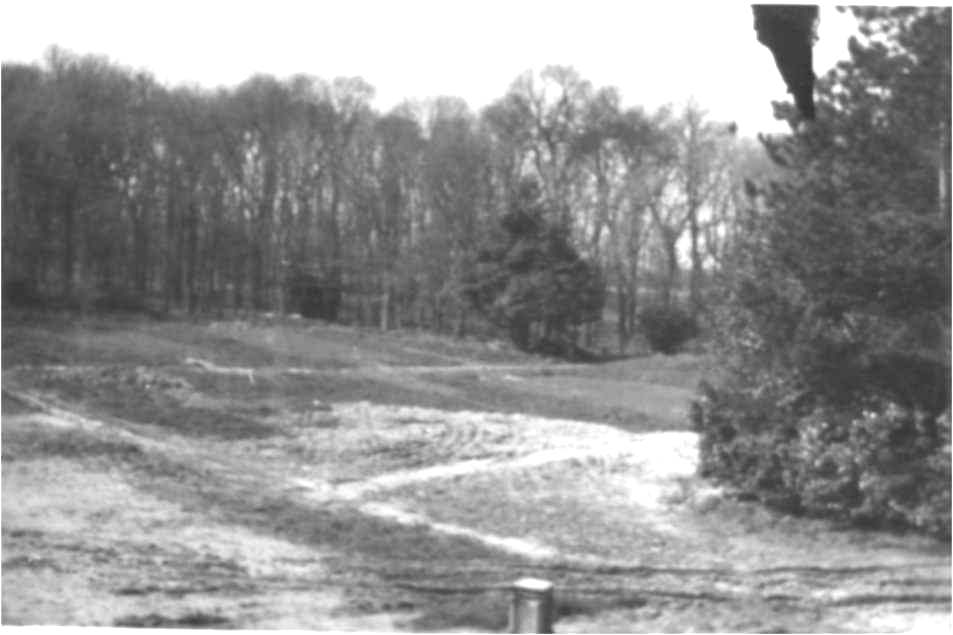
The back lawn and wood in Sept.44

The back lawn

The Abbot's turret in Sept. 44

1969, waterproofing work on the isolated tower

1949, the 2 towers

The East perimeter wall and the road traced by the US Engineer in the Bricsart field in winter 1945.

The field north of the castle transformed into a road and embankment

The Abbot's Tower in 1945

1950, turret with traces of a fire

1946, June 6, inauguration plate on the portal
After the war

1949, main portal

1953, the catalpas in front of the castle

1964, fire of the lumber shop

Greenhouse repaired, around 1950


1949, portal

Around 1949, roof repaired
