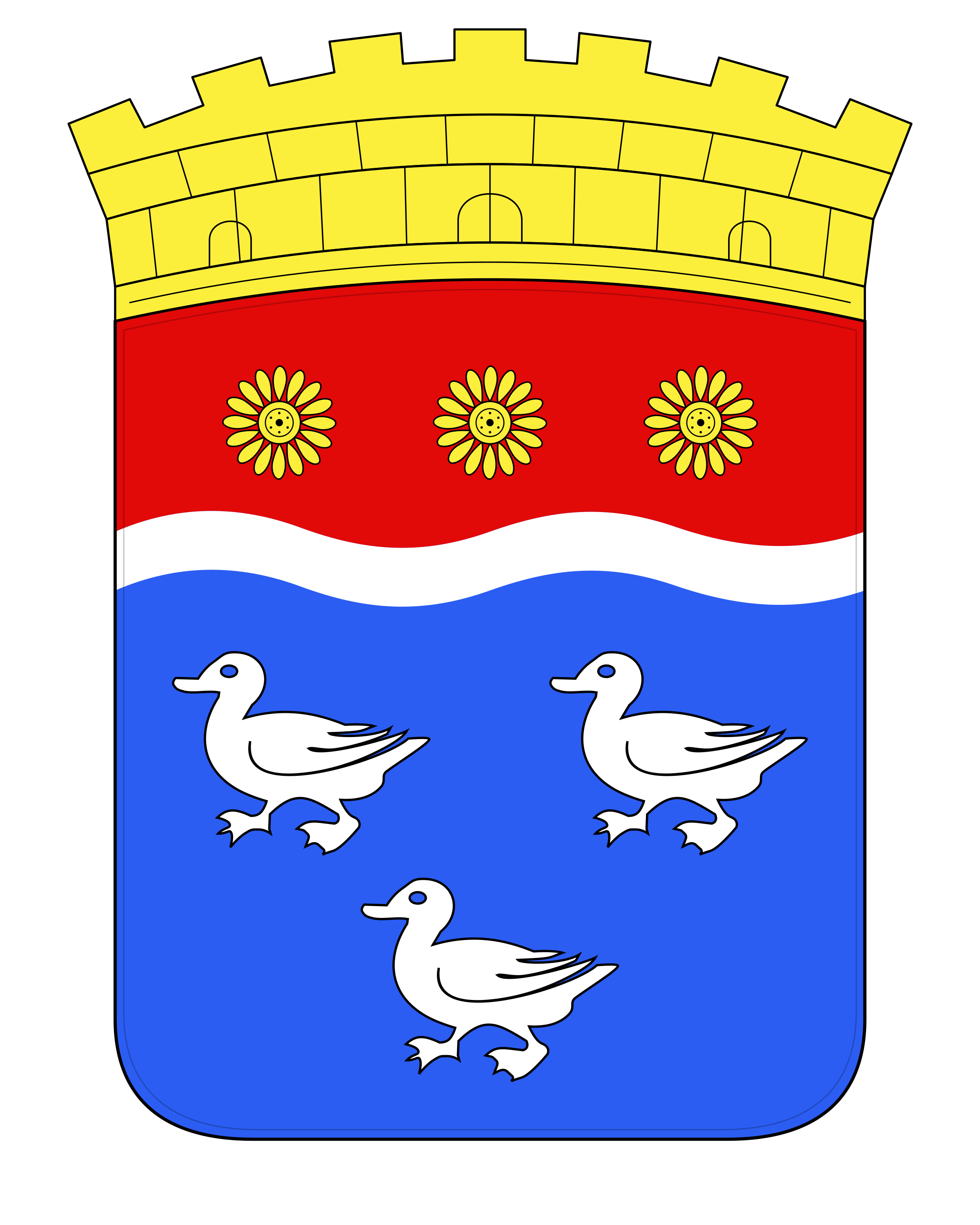
THREE PATRONS AND THREE PARISH PRIESTS for the parish of Louvières
(Excerpts and adaptations of the Historical Notes on the Bessin)In the years following the year one thousand, three of the main lords of Louvières contributed to the construction of the church choir and had the right to each choose their parish priest to whom the Bishop of Bayeux gave the necessary powers. Later, one of these three bosses put his share in the hands of the bishop who entrusted it to the Chapter of Bayeux. But during the wars that the sons of William the Conqueror fought, in Louvières as well as in Asnières and in many places, everything that belonged to the church of Bayeux was usurped.
In the middle of the 12thth century, Philippe d'Harcourt (one of the eight children of Robert d'Harcourt and Colette d'Argouges), who became bishop of Bayeux bought back several of the lands sold or stolen. A letter from Pope Eugene III dated February 3, 1152, says that Philippe d'Harcourt had one of the 3 portions of Louvières returned for 40 pounds paid to the one who held it. Then he gave back to the canons of Bayeux this portion as well as the patronages of Carcagny, Cahagnolles (parish currently reunited in Fresne-Camilly) "to be a perpetually participant in the prayers of the church of Bayeux".
Around 1350 when the Book Pelut was written, the 3 patrons of the church of Louvières were Guillaume de Vierville who was taxed at 40 pounds (for the war against the English), the chapter of Bayeux, taxed at 20 pounds and Raoul de Louvières taxed at 20 pounds.
His descendants owned the place where the mansion next to the church stood: in the 15ème century Artus de Louvières had Pierre and Jean de Louvières as sons and heirs. The aforementioned Pierre was the father of Artus II and Michel; they lived in Louvières when they proved their nobility in the 16th century (their cousins, David and François de Louvières lived in Vaux-sur-Aure).
The de Louvières ceded their portion of the patronage of Louvières to the de Bailleul who were already in possession of the first portion as successors of the de Vierville. In his diary, Jehan de Canivet qualifies Guillaume de Bailleul lord of Vierville and of Louvières, which, he says "passed from life to death on August 1, 1569"
The niece of this boss of Louvières gave her hand and the two patronages to Guillaume Canivet whose seven sons was lord of Louvières and as such "was buried in the choir against the wall of the south"on January 25, 1657. In the same place "Gilles and Michel Canivet were buried" the latter qualified as boss of Louvières, on September 2, 1663. Their heir Gilles Canivet, 2nd of the first name, sold in 1669, his two shares of the patronage to Adrien de la Rivière, sieur de Roumilly. Of old nobility, the de la Rivière who were in 1465 in St-Germain du Crioult had representatives in Bayeux and Hérils near Maisons. The church of Saint-Nicolas des Courtils, which once stood in front of the castle of Bayeux, received in 1584 the body of the late François de la Rivière, Sieur de Roumilly and Hérils, lieutenant general of the Viscount of Bayeux. One of his sons, Jean, continued the branch of the sieurs de Hérils and another was the ancestor of those of Romilly who gave this name to a mansion in Saint-Germain du Pert and who settled in Louvières in 1669.
From his marriage to Anne de Launay, Adrien de la Rivière had seven children, the eldest of whom Thomas answered God's call for the priesthes and became at the age of 30, parish priest of the first portion of Louvières. The registers kept at the town hall of this locality show him doing the pastoral functions jointly with one and the other on April 10, 1714 at the funeral of Pierre Picot, widower of Anne d'Aigneaux, baptizing on August 12, 1718 two bells and on the 13th a third bell given by him to serve the clock of the beautiful tower. The following year, the parish priest Thomas de la Rivière died on September 27, 1719, barely 41 years old, visiting his family in Cardonville, his body, transferred the next day to Louvières, was buried in the sanctuary next to the south, by Mr. Philippe Lelou, parish priest of the first portion of Englesqueville in presence, of Guillaume des Mares, priest of the 2nd portion of Louvières, of Jacques Féron, parish priest of the 3rd, Nicolas Le Breillon, parish priest of Asnières, JL Bidot, parish priest of Deux-Jumeaux, and the vicars of Vierville (Lequeux and Val-Jacquelin).
Before the death of the late parish priest, his family had left Louvières following the division of the property of the late lord, Adrien de la Rivière. The parish priest and his two sisters had had annuities encumbering the main fief that became the property of their brother Charles; the secondary fief was attributed to the 3rd son, Pierre-Louis; the common lands were divided between the 4th and 5th son, named Philippe and André. The boss of the first parish priest, Charles de la Rivière, seeing himself unable to serve the annuities due to the parish priest and his sisters, sold on April 28, 1719 to the canon Cosme de la Lande, archdeacon of Caen, his quarter of a knight's fief under the king with the right of jurisdiction and a fieff domain of two hundred acres, then the next day April 29 to another priest of Bayeux, Thomas Regnault, Sieur de Préville, a place and maintaining located in Louvières, containing five acres... on which was sitting "The seigneurial mansion and several attics of houses, dovecote, water mill, courtyard and vegetable garden; a piece of land in plowing, located in the countryside at the end of the avenue on the side of Asnières, the room named the Petit Val, containing 7 vergées, bounded by the Marquis de Bellefond, the Voie à la Dame, the Legrain heirs, and other lands bounded by the seller and his broken brothers, including a half-shaft enclosed in the room yawning in fief to the canon of the Lande."
This contract was published after the great mass celebrated by the priest Thomas de la Rivière, on May 7, 1719, but it was canceled on the 26th, because the canon of the Lande claimed the buildings sold to the abbot of Préville as "inseparable dependence on his fief". He obtained them shortly before his death which passed land and fief of Louvières to his niece, married to Jean-Jacques de Brossard, sieur of the Bardel Islands. But on June 3, 1720, Pierre-Louis de la Rivière withdrew from "droit lignager" the funds sold by his brother Charles to the abbots of the Lande and Préville, then he gave as a fief to Antoine de Faudoas several lands part of the contract for 92 pounds of annuity, etc. Charles and Philippe de la Rivière intervened in this act, endorsing their brother. On June 4, he sold to Antoine de Faudoas the surplus of the land of the contract at the expense of paying 13 pounds of rent to the Sieur d'Aigneaux, 3 pounds and 3 sols to the obits of Louvières, etc...
The de Faudoas resold the land of Louvières; Sieur Mabire was one of the buyers and one of the 50 taxpayers paying the tax of the 20th in Louvières. The patronage fiefs passed to Thomas de Pierres, son of Michel and Madeleine Louvel de Contrières whose tomb inscriptions are visible in the church choir. These are the ancestors of the Loys family, current owners of the castle of Gruchy in Louvières.
In the middle of the 18th century, as a measure of economy, it was decided that the three cures would be reunited. First titular of the 3rd cure, Jean-Jacques Mabire was in charge of the 2nd at the departure of Abbé Guérin de la Houssaye for the cure of Briqueville in 1762, then he also had the first cure at the death of his holder Jean Gaultier who died at the age of 71 and was buried in the church on May 10, 1771.
To those who wonder what three parish priests were doing in the small parish of Louvières, let's say that in addition to prayer, teaching and other priestly occupations, the parish priests ensured or at least actively overseed the education of children. They entrusted a nun of Sées with the instruction of the girls; one of the parish priests held the boys' school, the other two remained at the disposal of the sick and that of the neighboring parish priests for funerals often requiring the presence of several priests.
At that time, the parish priests performed the functions of civil status officer and even registration and police officers. In the old registers we find in addition to the acts of baptism, marriage and burial, the monitories for the search for criminals, the notifications of sales and purchases, the elections of the collectors of the size, the banishments of curial and monastic property.
Finally, the parish priests prepared their future successors by giving the first lessons of Latin and by initiating the clerics, sometimes the sub-deacons and deacons, to the holy ministry. Thus, in Louvières, not only Thomas de la Rivière became priests, but also Jean-Baptiste de Pierres, who was parish priest of Hyenville near Montmartin-sur-Mer, and Roland Léonard, parish priest of Louvières from 1656 to 1658. Son of the nobleman Charles Léonard and Noëlle Anseray, this parish priest had two brothers, the eldest of whom, François, was the ancestor of the Léonard de Rampan and Juvigny, the other, Gilles, that of the Léonard de Beaupré, the Isles and Courcy, in Vierville and Louvières. Roland Léonard also had two sisters who were married, one to Jacques de Canivet, Sieur des Londes, patron of Louvières and the other with François de Tallevast, Sieur des Hautes Terres in Longueville.
In 1876 all those who knew, Gaston de Pierres, eldest son of Marquis Adhémar de Pierres, general councilor, were convinced that he would be a priest. On pilgrimage to Rome with his family, he died after a few days of illness. Upon learning this news, a parishioner of Louvières, whom Gaston de Pierres had tried in vain to convert, wanted to prepare to receive the sacraments! When the body of the pious young man was transferred to the castle chapel, the inhabitants of Louvières offered themselves in large numbers to surround his coffin until the day of the funeral. The corners of the mortuary sheet were held by his first communion comrades, one of whom had been dressed at his expense.