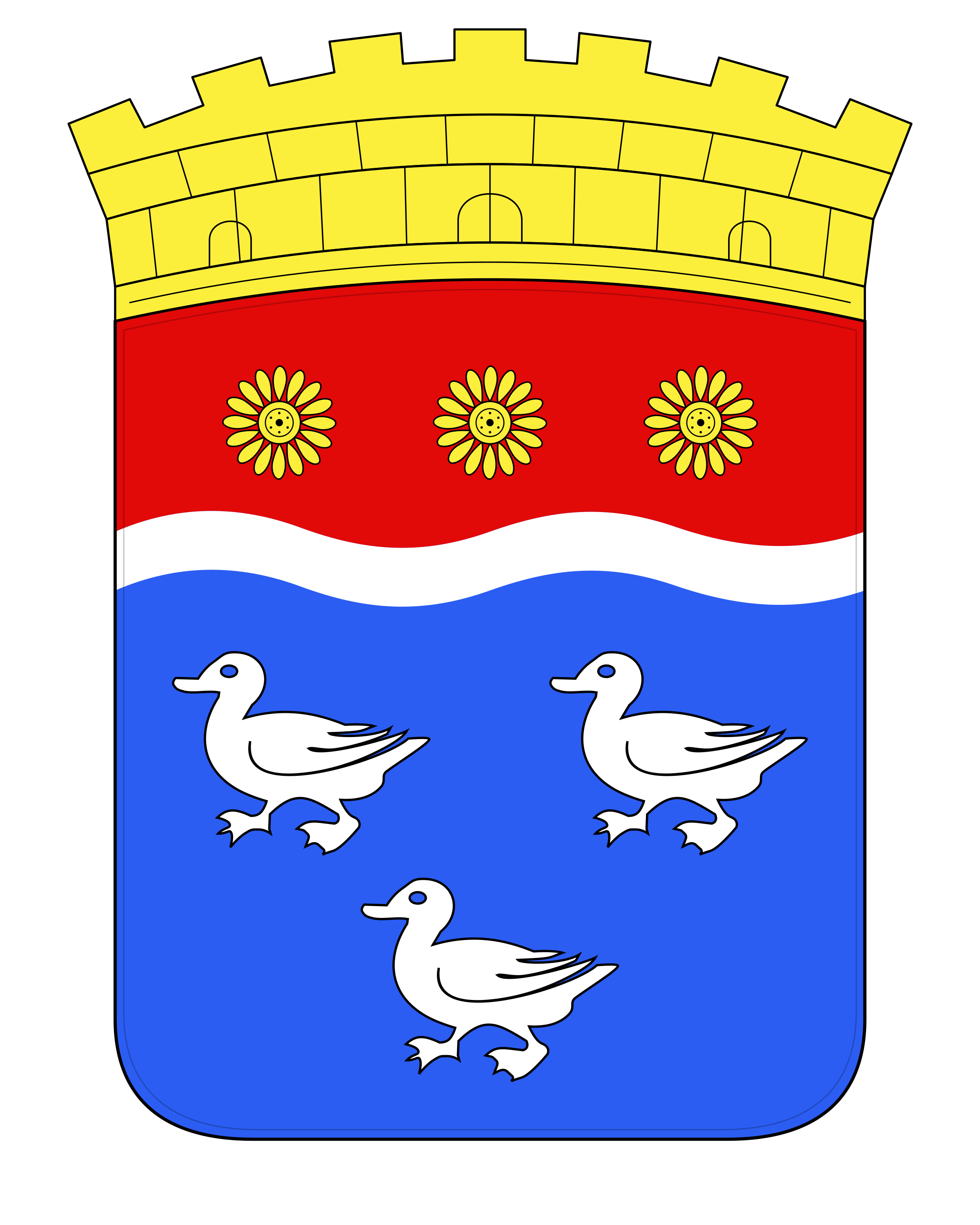
COLLEVILE & Ste HONORINE
Si Vierville saw its beach develop in such a flourishing way, thanks to the creation of Boulevard de Cauvigny.
Each generation brings with it new ideas at the same time that it benefits from the teachings of the past; which, about thirty years ago, seemed sufficient and even very good, today seems only a modest thing, even often old-fashioned. At that time there was no automobile, aircraft, etc., no one could have foreseen such a rapid development in these means of locomotion, we laughed a lot when the first car without horses appeared that was painfully 3 to 4 kilometers per hour, we whispered: Are not bitten these inventors who imagine exceeding the speed of our horses with their small machines, still passing the railways, there are rails, but these cars, they will never climb the coasts with a load, etc., etc. And now we see, on some Sundays on our boulevard, the line of parked cars reach up to nearly 300 meters; and when two transport buses cross each other there is no more room, even for a cyclist.
In addition, any road by the sea requires the widening of a dike for its protection, as are protected the Belgian coasts in Ostend and the surrounding area; this is hardly possible, given the large expenses required only for cities or countries created at a time when the workforce reached a modest price.
You have to count on the sea and no one ignores that so often it seems to sleep, it charges a lot when she wakes up, the bold attempts of those who want to encroach on a domain.
For a long time, Mr. Conil, one of the initiators of the Plage d'Or de Saint-Laurent, had planned the creation of boulevards that he could never open; however, if on the Vierville side this was easy to do, in the direction of Colleville-Sainte-Honorine the land seems to lend itself even better the slopes being a little further from the sea.
Looking in this direction, we are struck by the natural, picturesque and grandiose beauty that is offered to the eyes: really charming this immensity of greenery extending several kilometers away, bordered on one side by the cliffs and on the other by the sea. Just a few rare houses stain the horizon here and there. It should be noted that none of our Normandy beaches offers a landscape as beautiful as this one.
This is why this corner could not fail to attract attention and, for some time now, there has been talk of the creation of a new road on this side, not the continuation of Boulevard de Cauvigny, but of a modern artery, meeting current needs, with the most advantages, while requiring the least possible costs by giving the greatest value to the land of this part of the Bessin.
This road would be almost unique on the littora] of our France because, extending over a length of several kilometers, it could reach up to 20 meters in width, which would not be a luxury for our time, but a necessity for current locomotion, as there are some in the North between Lille and Roubaix.
This boulevard, about fifty meters from the place where the waves break, would be protected by the natural dike formed by the earth and the sands; it would thus have nothing to fear from spray or tidal wave, it would be safe. If we notice that at about the location where it would be built there is a lower, the leveling of this part would considerably improve the whole by avoiding the stagnation of the water that could no longer exist there.
It cannot be denied that this creation would give an indisputable value to our country, that idea being launched, preliminary work having even, it seems, been done, one generation or another will perhaps accomplish it.
One day, our Colleville-Sainte-Honorine Beaches, which are currently lagging behind many others, will be in the lead, the most beautiful and most renowned, because every new thing benefiting and taking advantage of the advantages that the past has been bequeathed to it benefits for its particular improvement, and who knows if future generations will not see, on these surfaces, so to speak, uncultivated, aircraft landing fields, car parks, racetracks and pitches for water and land sports, at the same time as splendid constructions, parks and gardens will replace the grass of the cliffs. Each country has its destiny, and perhaps ours is currently in the Society that has undertaken the development of these untapped riches that are the coasts of Saint-Laurent, Colleville and Sainte-Honorine.
VISIONS of the Côte de Nacre! Enchanted visions! Such appears on at least four points the superb panorama that is offered to the eyes in Colleville; one of these points is taken in front of the Castle inhabited by Mr. Klein and once built by the de Marguerie, lords of Colleville; another on the promontory where the path du Hamelet ends, at the sunset of the Moulins; a third on the other side called "Le Cabourg", and the fourth in the Cemetery, north of the Church.
Above the apple trees loaded with flowers in spring and golden fruits in autumn, we can see the fine sand of the shore and the beautiful white and blue pebbles that precede the waves where a few ships with white sails and gray smoke swing gracefully.
A deliciously shaded path leads from the village to the seashore; we breathe the pure and fortunate air in the middle of the field flowers: golden St. John's worts, silver borders, red and violet cardamoms; going down it we see or hear the always clear and whispering waters that made the ancient mills turn; their mysterious source is called from time immemorial "La Fontaine Saint Clair". A chapel of this name had been founded and endowed by an elder of the country, Mr. Joachin Avenel, whose distant great-nephews perpetuate the name.
On the right and left are the vacant lots and unfit for cultivation or livestock; most were bought for the construction of summer homes: some have been rising for a few years now, that of Miss Maud Gone for forty years.
Starting from the castle to lead to the sea path there is a delightful path under wood; over a distance of about 600 meters, the chirping of a stream with crystalline waterfalls and that of the birds coming to quench their thirst alone disturb the silence of this green Eden.
Do not curse the car breakdown that could stop you at this place, but consider it a providential chance, - because if you have a skilled mechanic in Colleville to remedy this thing, Mr. Ouin - you will keep from the excursion that you can make a very good memory, which will amply compensate you for this slight boredom.
We cannot fail to be interested in the magnificent Monumental Church that is Notre-Dame-de Colleville, because Norman architecture has no more interesting specimen:
Arcisse de Caumont says that his bell tower is one of the most remarkable in Calvados in the Romanesque style. Its base dates back to the linen of the eleventh century on its southern and northern laces appear two arcades combining long strips of hard stone. The body of the four-story bell tower: the first adorned with small arches resting on columns alternating with pilasters, decoration not found anywhere other than in Colleville; the second has two openings included in two superimposed archivoltes; the third has its two openings each provided with a lower archivolte and united in a single upper archivolte; the fourth has two round openings called oculi and adorned with a circle of dice.
It was assumed that these oculis were lit by a fire during the night to serve as a lighthouse, for sailors of the 12th century. On the north side there is only one opening while there are two on the west, south and east. When the navigators saw two enlightened oculis they recognized that they were below Colleville: when they sent only one they had the certainty of being in front of this locality.
Above the square body of this bell tower rises a four-sided stone spire, each of which has a skylight surmounted by a pediment with a pointed roof. This arrow can only go back to the end of the 12th century.
Presumably the nave of the church is a little older, judging by the beautiful door of the south, by the grimacing figures of the outer cornice and by the five columns that put, inside, this nave in communication with the long-deleted aisle. Of the five capitals adorning these columns, the fourth represents a man struggling with a sea monster whose teeth are threatening and with a mermaid wearing a conical cap. The man strangles it with one hand and the other, he stops the monster by earthing one of his fins.
In the same style is decorated the tympanum that surmounts the southern entrance of the nave: it carries two dragons faced and joined by strips coming out of their mouths by mixing gracefully.
Also note the baptismal fonts of the 13th or 14th century: each of their eight sides has an arch framing a carved flower of different shape. Between the nave and the choir, beautiful triumphal arch reproducing the decorations of a small door now walled up, on the southern side of the choir.
Rebuilt in modern taste, the windows of the choir are adorned with stained glass windows recalling the baptism of Clovis and the wish of Louis XIII. The painting of the counter table of the altar represents the Assumption of the Holy Virgin; it seems to date back to the 18th century as well as that of St. John the Baptist adorning! The seigneurial chapel next to the choir.
Sainte-Honorine-des-Pertes was once a small seaport and for 40 years a charming seaside resort! Around 1700, Mr. de Foucault, intendant of the Generality of Caen wrote:
In the parish of Sainle-Honorine -des-Pertes, there were once a large number of sailors, most of whom left and deserted the said parish to go and live in Saint-. Malo and Granville where they got used to and married. Arcisse da Caumont notes that probably the emigration of these sailors was due to the difficulty of sheltering the ships as a result of the changes made on the coast by the invasions of the sea. According to the newspaper written day by day, in 1656 and following years, by Gilles Picquot, sr de Russy and Gouberville, we left Sainte-Honorine for cabotage towards Haute-Normandie and to Colentin. On December 6 I560 Gilles Picquot was at
Sainte-Honorine Richard Castel and his brother Robin, Friset and son Bibet who were able to get on the boat because they came from Dieppe. The path where this boat was mounted and the neighboring lands
are still called Les Bateaux. One hundred years later there was a 12-ton ship on the Sainte-Honorine harbor belonging to the heirs of Michel de Russy, Sieur de Lormel. Now there is only a small amateur canoe.
At low tide, many vacationers and residents of neighboring localities will fish "the beautiful
Blondes" and other delicious shells a short distance from the high and beautiful cliffs. Looking at these when the sea is removed and allows you to move a hundred meters away from the shore, we think we see walls built by man and towers forming a projection. Here and there the calcareous waters of these cliffs petrify the branches of shrubs and mosses.
On the other hand, the wonderful properties of the Saint-Siméon Fountain were already reported by a 17th century geographer. We came and still come every year, in crowds, to worship and pray to Saint Simeon. His chapel, which was destroyed by a tidal wave, had been rebuilt with the permission of King Louis IX.
Picturesque is the path that leads from the sea to the current chapel dating only from 1850 and visible from the road from Vierville to Port-en-Bessin
In addition to the individual visits it receives all year round, this chapel is very popular on the afternoon of Ascension and on Trinity Sunday. On this day called the "Great Saint-Siméon", there is Mass and Vespers, then a popular assembly in the grassland near the road where the stalls of fairground merchants of all kinds are. In the midst of tourists, simple spectators, there are many real Christians, many of whom come to thank Saint-Siméon for the healing of fevers or other diseases. Most of the Pilgrims go to the Saint-Siméon Fountain, whose water is presented to them by an employee of the farm, which has become the property of Messrs. Dupont and the Chapel.
From the other end of Sainte-Honorine-des-Pertes where the schools, the old farm and the castle of Grand-Val are located, a path that passes near the Cabourg fountain and from where you can enjoy a beautiful panorama. It is first the shady valleys, the green grasslands and the monumental bell tower, then in the distance the blue waves that limit the horizon. It is understandable that very distinguished characters have chosen Sainte-Honorine for their summer residence.
Currently every summer brings back the family of Mr. Louis Balifol, curator of the Arsenal Museum and Historian of the Louvre of Henry IV; the Orphans of Notre-Dame-de-France and their devoted befactor Miss de Coursière, Mr. Charles Delangle, president of the Inter-departmental Prefecture Council and his wife the artist-painter of Norman beauties; the Family members of the devoted mayor Mr. Raymond Salles, professors at the Catholic Institute, engineers and other notabilities who appreciate the beautiful and calm landscapes of Sainte-Honorine.