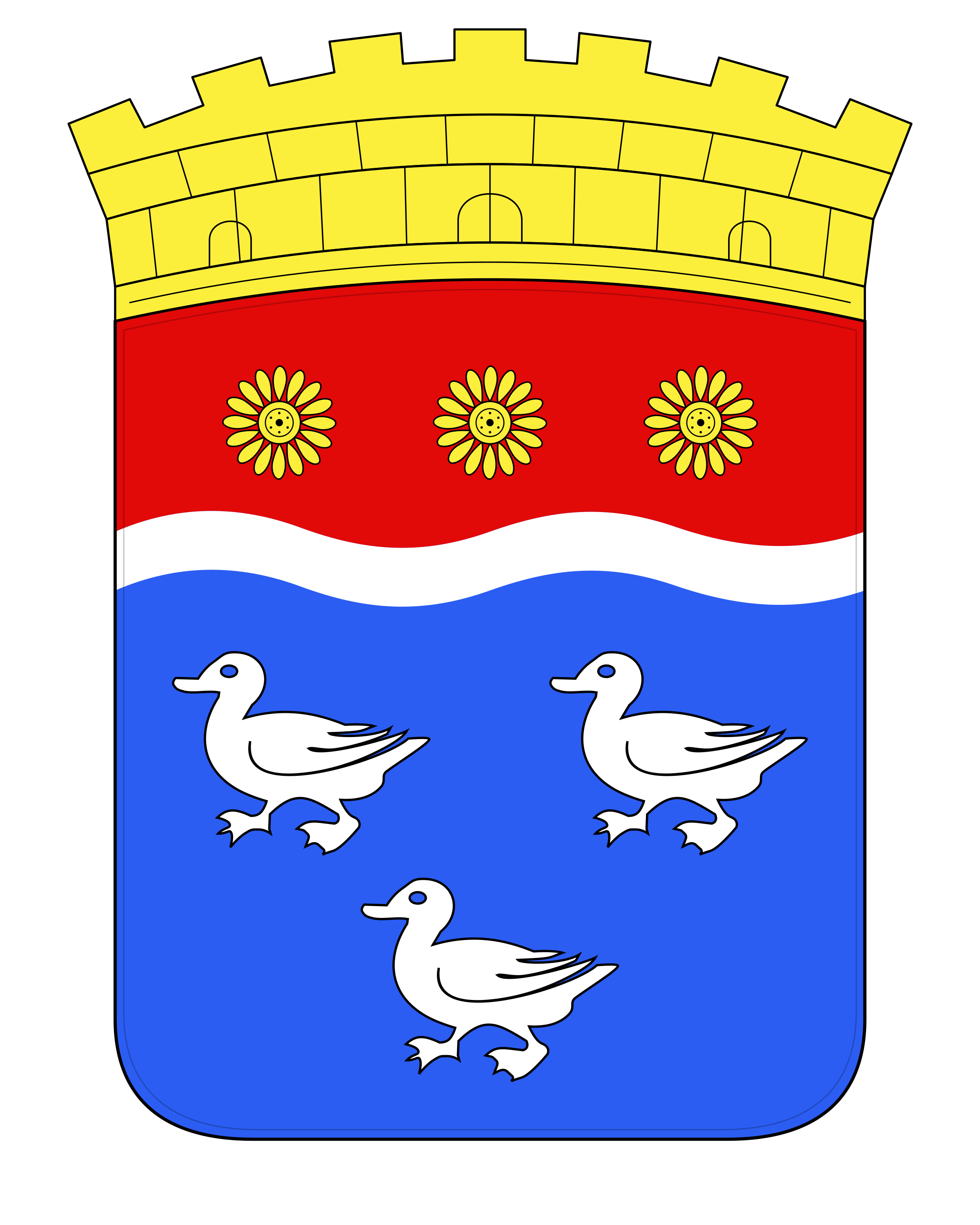
388- Terrestrial and marine vegetations, various
Jellyfish found on the beaches of BessinRead the rewritten text
This reading version has been rewritten from the newspaper clipping. Connecting phrases and any reconstructed words are not a verbatim quotation.
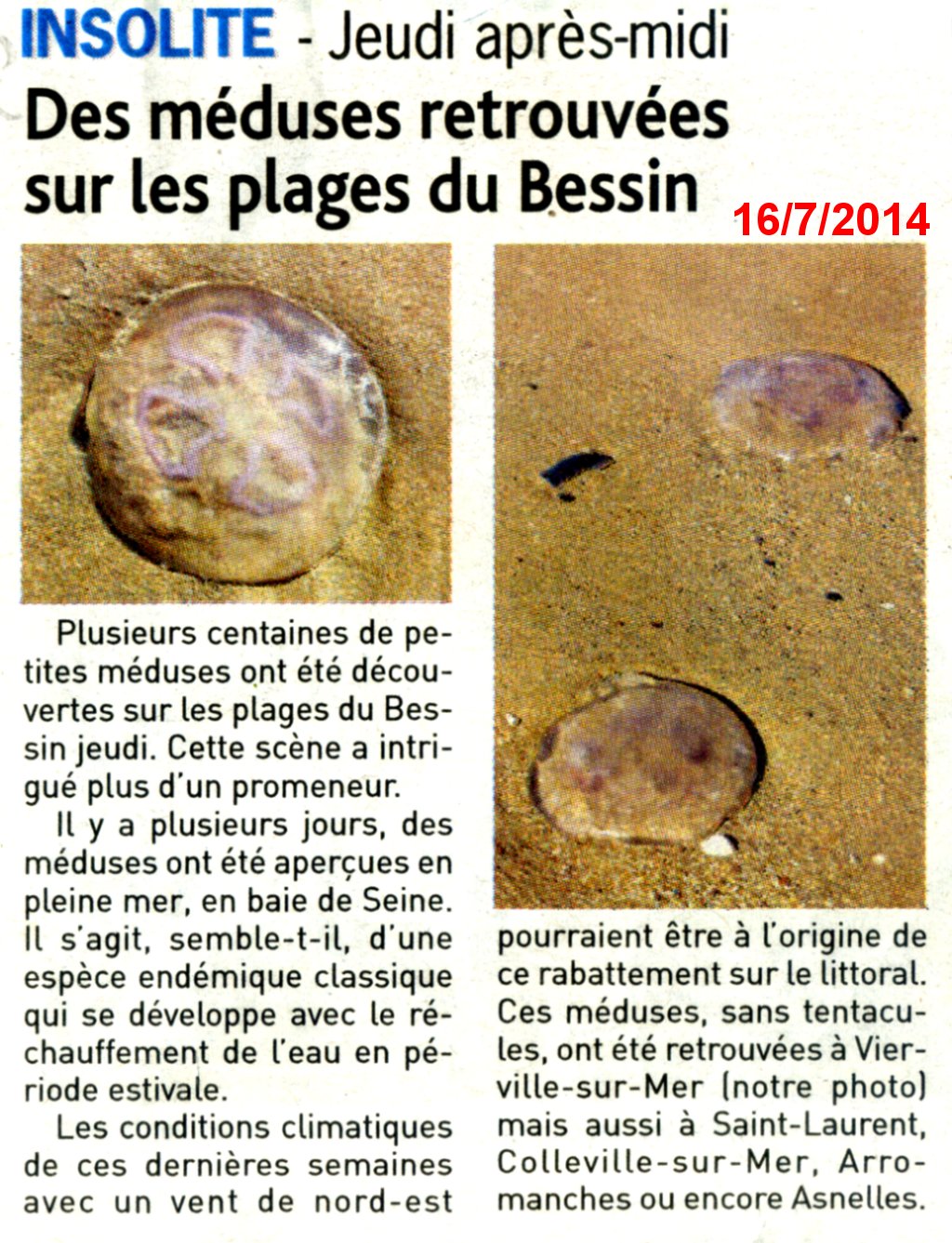
One Thursday afternoon, several hundred small jellyfish were discovered on the beaches of Bessin, intriguing walkers. The press clipping kept in the archives reports that they had already been seen a few days earlier offshore, in the Bay of Seine.
The newspaper cautiously mentioned a common endemic species whose development would be favored by warming water in summer. He also put forward a possible explanation upon their arrival on the shore: the weather conditions of the previous weeks, marked by a northeast wind, could have pushed them back to the coast.
Described as devoid of tentacles, these jellyfish were found in Vierville-sur-Mer, as illustrated by the cut, but also in Saint-Laurent, Colleville-sur-Mer, Arromanches and Asnelles.
View the archive imageDownload the rewritten text
Original OCR text
The original OCR text is kept for comparison with the image. Its reading order and some words may be incorrect.

Calvados fights against algae on our beachesRead the rewritten text
This reading version has been rewritten from the newspaper clipping. Connecting phrases and any reconstructed words are not a verbatim quotation.
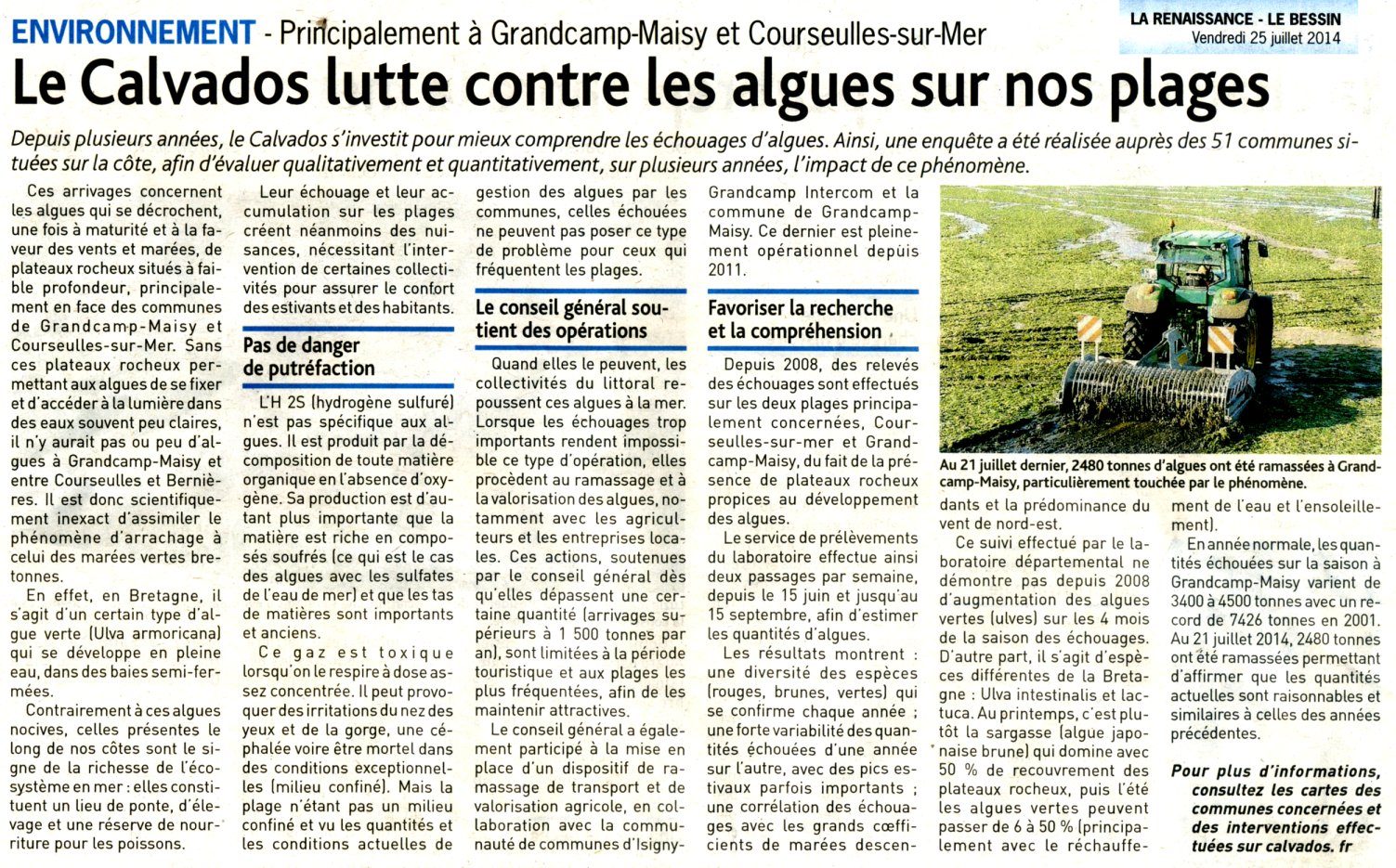
On July 25, 2014, La Renaissance – Le Bessin presented the actions of Calvados against algae stranding, mainly in Grandcamp-Maisy and Courseulles-sur-Mer. A survey conducted among the 51 coastal municipalities sought to measure, over several years, the nature and extent of the phenomenon.
Understand the origin of stranding
The article explained that the algae were fixed on shallow rocky plateaus, where they could receive light despite often unclear water. Once they reached maturity, they broke out under the effect of the winds and tides, then ran aground in Grandcamp-Maisy and between Courseulles and Bernières.
The newspaper distinguished this phenomenon from Breton green tides. He cited, for Brittany, Ulva armoricana, a green algae growing in open water in semi-closed bays. On the coasts of Calvados, he presented algae as a component of the wealth of the marine environment: they provided the fish with laying places, breeding spaces and food. However, their accumulation on the beaches led to nuisance for residents and holidaymakers, and required the intervention of local authorities.
The explanations given in 2014 on hydrogen sulphide
The cut also covered H2S, or hydrogen sulfide. She recalled that this gas came from the decomposition of oxygen-deprived organic matter, and not just algae. Its production increased when the materials were rich in suffur compounds and when the piles were large and ancient.
The text described the possible effects of sufficiently concentrated inhalation: irritation of the nose, eyes and throat, headaches and, in exceptional circumstances in a confined environment, a fatal risk. However, he considered that beaches, open spaces, did not present this type of problem in the conditions of quantity and management of algae reported to that date. This assessment belongs to the explanations given in the 2014 article.
Collect and enhance algae
When possible, coastal communities pushed algae back to the sea. When stranding became too large, they organized their collection and recovery, especially with farmers and local businesses. The General Council supported these operations for arrivals exceeding 1,500 tonnes per year. Interventions were limited to the tourist season and the busiest beaches.
The department had also participated in a collection, transport and agricultural recovery system, set up with the community of municipalities of Isigny-Grandcamp Intercom and the municipality of Grandcamp-Maisy. This system had been fully operational since 2011.
Track species and quantities
Since 2008, the departmental laboratory followed the strandings on the beaches of Courseulles-sur-Mer and Grandcamp-Maisy, in front of the rocky plateaus favorable to the development of algae. His sampling service made two visits per week, from June 15 to September 15, to estimate the quantities present.
The observations showed a diversity of red, brown and green algae, as well as strong variations from one year to the next, with sometimes significant peaks in summer. They also revealed a link between stranding, large descending tidal coefficients and the predominance of the northeast wind.
According to the results reported, the monitoring undertaken in 2008 did not show an increase in green algae over the four months of the stranding season. The species mentioned, Ulva intestinalis and lactuca, differed from the one mentioned for the Breton green tides. In the spring, sargassum, described as a brown Japanese algae, dominated with a 50% coverage of the rocky plateaus. In summer, the proportion of green algae could increase from 6 to 50%, especially with water warming and sunshine.
In Grandcamp-Maisy, the quantities stranded during a normal season ranged from 3,400 to 4,500 tonnes. The record indicated was 7,426 tonnes in 2001. As of July 21, 2014, 2,480 tonnes had been collected: the article considered these volumes reasonable and comparable to those of previous years.
To complete this information, the newspaper then referred to the calvados.fr website, which included the maps of the municipalities concerned and the interventions carried out.
View the archive imageDownload the rewritten text
Original OCR text
The original OCR text is kept for comparison with the image. Its reading order and some words may be incorrect.