The articles and photographs of the collection trace the history of the two successive museums of the Landing in Vierville, from the first exhibitions to the documented transformations in the early 2010s.
Daning Museums
First museum 1985-1993, Mr Levéel
Second museum from 1999, Mr Brissard (died late 2012)
The establishment reopened in June 2013
Files developed in particular with cuts from the local press
(La Renaissance, Le Bessin Libre, Ouest France, united in particular with the good care of Mr. Françoise)
The first museum originated from an exhibition of materials collected by two collectors, Mr. Levéel and Mr. Tréfeu.
This exhibition was held between April 5 and July 1, 1980 in a room loaned by the town hall, near the beach and the Casino Hotel.
But this place was too small for all the available equipment and the town hall then thought of using an available barracks near the old town hall.
This barrack (a "Nissen hut"), in the shape of a half-cylinder, had originally been set up by the American Engineer in 1944, on the grounds of the current Casino Hotel. It was used for the maintenance of the operating equipment of the US base "Omaha Beach Command".
At the beginning of the Americans, in early 1945, they donated it to the Commune of Vierville. The barracks was then dismantled by the municipality, repaired and reassembled on the communal land of the former town hall, route de Grandcamp.
It then served as a party hall and then as a cinema for many years, at least until 1969. As television develops, the cinema has finally closed. A new party room was built in the 1960s. The aging building was therefore nothing more than a warehouse.
Around 1981, this former Nissen shack of the Americans was then made available to Messrs. Levéel and Tréfeu, to operate a first landing museum in Vierville.
Mr. Levéel was also housed next door, in the old town hall (a room that had been built between the 2 wars and which was planned to be expanded in order to install both the town hall and a school with 2 classes).
This first museum closed in 1993 and the collection was separated. The part belonging to Mr. Levéel was bought by the Commune and another part, belonging to Mr. Tréfeu, was taken away to serve as the nucleus of the museum he later created in Saint-Laurent-sur-Mer.
The Commune, having given up installing a new museum itself, finally decided in 1998 to sell its collection. This was done at the auction in the Vierville Festival Hall, by the auctioneers of Bayeux, on December 20, 1998.
A new collector, Mr. Michel Brissard, then proposed to the municipality to present his own collection in Vierville. The old American hangar had become available, and in 1999 it was made available to Mr. Brissard to operate a second museum, the D-DAY OMAHA Museum. The hangar has been refurbished for this purpose by the new operator.
Long after, the land of this museum was bought around 2005 from the municipality by Mr. Brissard.
The death of Mr. Brissard on November 24, 2012 resulted in a temporary closure in the spring of 2013. The fund's documents indicate a reopening in June 2013.

An exhibition on the Landing opens near the beachRead the rewritten text
This reading version has been rewritten from the newspaper clipping. Connecting phrases and any reconstructed words are not a verbatim quotation.
An exhibition dedicated to the Vierville sector and Omaha Beach was announced from April 5 to July 1, for five francs, in a communal premises near the Hôtel du Casino. Located in the heart of the fighting of June 1944, this place was however too small to accommodate all the collections of Messrs. Leveel and Tréfeu, forced to select the pieces.
A railway employee based in Saint-Lô, Mr. Leveel had lived in Lison during the Landing and remembered the first bombings. He had only begun to gather memories much later. After twenty-five years in the countryside, always busy, his installation in the city had given him the desire for this activity. About ten years of research had transformed this interest into passion: the objects were found, restored, cataloged and classified.
The two friends complemented each other: Leveel studied the German occupation in the region and Tréfeu the American documents. The visit passed mannequins, uniforms, weapons, ammunition, photos, maps and posters in French and German attributed to Hitler, with the arrival of the American divisions.
The objects of the soldiers' lives ranged from the soap to the German-American or Franco-American dictionary, from the razor to the medicine kit, from the bowl to the ball and the baseball glove. More than twenty mannequins, sketches and paintings evoked the Landing. The legend showed Tréfeu with a grapple found at the tip of the Hoc.
Ordinary objects were sometimes the rarest: the German mountain cap, although common during the war, was presented as having become difficult to find. Bread tickets, priority and food cards and passes were also reminiscent of civilian life. The Resistance had its place, despite the limits of the premises.
Nearly thirty-six years after the Landing, the report highlighted the role of such exhibitions, based on the documents, to maintain a history still vivid in the memories.
View the archive imageDownload the rewritten text
Original OCR text
The original OCR text is kept for comparison with the image. Its reading order and some words may be incorrect.
April 1980, a first exhibition is presented by MM. Levéel and Tréfeu. The room was too small for anything that could have been presented. It was loaned by the municipality and was next to the beach and close to the Casino hotel

The Vierville Museum, a local history from the Occupation to the LiberationRead the rewritten text
This reading version has been rewritten from the newspaper clipping. Connecting phrases and any reconstructed words are not a verbatim quotation.
An article devoted to the Vierville Museum points out that a small private initiative can be as documented as large institutions. He compares the approximately four hundred thousand annual visitors to Arromanches and the almost one hundred thousand to Bayeux to the large attendance of Vierville: forty-six thousand people the previous year, including many foreigners. However, the museum is installed in a simple sheet metal shed on the edge of departmental road 514.
According to the story, this building had been installed by the Americans in 1944. The municipality had used it as a party room until 1964, then as a warehouse, before leaving it abandoned. Two enthusiasts, Mr. Leveel and Mr. Tréfeu, had asked to make it a museum. Mayor Michel Hardelay had given his authorization two years earlier and largely helped their project.
Mr. Leveel explained that he began to preserve objects fifteen years earlier and thought of a museum in 1969, on the twenty-fifth anniversary of the landings. At that time, he said, memories of war were still easy to find. It dated the beginning of the "razzia" about ten years ago and regretted that there is now almost nothing left to discover.
The purpose of the museum differs from those of Arromanches, devoted to the Landing, and Bayeux, centered on the Battle of Normandy. Vierville wants to show the life of an era. The journey begins in 1940 with the Occupation: newspapers that disappeared during the war, but also Nazi propaganda titles in French, such as La Gerbe, Aujourd'hui, Je suis partout and Le Cri du peuple. Then comes the Resistance. Leveel judges this subject delicate, because protagonists are still alive, but the great local figures are cited.
This local dimension is at the heart of the establishment: the rooms concern Vierville and its surroundings, or, at the farthest, the canton of Isigny. Repression, deportations and torture are also mentioned. Leveel reports that this part displeases some German visitors, while defending its necessity in the name of historical truth.
The route continues with the Atlantic Wall and a collection of German ammunition that the article describes as unique in France. For June 6, the presentation changes: the collection is succeeded by a striking reconstruction of the Landing, of which Omaha Beach is a few hundred meters away. The evocation then follows the departure of the troops from Vierville to Saint-Lô and Caumont, then the end of the war. A large painting, made from a period document, represents a rue d'Isigny in August 1944.
Hundreds of documents were sorted and labeled in two languages. Some attract particular attention, such as a letter addressed to his family by an American soldier on the evening of June 6. The managers chose the free visit, without a guide, to let everyone stop on what interests them. The courses last from five minutes to two hours. Leveel, however, deplores the lace of interest of some visitors and says, with disappointment, that Americans are the most jaded.
At the time of the article, the museum was open from April 1 to October 1. Its managers wanted to better distribute attendance by attracting more visitors in May and June: July and August were approaching saturation and did not always allow good visiting conditions.
View the archive imageDownload the rewritten text
Original OCR text
The original OCR text is kept for comparison with the image. Its reading order and some words may be incorrect.
April 1981, opening of the museum "Omaha June 6" by MM. Levéel and Tréfeu

The Omaha Beach Museum settles in the old party hallRead the rewritten text
This reading version has been rewritten from the newspaper clipping. Connecting phrases and any reconstructed words are not a verbatim quotation.
After a first exhibition near the sea the previous year, Mr. Tréfeu and Mr. Leveel had acquired the old Vierville ballroom to set up their museum. The previous room was too small to present the collections in good conditions.
The half-cylinder building covered with sheet metal had been renovated: paintings redone, defective sheets replaced and parking prepared for visitors. The opening was announced for the day after the publication.
The two collectors wanted to remain focused on Vierville, its surroundings and the period from June 1940 to August 1944, in order to tell rather than juxtapose objects about an era or region that was too large. Two large models represented American and German soldiers around Omaha. Drawings, weapons, ammunition, uniforms and everyday objects had been gathered to correspond to the units and local events, a process that they considered less simple than it seemed.
Civil life was also mentioned by the newspapers, posters and directives of the prefect of Calvados, the sub-prefect and the mayor of Bayeux. An order prohibiting the movement of raspberries from Calvados to other departments was side by side with otherwise serious documents on the census of Alsatians and Jews. The report, signed Jacques Fauchon, invited to discover this new place dedicated to Omaha the Bloody.
View the archive imageDownload the rewritten text
Original OCR text
The original OCR text is kept for comparison with the image. Its reading order and some words may be incorrect.
Photos of the Americans' Nissen shack in 1944, then after 1945, back in the village.

details This photo from the summer of 1944 shows the American genius Nissen shack installed at the bottom of Vierville, on the site of the future Casino hotel, built in the 1950s.

details the museum "Omaha June 6" around 1986, we see next to the building built between the 2 wars by the municipality to be the first element of a future town hall supervised by 2 school classes (girls and boys). In 1939, this room served as a town hall, the school being still in its old premises at the crossroads, destroyed by the war.
The municipality renounces its museum project and sells part of the collectionRead the rewritten text
This reading version has been rewritten from the newspaper clipping. Connecting phrases and any reconstructed words are not a verbatim quotation.
The municipality of Vierville announced the sale of the collection purchased as a precaution when the Omaha Museum closed on June 6 in 1993, after a dozen years of existence. She had acquired part of the fund from Marcel Leveel, one of the two partners, in the hope of relaunching a museum on the Landing.
Mayor Jean-Marie Oxéant explained that the collection had to be enriched, that its presentation required a significant investment and that the municipal premises no longer met safety standards. The search for partners had not been successful. In the meantime, a museum of the same name had opened in Saint-Laurent; an in-communal process in progress had completely dissuaded the council from pursuing alone a project it wanted ambitious.
The municipality renounced with regret a whole linked to the history of the village, but kept some symbolic objects: sailor's uniform from the artificial port, badges, galene post made by an inhabitant and American rifle. They were to be displayed in a window at the town hall. Documents concerning the Jews would be entrusted, out of respect, to an association of deportees.
About four hundred pieces, including about twenty American and German uniforms, weapons, radios, usual objects and documents, were to be sold on December 20 by Me Régis Bailleul at the party hall. The municipality hoped to cover its costs.
View the archive imageDownload the rewritten text
Original OCR text
The original OCR text is kept for comparison with the image. Its reading order and some words may be incorrect.
This museum lasted from 1981 to 1993

The renovation of the party hall and the decisions of the city councilRead the rewritten text
This reading version has been rewritten from the newspaper clipping. Connecting phrases and any reconstructed words are not a verbatim quotation.
Meeting several times under the presidency of the mayor, the municipal council of Vierville-sur-Mer examines various issues. The additional budget of 1993 is voted in balance, in revenue and expenditure: 120,798 francs for operation and 274,900 francs for investment.
Regarding La Poste, the municipality obtains from the PTT a temporary flame of obliteration for the fiftieth anniversary of the Landing, from May 15 to August 15, 1994. At the request of the post recipient, the council gives a favorable opinion to an opening to the public at 1:30 p.m. instead of 2 p.m. However, he wishes to maintain the closure at 5 p.m. during the summer season, in order to best welcome visitors.
After the opinion of the municipal buildings commission and verification of the offers by the SO.CO.RAC, the renovation work of the party room is assigned to the following companies: SCL, in Isigny, for masonry; Joret for carpentry; Marie for roofing; Normen for PVC carpentry; Ménard for plastering; Lechevrel for tiling; Royer for electricity and heating; Geffroy-Hamon for plumbing; Marie Michel for suspended ceilings; and Demoor for painting and coatings. After comparing two proposals, the council entrusts Tecnorest with the supply and installation of complete kitchen equipment, for about 62,000 francs excluding taxes.
The house is rented to Mr. and Mrs. Jean Costy as of January 1, 1994, with a six-year lease that is tacitly renewable. For the museum, no agreement having been reached with Mr. Tréfeu despite several meetings, the council decides to move Mr. Level's collection as soon as it is actually acquired. A qualified company must ensure the move to a safe place, under electronic control. The fee due by Mr. Tréfeu for the rental of the municipal premises in 1994 is set at 70,000 francs, payable in tranches of 10,000 francs from May 1, 1994.
The council also decides to buy an aerial photograph of Vierville to exhibit it at the town hall. It renews a temporary occupation authorization on the edge of the beach, from July 2 to August 28, 1994. Work is planned in the housing of the lifeguard in charge of the summer surveillance of the beach. The municipality also agrees to take charge, from January 1, of the subscription to the church's electricity meter.
On the roads of Formigny and Louvières, the SDEC must strengthen the network served by the Ormel processing station, while France Telecom plans to bury its air network. The council chooses to partner with these operations to eliminate the air networks in the sector.
A grant of 1,500 francs was awarded to the Syndicat d'initiative d'Isigny-sur-Mer for its participation in the opening of the Syndicat d'initiative in July and August 1993. The council also grants aid corresponding to 30% of the cost price of the discovery classes of the schools and the Collège de Trévières for children of Vierville-sur-Mer who attend these institutions. The photograph of the party hall under construction is credited to Boudonnet.
View the archive imageDownload the rewritten text
Original OCR text
The original OCR text is kept for comparison with the image. Its reading order and some words may be incorrect.
In February 1994, the municipality found that it had not been able to find an agreement with Mr. Tréfeu whose collection will therefore be exhibited in a future museum to be built in St-Laurent by Mr. Tréfeu.
The part of the collection that belonged to Mr. Levéel was bought by the municipality.

In September 1998, the municipality of Vierville decided to auction the part belonging to it from the collection of the first museum

The Leveel collection scattered at auction in ViervilleRead the rewritten text
This reading version has been rewritten from the newspaper clipping. Connecting phrases and any reconstructed words are not a verbatim quotation.
Nearly four hundred visitors visited the public exhibitions on Saturday afternoon and Sunday morning, before the sale of the Leveel collection at the Vierville-sur-Mer festival hall. From two o'clock on Sunday, the collectors crowded into the room. Coming from Normandy, Strasbourg, Paris, but also from Great Britain, Belgium and the Netherlands, many had spent the weekend in Bessin so as not to miss the dispersion of the objects presented at the " Omaha 6 June" museum from 1981 to 1993.
Arms expert Gaëtan Brunel stressed the rarity of such a sale. Auctioneer Régis Bailleul reported many purchases by local museums, including the Museum of the Battle of Bayeux, as well as the acquisition of rare pieces by the War Museum of the Ministry of Defense. All objects had to be auctioned. The product exceeded 230,000 francs, almost the estimate announced.
Among the prices recorded, a German rocket launcher "panzerschreck" reached 4,050 francs and an American bazooka 3,200 francs. A U.S. military police sergeant mannequin was sold for 4,100 francs; German paratrooper hunter pants, 6,500 francs; and a Feldgendarme mannequin, including a motorcycle waterproof coat, 8,000 francs. A German dorsal parachute went to 3,800 francs, and a Wehrmacht regulation bike to 3,500 francs.
The photographs also show the importance of common objects overall: helmets found at sea, insignia of American divisions, soldier's equipment, camouflaged gas masks and handkerchiefs. Patrice Daimassie, clerk of the Langeard study, was pleased that the inhabitants and their neighbors were able to review this collection one last time. Régis Bailleul also appreciated this local and emotional dimension of the sale, beyond the sole trade in objects. The article is signed Élisabeth Burnouf.
View the archive imageDownload the rewritten text
Original OCR text
The original OCR text is kept for comparison with the image. Its reading order and some words may be incorrect.
December 1998, auction of the collections of the first museum that the municipality had bought from Mr. Levéel after the closure of the 1st museum.
The municipality has given up reopening a new museum

Vierville's collection of war objects scattered at auctionRead the rewritten text
This reading version has been rewritten from the newspaper clipping. Connecting phrases and any reconstructed words are not a verbatim quotation.
Three hundred pieces and lots from a collection of war objects collected in the Omaha Beach area were sold on a Sunday in Vierville. After the closure of a private exhibition in 1993, the municipality had bought the whole in the hope of opening a museum. Since the project was not successful, the municipal council had chosen the auction.
The party hall turned out to be too small for collectors from all over France. Under the hammer of Me Régis Bailleul, all the lots are gone. Expert Gaëtan Brunel judged the pieces to be unexceptional individually, but representative of the region, the period and their histories.
The auctions cited were four thousand francs for the uniform of a soldier of the 29th division; 2,050 francs for a paratrooper gas mask; two thousand francs for a French outfit; two thousand for a batch of signs in German; 3,800 for an aviator parachute; 3,500 for a German regulatory bicycle; and 280 francs for a pack of cigarettes. The collection was thus scattered, while the report highlighted the persistence of the memory of the Landing.
View the archive imageDownload the rewritten text
Original OCR text
The original OCR text is kept for comparison with the image. Its reading order and some words may be incorrect.
December 20, 1998, at the Vierville festival hall
The second museum
Opened in June 1999 by Michel Brissard
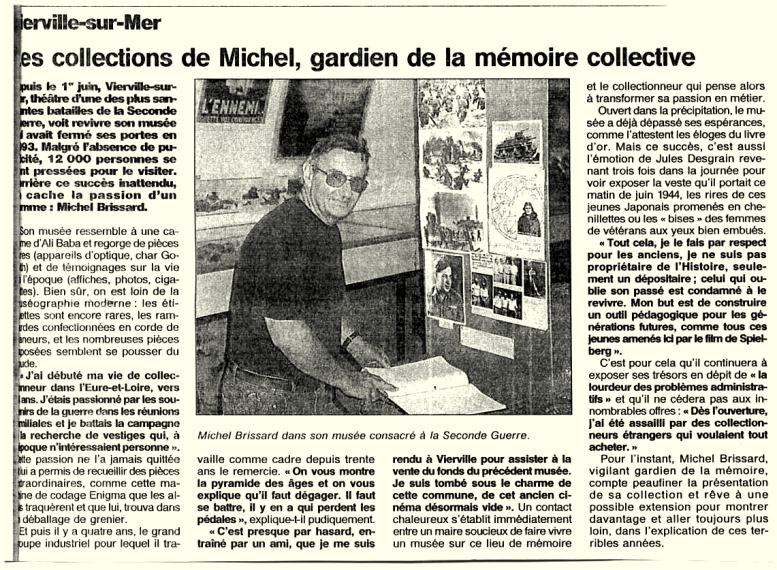
Michel Brissard wants to transmit memory through his collectionsRead the rewritten text
This reading version has been rewritten from the newspaper clipping. Connecting phrases and any reconstructed words are not a verbatim quotation.
Since its reopening on June 1, the Vierville museum, closed in 1993, had welcomed twelve thousand people despite the lack of advertising. The report explained this recovery by the passion of Michel Brissard.
His museum was full of rare objects, including optical devices, a Goliath tank and an Enigma coding machine found in an attic unpacking, but also posters, photographs, cigarettes and other witnesses of daily life. The presentation remained simple: few labels, glider ropes for the railings and many pieces, pressed against each other.
The collector told his beginnings in the Eure-et-Loir, interested in war memories told in the family, then his research in the countryside for remains then abandoned. Four years earlier, the industrial group where he had worked for thirty years as an executive had initially pushed him, an experience that he evoked with difficulty.
A friend had almost by chance led him to the sale of the collection of the previous museum. Seduced by Vierville and by the old cinema now empty, he had found a favorable reception from the mayor. The municipal desire to maintain a museum on this place of memory met his desire to make his passion a profession.
Opened quickly, the establishment exceeded its expectations and received praise of the guest book. Above all, he retained the emotion of Jules Desgrain, who returned three times in a day to see the jacket worn on a morning in June 1944, the laughter of young Japanese walking in a caterillet and the signs of affection of veterans' wives.
Michel Brissard considered himself a custodian rather than the owner of history. He wanted to build an educational tool for future generations, especially young people attracted by Spielberg's film. Despite the administrative difficulties and the purchase proposals from foreign collectors received from the opening, he intended to keep his pieces, improve their presentation and, if possible, enlarge the museum to better explain these years of war.
View the archive imageDownload the rewritten text
Original OCR text
The original OCR text is kept for comparison with the image. Its reading order and some words may be incorrect.
September 1999, the new museum "DDAY Omaha"

A military scholarship extends the commemorations of the 55th anniversaryRead the rewritten text
This reading version has been rewritten from the newspaper clipping. Connecting phrases and any reconstructed words are not a verbatim quotation.
After the weekend of the fifty-fifth anniversary of the Landing, hundreds of collectors of vehicles, equipment and military uniforms remained in the area until Wednesday. British, Americans, Belgians and French met in Vierville-sur-Mer for a military scholarship.
The MVCG, Military Vehicle Conservation Group, organizer of the Sunday parade in Bayeux, had installed this exchange under the hangars and around the agricultural buildings of the Laronche farm. The entrance cost fifteen francs. Mechanical parts, accessories, clothing and badges from all over the world were bought, sold or exchanged. The enthusiasts explained that these transactions also made it possible to finance their trips. Many left by jeep, GMC or vintage motorcycle, after a last pass along Omaha.
A box gave the floor to "Titus", who came from the Paris region as during the birthdays of 1989 and 1994. With his friends, dressed as gendarmes, he had been refused at the Bayeux parade. The group, independent of the organizing association, nevertheless claimed the authenticity of its approach. He owned a Traction and a Citroën U23 truck, presented as vehicles taken back from the Germans by the FFI.
Titus insisted on the difference between wearing a historical uniform and dressing up. He criticized anachronistic or carelessly reconstituted outfits, jeans in fashion shows and modern equipment added to vehicles. According to him, wanting to represent history meant going to the end of the requirement of fidelity. The photograph of the purse showed him with his comrades in Navy uniforms, after their gendarmes uniforms.
View the archive imageDownload the rewritten text
Original OCR text
The original OCR text is kept for comparison with the image. Its reading order and some words may be incorrect.
Military Scholarship of June 1999
A turret and a barge arrive at the museum before June 6Read the rewritten text
This reading version has been rewritten from the newspaper clipping. Connecting phrases and any reconstructed words are not a verbatim quotation.
On a rainy Friday, about twenty curious people were waiting near the D-Day Museum in Vierville for the arrival of two pieces: a bell turret from Cherbourg and a landing barge returning from a stay in Royan with a collector. Michel Brissard, who had reopened the museum on his own in June of the previous year, presented it as an LCPV who participated in the Landing.
The company Cherbourg Levage carried out the transport and handling. The removal of the turret, estimated here at sixty tons, was quick. That of the eleven-ton barge took more than half an hour: properly balanced by the straps, it had to cross an electric cable before being placed and wedged near the museum, under the watchful eye of its owner.
The marine plywood had stood well over time, but a restoration was still necessary. The presence of the engine was highlighted as rare. The two pieces were to enrich the visit of the season.
The museum now appeared in the brochures of the Historical Space of the Battle of Normandy. Michel Brissard was considering a new establishment of at least 1,500 square meters, with a video library and a bookstore, a project supported by Mayor Jean-Marie Oxéant. In the meantime, he hoped to double an attendance of the previous year exceeding fifteen thousand visitors, obtained according to him without advertising. The article is signed V. G.
View the archive imageDownload the rewritten text
Original OCR text
The original OCR text is kept for comparison with the image. Its reading order and some words may be incorrect.

D-Day Omaha Museum Presents War TechnologiesRead the rewritten text
This reading version has been rewritten from the newspaper clipping. Connecting phrases and any reconstructed words are not a verbatim quotation.
This presentation by the D-Day Omaha museum emphasizes as much the history of the Landing as the techniques used during the war. She cites authentic pieces related to the coding of German submarines and radio transmissions, alongside American, British, Canadian, German and French objects.
Motorcycles and aircraft engines illustrate larger equipment. The Resistance's sabotage equipment shows another aspect of these technologies. Nearby, in a field, the footbridges of the first artificial port of Omaha are, for the newspaper, the most impressive presentation of the remains of a set then almost completely disappeared. The collection is described above all as a way to preserve the history of the region.
The information published at the time announced an opening from 9:30 a.m. to 7:30 p.m. The rates indicated were 5.70 euros per adult, three euros for a child under eight years of age and 3.50 euros for groups; the information number was 02 31 21 71 80. These old conditions are not valid for current practical information.
View the archive imageDownload the rewritten text
Original OCR text
The original OCR text is kept for comparison with the image. Its reading order and some words may be incorrect.
August 2010

A barge and a turret join the D-Day Omaha museumRead the rewritten text
This reading version has been rewritten from the newspaper clipping. Connecting phrases and any reconstructed words are not a verbatim quotation.
Opened the previous year, Michel Brissard's D-Day Omaha Museum received two imposing rooms in its parking lot on a Friday: an American landing barge and a German observation turret.
The barge, designated LCPV in the article, returned to Normandy fifty-six years after the Landing. A collector friend had previously taken her to Royan. Michel Brissard presented it as a model who landed in Omaha on June 6, 1944. He wanted to restore it to allow visitors to board the following year and discover the design, with its engine still in place.
The turret weighed fifty tons. Found in a blockhouse near Cherbourg, she had been rescued from scrap metal by a collector. Marcel Jossi, who accompanied her to the museum, showed the impacts of Sherman tank shells remaining in thirty centimeters of steel, near an observation hatch. The central periscope had been stolen during the dismantling of the blockhouse.
View the archive imageDownload the rewritten text
Original OCR text
The original OCR text is kept for comparison with the image. Its reading order and some words may be incorrect.
2000, May


British veteran Eric Rackham offers his medals to the museumRead the rewritten text
This reading version has been rewritten from the newspaper clipping. Connecting phrases and any reconstructed words are not a verbatim quotation.
Born in London on May 22, 1925, Eric L. J. Rackham had voluntarily joined the British army at the age of eighteen. According to the story of this cut, he was off the coast of Arromanches on June 6, 1944, landed there the next day and stayed there for about five weeks. Dukw driver, he transported equipment during the construction of the artificial port.
One Tuesday, accompanied by veteran Edwin Jeffery and Tenno Dogger, president of the Deep Respect association, he came to offer four decorations at the D-Day Omaha museum: France and Germany Star, 1939–1945 Star, Defence Medal and War Medal 1939–1945. In the absence of the owner Michel Brissard, Marie-Christine Costy, manager of the museum and president of the association Les Passerelles d'Omaha, officially received them.
The veteran acknowledged that his career could have led him to give them instead to a museum in the Gold Beach area, such as Arromanches. However, he had chosen Omaha, where his annual stays had allowed him to establish privileged relationships with residents, museum actors and reconstitution associations.
The legend identifies, from right to left, Tenno Dogger, Eric Rackham, Marie-Christine Costy and Edwin Jeffery. The information of the time located the Grandcamp route museum in Vierville-sur-Mer, at 02 31 21 71 80, with an opening from 9:30 a.m. to 7 p.m.
View the archive imageDownload the rewritten text
Original OCR text
The original OCR text is kept for comparison with the image. Its reading order and some words may be incorrect.
July 2012

2008 - At the Vierville Museum, a very rare German "Enigma" coding-decoding machine is stolen and quickly found by the Gendarmerie
Enigma machine returned to museum ownerRead the rewritten text
This reading version has been rewritten from the newspaper clipping. Connecting phrases and any reconstructed words are not a verbatim quotation.
One Thursday morning, Michel Brissard, owner of the Vierville Landing Museum, found his German Enigma encryption machine, stolen on the previous March 1st, on the gendarmerie premises.
The investigation had found her at the home of two men in the Paris region, sentenced to prison the previous week according to the brief. The restitution, lived with emotion, was the subject of a reference to an article on page 6, absent from this image.
View the archive imageDownload the rewritten text
Original OCR text
The original OCR text is kept for comparison with the image. Its reading order and some words may be incorrect.

Two men convicted of stealing Enigma; the machine is returnedRead the rewritten text
This reading version has been rewritten from the newspaper clipping. Connecting phrases and any reconstructed words are not a verbatim quotation.
Two young men domiciled in Épinay-sur-Seine were tried in immediate appearance on Monday before the Caen Criminal Court after the theft of the Enigma machine at the D-Day Museum in Vierville. Wissem B., twenty, invoked a need for money to repay his parents for a car they had bought him and which had been stolen from him. Nineteen-year-old Nassim B., whose record already contained several convictions, was trying to minimize the facts. Passionate about the Second World War, he knew the museum for having visited it three years earlier. The third accomplice remained wanted; the defendants did not reveal his identity.
On Saturday, March 1, the day of reopening after winter, three men broke in. Marie-Christine, an employee, had been pressed against a window, one hand over her mouth and the other on her stomach, an assault that she described as traumatic. German military headgear, knives and bayonets had been carried away with Enigma, an encryption and decryption machine used by the German diplomatic and intelligence services.
The thieves had loaded a Bordeaux Peugeot 106 registered in Seine-Saint-Denis, then fled. A witness had picked up part of the plate. The investigation lasted fifteen days. The defendants allegedly showed photographs of the loot, stored in a carton in a cellar, to a merchant who is said to have immediately alerted the investigators. They had first talked about a purchase at a market in Barbès before recognizing the facts. Nassim had just entered training at RATP and Wissem was preparing a professional baccalaureate in energy cold; both had been incarcerated since the previous Saturday.
Michel Brissard, manager of the museum, denounced the theft of part of history and the fall that damaged the machine. The prosecutor's office highlighted an attack prepared after a journey of more than three hundred kilometers. On the contrary, the defense insisted on the amateurism of its clients. Nassim received a three-year prison sentence, with one year to be served in custody, and Wissem a one-year sentence, with six months to be served in custody. This report is signed by Briac Trébert.
A second article relates the restitution, on Thursday morning, to the Bayeux gendarmerie company. Michel Brissard, moved and relieved, said he feared a departure abroad. Enigma still bore the traces of broken glass and deterioration. He had mobilized a network of friends, collectors and art dealers who, approached with photographs, had worked with the gendarmes.
The arrest took place during an appointment with an antique dealer. The investigation associated the Bayeux company, the Saint-Denis research brigade specialized in works of art and the judicial technical service of Rosny-sous-Bois. Commander Deschamps explained that documents and composite sketches had been disseminated, then that the Parisian police had carried out arrests and searches before the arrival of the gendarmes In the afternoon.
Some distinctive items and the third offender were still being sought. Michel Brissard wanted to have the machine restored as soon as possible, acquired about ten years earlier in a garage sale. This second text is signed V. T.
View the archive imageDownload the rewritten text
Original OCR text
The original OCR text is kept for comparison with the image. Its reading order and some words may be incorrect.

Thefts in the Museums of the Landing: Vierville's testimony in 2009Read the rewritten text
This reading version has been rewritten from the newspaper clipping. Connecting phrases and any reconstructed words are not a verbatim quotation.
A clipping from La Renaissance, annotated on September 25, 2009, relates the placing under formal investigation in Cherbourg of a couple suspected of jointly committing thefts in several museums related to the Landing, between Calvados and the Manche. Michel Brissard's D-Day Omaha Museum in Vierville-sur-Mer is among the establishments affected. The article describes an ongoing investigation and does not report a conviction.
Peggy Laronche, an employee of the museum, had discovered an open display case on a Monday morning: two screws had been removed and two objects were missing, a German cap and a dagger. Absent on the day of the theft, she explains that her colleague, yet a few steps from the display case and near the cash register, had not noticed anything. The sixty-fifth anniversary of the Landing then attracted many tourists. The museum presented radio and optical equipment, machines and around ten mannequins from both sides.
According to the employee, it was not the first theft of the season, but these facts remained unparalleled with the attack of the previous year: hooded men had then forced entry, held an employee captive and took away several objects, including the Enigma. Peggy recalls that a German cap had already been found, like the coding machine. This background had transformed the daily work: at the slightest noise, the staff went to check and sometimes followed the visitors, at the cost of a loss of confidence regretted by the employee. The display cases had been reinforced, a video surveillance device was mentioned and the team wondered whether photographs and backpacks should be banned.
The article questions the perpetrators of these thefts: amateur collectors or people stealing to order for others? Peggy believes that we must at least know the value of these objects. The newspaper recalls that Michel Brissard had been constituting his collection for about forty years and planned to expand the museum. Among the places mentioned in this series are Quinéville, Sainte-Marie-du-Mont and Sainte-Mère-Église. In Arromanches, Frédéric Sommier, director of the Landing Museum, thought that the suspects had probably passed without stealing anything; he considered theft difficult because all his objects were in display cases.
A box signed by Briac Trébert specifies that the fifty-two-year-old woman and the forty-eight-year-old man, from the North, had been reported to the places of memory after the disappearance of medals, uniforms and books from the Second World War. They had been arrested the previous weekend at the door of the Ouistreham museum; a German dagger was reportedly found in their car. They were reported to have admitted around twenty offences, for an estimated damage of four thousand euros, and had been placed under judicial supervision. The main body of the article is signed V. T.
View the archive imageDownload the rewritten text
Original OCR text
The original OCR text is kept for comparison with the image. Its reading order and some words may be incorrect.
September 2009, a new flight took place again in broad daylight. As in 2008, the thieves were quickly found and the equipment recovered
The D DAY OMAHA Museum


The "Enigma" coding-decoding machine

Canon PAK43
In 2007, the director of the Vierville museum was sued for arms trafficking. Material presented in the museum or in its reserves was seized. The procedure lasted several years, and questions of principle were raised. In particular, should war equipment, dating from the Second World War, landed in France in wartime, and demilitarized, be accompanied by import certificates???
The trial held in Chartres in October 2010 ended with the complete release of Mr. Michel Brissard. The seizure was considered irregular. The seized material was returned in full by order of the court. The state was ordered to pay the costs and waived the appeal.

An appearance announced for the director of the D-Day museumRead the rewritten text
This reading version has been rewritten from the newspaper clipping. Connecting phrases and any reconstructed words are not a verbatim quotation.
This press announcement indicated that the director of the D-Day museum in Vierville-sur-Mer was to appear on a Thursday for illegal import of weapons. She referred to an interview on page 3 in which he gave his explanations. The retained cut does not contain either this interview or the outcome of the procedure.
View the archive imageDownload the rewritten text
Original OCR text
The original OCR text is kept for comparison with the image. Its reading order and some words may be incorrect.

Michel Brissard disputes a prosecution for importing weaponsRead the rewritten text
This reading version has been rewritten from the newspaper clipping. Connecting phrases and any reconstructed words are not a verbatim quotation.
The director and curator of the D-Day Omaha museum in Vierville, Michel Brissard, was to appear one Thursday before the Chartres Criminal Court for illegal importation of weapons. He denied any trafficking and denounced a situation that he considered aberrant. The article announced a request for a fine of thirteen thousand euros, the confiscation of the items and a maximum of ten years in prison; it did not yet report the judgment.
His lawyer, Me Philippe Mullot, traced the facts back to July 7, 2007. Customs officers from Rouen had gone to a museum storage facility, at his client's home in Nogent-le-Rotrou. He described it as a storage facility declared under a lease, comparable to those of other museums. Around ten heavy weapons, including an anti-tank gun and rocket launchers, were reportedly seized. The agents had also come to Vierville to ask for an invoice for a cannon and take equipment.
Michel Brissard argued that the requirement of an invoice for each object entered France was inappropriate for the remains of 1944. He took the example of the tanks exhibited in Vimoutiers and in the Écouves forest. He said he had never engaged in trafficking, suspected a denunciation related to an expansion project and declared himself supported by scandalized relatives.
Me Mullot believed that Article 215 of the Customs Code, allowing to request the origin of dangerous materials, was diverted from its purpose. He feared that the lack of proof would prevent museums from acquiring important pieces, with fines that could, according to his analysis, reach five times the value of the equipment and the loss of objects sometimes entrusted to their curator.
The lawyer denounced a contradiction between customs, prefectural authorization and police register necessary for the entry of a weapon into a museum. He equated the fine requested to the value of the seizures and accused the administration of seeking an easy settlement. He called for a text to be clarified that the prefectural authorization to present weapons and ammunition was proof of origin.
The editorial staff had contacted Rouen customs, who had referred her to their press service in Paris. He had not responded to calls or emails before publication. The legal criticisms and interpretations reported are those of Michel Brissard and his defense.
View the archive imageDownload the rewritten text
Original OCR text
The original OCR text is kept for comparison with the image. Its reading order and some words may be incorrect.


.jpg)
Michel Brissard acquitted by the Chartres court in 2010Read the rewritten text
This reading version has been rewritten from the newspaper clipping. Connecting phrases and any reconstructed words are not a verbatim quotation.
In La Renaissance du Bessin of October 12, 2010, Murielle Bouchard reports on the acquittal of Michel Brissard, director of the D-Day Omaha museum in Vierville-sur-Mer. He had appeared the previous Thursday before the Chartres Criminal Court for illegal possession of weapons, after the case presented in the previous Tuesday edition.
The collector tells of a very fast hearing: according to his account, the presiding judge announced the acquittal and ruled that the customs seizure was irregular. He says he never doubted that he had not engaged in trafficking, but says that a conviction would have led him to stop everything. He still disputes the obligation to provide proof of origin for these World War II weapons and presents his activity as a duty of memory. It is his words and his reading of the case that the interview reproduces.
Michel Brissard then estimated the attendance of the museum at fifty thousand visitors per year. He does not know how to measure the effect of the procedure on the entries, the results of which remain good. On the other hand, he says he is deeply hurt to have sometimes been called a trafficker, after having set up a museum alone and without subsidies and having fought daily to find beautiful pieces. He highlights the worldwide reputation of Omaha and believes that the museums of the Bessin coast play an essential role in the local economy.
He now wants to carry out, with a friend, an extension project for which he already has land. The article is about the creation of the museum, in the immediate vicinity of the landing beaches, eleven years ago. No opening date for the expansion has yet been announced, but important collection items were due to arrive in the following weeks to be exhibited later.
The photograph is older than this procedure: taken in 2008, it shows Michel Brissard surrounded by gendarmes during the restitution of the Enigma, a German secret message coding machine stolen a few months earlier at the museum.
View the archive imageDownload the rewritten text
Original OCR text
The original OCR text is kept for comparison with the image. Its reading order and some words may be incorrect.

Roy O'Neill present at the seasonal reopening of the D-Day Omaha MuseumRead the rewritten text
This reading version has been rewritten from the newspaper clipping. Connecting phrases and any reconstructed words are not a verbatim quotation.
The D-Day Omaha Museum in Vierville reopened for the season on a Saturday morning, in the presence of veteran Roy O'Neill and the mayor, Antoine de Bellaigue. 91-year-old Roy O'Neill was invited by Tenno Dogger, president of Deep Respect, an association established at the museum of which he was an honorary member.
Tenno Dogger presented his military career: landing at Sword Beach on June 6, 1944 within the Royal Corps of Signals, injury in Caumont-l'Éventé on July 31, 1944, then participation in many operations. The story quoted in the cut mentioned Overlord, Cobra, the Ardennes, Belgium, the Netherlands, Germany, a return to Paris, then Egypt, Syria and Japan, before his return to England in 1948. His courage and tenacity were praised on this occasion.
The photograph shows Roy O'Neill surrounded by Tenno Dogger, on the left, and Fabien Brissard, presented as the owner of the museum, on the right.
The practical information published at the time indicated the Grandcamp route museum, in Vierville-sur-Mer, the number 02 31 21 71 80 and the website dday-omaha.fr. The announced hours were 10:30 a.m. to 6:00 p.m. in April, May and September, and 10 a.m. to 7 p.m. in June, July and August.
View the archive imageDownload the rewritten text
Original OCR text
The original OCR text is kept for comparison with the image. Its reading order and some words may be incorrect.

Following his acquittal, the D-Day Omaha museum’s director plans an expansionRead the rewritten text
This reading version has been rewritten from the newspaper clipping. Connecting phrases and any reconstructed words are not a verbatim quotation.
The cut reports that, on October 7, the Chartres court acquitted the director of the D-Day museum in Vierville-sur-Mer, Michel Brissard. The customs, which had appealed this judgment, had just withdrawn their appeal.
In 2007, weapons and ammunition from the Second World War were seized from his home in Eure-et-Loir. The customs administration wondered about the origin of this equipment. In the article, the curator's lawyer, Me Philippe Mulot, presented the decision and the withdrawal of the appeal as the end of the case, while Michel Brissard hoped that it would set a legal precedent.
He now had to recover eleven seized items, ranging from a gun described as a “57” to a submachine gun. The equipment was kept in Rouen; its return still depended on the organization of transport. These objects were to join the museum's collections.
Michel Brissard also announced an expansion and the addition of other weapons from the time of the Landing, which he described as very rare.
View the archive imageDownload the rewritten text
Original OCR text
The original OCR text is kept for comparison with the image. Its reading order and some words may be incorrect.

Fabien and Antoine Brissard prepare the commemorations at the museumRead the rewritten text
This reading version has been rewritten from the newspaper clipping. Connecting phrases and any reconstructed words are not a verbatim quotation.
After the death of Michel Brissard on November 24, 2012, his son Fabien took over the management of the Vierville-sur-Mer museum with the help of his older brother Antoine. In view of the June festivities, the two brothers engaged in a major sorting and refurbishment of the parts that needed them. The museum then gathers between eight hundred and a thousand objects, from small equipment to large equipment.
About twenty friends and volunteers participate in the work. The photograph shows in particular Mayor Antoine de Bellaigue and his first deputy Daniel Laronche who came to lend a hand. Fabien is looking forward to continuing his father's work, with the support of Madeleine Brissard, their mother-in-law and Michel's wife, and the encouragement of the municipality.
Nocturnes are planned during the week of June 6. The team wants to be ready on time and also has a refreshment point to allow visitors to take their time. The article recalls that Michel Brissard is also at the origin of the Vierville footbridges; a plaque must be placed in his memory on June 9.
The practical information of this cut announced a daily opening from 10:30 a.m. to 6 p.m., from April to October, and the museum number, 02 31 21 71 80. They describe the reception conditions of the time.
View the archive imageDownload the rewritten text
Original OCR text
The original OCR text is kept for comparison with the image. Its reading order and some words may be incorrect.
(details) 2014, at the Museum, preparation for the 70th anniversary of the landing

Fabien and Antoine Brissard prepare the commemorations at the museumRead the rewritten text
This reading version has been rewritten from the newspaper clipping. Connecting phrases and any reconstructed words are not a verbatim quotation.
After the death of Michel Brissard on November 24, 2012, his son Fabien took over the management of the Vierville-sur-Mer museum with the help of his older brother Antoine. In view of the June festivities, the two brothers engaged in a major sorting and refurbishment of the parts that needed them. The museum then gathers between eight hundred and a thousand objects, from small equipment to large equipment.
About twenty friends and volunteers participate in the work. The photograph shows in particular Mayor Antoine de Bellaigue and his first deputy Daniel Laronche who came to lend a hand. Fabien is looking forward to continuing his father's work, with the support of Madeleine Brissard, their mother-in-law and Michel's wife, and the encouragement of the municipality.
Nocturnes are planned during the week of June 6. The team wants to be ready on time and also has a refreshment point to allow visitors to take their time. The article recalls that Michel Brissard is also at the origin of the Vierville footbridges; a plaque must be placed in his memory on June 9.
The practical information of this cut announced a daily opening from 10:30 a.m. to 6 p.m., from April to October, and the museum number, 02 31 21 71 80. They describe the reception conditions of the time.
View the archive imageDownload the rewritten text
Original OCR text
The original OCR text is kept for comparison with the image. Its reading order and some words may be incorrect.

A Broadsword Empire cannon recovered and destined for the Omaha MuseumRead the rewritten text
This reading version has been rewritten from the newspaper clipping. Connecting phrases and any reconstructed words are not a verbatim quotation.
On Friday, May 16, the trawler carrying Le Défi had put up a naval cannon in his nets. Daniel Tréfeu, curator of the Omaha Beach Memorial Museum in Saint-Laurent-sur-Mer, announced his identification and his arrival at the museum in early July, after restoration.
It was a four-inch, 102 mm gun, built by Vickers in 1913 and installed at the steer of the Broadsword Empire. The museum already had many documents on this ship as well as a 20 mm Oerlikon anti-aircraft gun from the board.
The article retraced the history of the building, built in the United States in 1942 and then sold to the British as part of the loan-lease. Presented as a Victory Ship, slightly larger than a Liberty Ship, it carried 1,500 men and their LCA barges. At the dawn of June 6, he had put his barges in the water in front of Hermanville to land the first wave of the British 3rd Infantry Division on Sword Beach. He then made four crossings to bring American reinforcements to Omaha.
On Sunday, July 2, 1944, after dropping off men at Utah Beach, he joined a convoy departing from Omaha. Around 6 p.m., in front of Saint-Laurent-sur-Mer, two mines had hit him. In a letter of June 30, 1945, the cannoner Jones described two explosions, the stay on starboard, the Bofors cannons and the four-inches passing overboard, and LCAs projected forty meters away. The newspaper reported that 170 crew members had been recovered and seven had perished.
View the archive imageDownload the rewritten text
Original OCR text
The original OCR text is kept for comparison with the image. Its reading order and some words may be incorrect.
details May 2014

The Gateways of Omaha celebrate ten years of preservationRead the rewritten text
This reading version has been rewritten from the newspaper clipping. Connecting phrases and any reconstructed words are not a verbatim quotation.
Created in 2004 by Michel Brissard, the association Les Passerelles d'Omaha celebrated its tenth anniversary with its members, the mayor and the municipal council. About thirty people attended the unveiling of a plaque in memory of the founder.
The mayor recalled that these footbridges were destined for destruction and that Michel Brissard's tenacity had made it possible to save them to testify to the Landing.
View the archive imageDownload the rewritten text
Original OCR text
The original OCR text is kept for comparison with the image. Its reading order and some words may be incorrect.