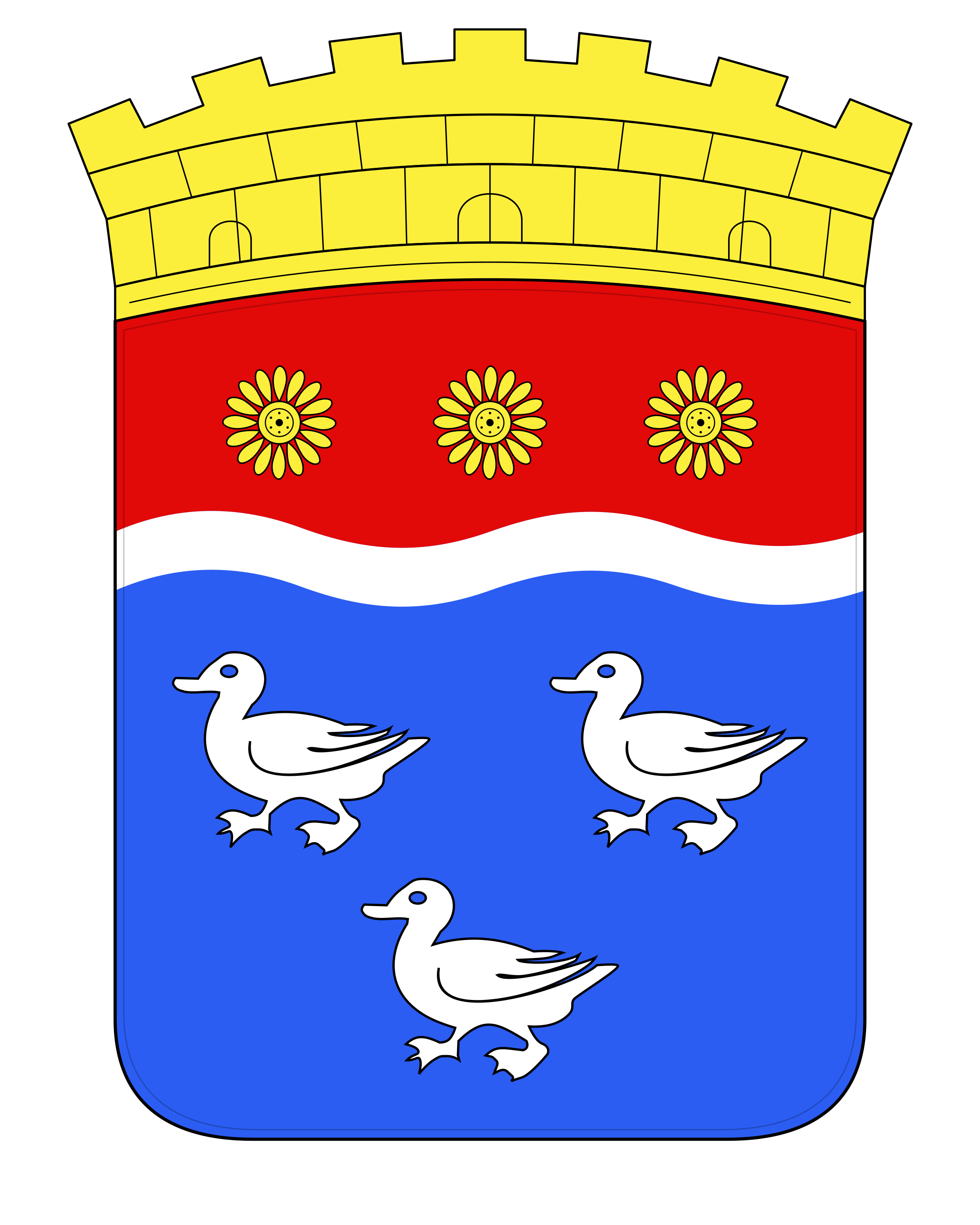
Sea baths, villas and hotels gradually transformed Vierville from the 19th century. After 1944, the memory of the Landing gave another dimension to the use of the coast. The documents gathered here make it possible to follow these developments.
Tourism in Vierville
Vierville-sur-Mer is located on the coastal facade of Bessin, a former historical territory in the province of Normandy.
It is one of the municipalities on which the beach of Omaha Beach extends, beach conducive to seaside activities for well over a century.
But it is also a beach of the landing of the Second World War. It therefore has a strong tourist attendance linked to the historical and commemorative context of this site.
In addition, the municipality is part of a territory that has a built and natural heritage (the Bessin) suit for discovery and green tourism.
Finally, the site is adapted to leisure in general - hiking, tennis, cycling, paragliding, horseback riding, etc....
Thus, the municipal (and intermunicipal) territory has an assertive tourist vocation which is reflected in particular in the accommodation and the activities offered.
The tourist activities are diverse, supervised and provided by the administrative bodies, associations and companies listed below:
Tourism offices and initiative unions, (activities located in Vierville)
Association for the Development of Tourism in Bessin ADTLB, (localized activities in Vierville)
Omaha Club (beach activities)
Amis de la Plage (Norman party, fair for everything, fire of St-Jean, rally, ping-pong, petanque, sports competitions, sand castles...)
Eolia (wind sports)
Icare (paragliding)
Veterans
Alumni of the Vierville school
Omaha Beach-Bedford (VA)
"Deep Respect" Association
Association "The Gateways of Omaha Beach"
Military Vehicle Collectors' Associations
The 2 successive museums of the landing
From before the war and today
1 - Resort
2 - Ancient historical heritage
3 - Memory of June 6, 1944
4 - Future trends
1 - A place of family and tourismsince the end of the 19th century

The beach of Vierville, washed twice a day by the tides, is a superb expanse of golden sand, more than 300m wide by low seas of lively waters.
This seaside beach, which borders the territory of the municipality to the northeast, was originally the pole of attraction.
The families of the neighborhood and the cities, who had always come fishing there, began to settle there on holidays for the joy of the children, then gradually built holiday villas there.
Since 1900, commerce and the hotel industry have thrived around these activities, including the establishments created more than a century ago by the Piprel and Legallois families, establishments mentioned in the old documents of the fund.

View to the West
The fishing and the Pointe de la Percée
Immediately to the west of the beach
Of Vierville, where mussels are fished,
Of the bouquet (pink shrimp),
Etrilles (rock crabs) and tourteaux

View to the East
Vierville beach at the foot of the village,
Dominated by the campsite located
On the cliff

A rainbow on the sea on March 26, 2010
As early as the 19th century, Vierville had to be known since a painter was interested in his site, the newspaper La Liberté recalled it in the article kept in this file, on the occasion of the exhibition at the Abbaye aux Dames de Caen of a canvas by Adolphe-Félix CALS representing (very freely) Vierville sur mer:

" Born in Paris in 1810, Adolphe-Félix Cals is considered by some as the true inventor of Impressionism. Alas, Alain Tapié, scientific director of the Painting in Normandy collection, notes that "this does not change his notoriety deficit". Cals was a precursor. Before everyone else, he paints the humble and immediate equality of all things. "On the motif, he grasps nature at work," adds Alain Tapié. like this painting representing the beach of Vierville, which was going to go down in history...
...... Cals died in 1879 in the city of painters. The artist rests at the Sainte-Catherine cemetery in Honfleur...
Frédéric LETERREUX
See the newspaper article "La Liberté":

A canvas by Adolphe-Félix Cals represents the beach of ViervilleRead the rewritten text
This reading version has been rewritten from the newspaper clipping. Connecting phrases and any reconstructed words are not a verbatim quotation.
The eighth and last part of a series devoted to painting presents a canvas by Adolphe-Félix Cals representing Vierville-sur-Mer. Born in Paris in 1810, the painter is described as a precursor of Impressionism, still insufficiently known. Alain Tapié, scientific director of the Painting in Normandy collection, highlights his interest in humble subjects and his way of grasping nature at work.
The article brings this landscape closer to the later destiny of the beach: a century after the painted scene, the American soldiers of the 1st and 29th divisions would suffer heavy losses on June 6, 1944, at the beginning of Operation Overlord.
At the end of his life, Cals frequented the Saint-Siméon farm in Honfleur. The characters seated under the apple trees and the portraits inspired him. In his letters, he insisted on the place of the heart in art and on the inexhaustible resources of nature.
Died in Honfleur in 1879, he rests in the Sainte-Catherine cemetery, a few meters from the burial of Michel Serrault. The exhibition was then open every day from 2 p.m. to 6 p.m. at the Abbey of the Ladies of Caen, with free admission. The article is signed Frédéric Leterreux.
View the archive imageDownload the rewritten text
Original OCR text
The original OCR text is kept for comparison with the image. Its reading order and some words may be incorrect.
2 - Ancient historical heritage
But Vierville was not only a pleasant beach, it presents on its territory much older memories, works of art bequeathed by centuries, which attracted the curious and then tourists.
It was in the first third of the 20th century that some were classified as Historical Monuments such as the church bell tower and the Vaumicel mansion.
Others deserve to be noticed by the passing traveler: castle, mansions, inn or old farms, old wells and walls, wooded spaces and hedges modeled by agriculture over the centuries. Here are some examples:


The church of Vierville with its classified bell tower from the 13th and 14th centuries


The Vaumicel mansion, built in the 16th century away from roads and sea wind, picturesque and original with its 4 corner turrets.

The Château de Vierville (above), built at the end of the 17th century, facing the valley that leads to the sea, around some remains (below) of a fortified castle from the Middle Ages.


An old covered well on Rue du Hamel at the Priest.
These "well-shells" are common in the Bessin. There are several in the municipality, especially near Vaumicel and Fosses-Taillis

On the Grandcamp road, the old house of the Crespigny farm, with a front dovecote, and an extraordinary 16th century monumental chimney
(Photo on the right)
This old house was renovated in the style of the time, according to the notes of the fund


Curious ancient sculptures (reuse of old carved stones), on the facade of the former hotel-restaurant of the Tourists, called today to the "Pie qui Tête", on the village square

The tithe barn of the old presbytery, near the church, has been recently restored and it has regained an aspect close to its original architecture.

Route de Formigny, the old house of the Ormel with the church bell tower in the background.
It was a relay of English pilmers on the road to Mont Saint-Michel and Santiago de Compostela, via Vierville, the abbey of Deux Jumeaux and the abbey of Cerisy, a relay attested by a shell on the facade.

The old fortified gate of the Ormel, with its machicoulis, memories of uncertain times.
3 - June 6, 1944 This date remains engraved in the memory of the Viervillais.
That day, at dawn, thousands of American soldiers were landed on his beach, strongly defended by German troops. Thousands of young people were killed or injured. The survivors climbed the cliffs, occupying Vierville on the morning of June 6 and thus isolating the German defenders concentrated at the foot of the valley.
Many commemorative monuments, many information panels and some German bunkers mark the memory of these difficult battles, where fighters from both sides competed in courage and sacrifices.
4 - Development prospects set out in the old file of the PLU
(cf investigation file of the Local Urban Plan):
Economic activity is mainly focused on tourism, whether historical or seaside. This induces a sometimes significant use of coastal areas, which is not without a problem in terms of traffic (car, pedestrian, cyclist) and parking. Thus, developments are to be planned to improve this situation.Some shops and services are present in the village and on the beach (seasonal shops). This commercial equipment makes it possible to meet the basic needs of the population. This also makes it possible to maintain a certain dynamism on the territory. Maintaining them is important for the community. Agricultural activity remains strongly present even if the farm headquarters located in the municipality have recently disappeared.
The attractiveness of the territory is based both on the tourist dimension of the site but also on the quality of the natural spaces present. They should be preserved because they contribute to the charm and identity of the municipality. This wealth has recently led to the classification of part of the territory as a classified site of Omaha Beach, which induces a number of requirements regarding the possibilities of developing the plots included in the site.
The landscapes of the town, linked to the bocage but also to the old built heritage deserve special attention.
- Tourism linked to history and activities related to sport, wind and the sea generate attendance and therefore accommodation needs that will always be insufficient by the sea.
- the different uses of the coast require the coexistence of several uses: boating, fishing, swimming, historical tourism. The space available for these uses is limited by the relief of the Vierville coast. As a result, this cohabitation sometimes appears complicated to ensure between the different activities. For example:
- There is a lot of car traffic during the summer period, especially of tourist buses, cars and motorhomes that all need parking. And at the same time, road development is needed for gentle travel on the seafront.
- fishing on foot requires satisfactory water quality and parking for fishermen
- boating needs a practical boat dock, which is not currently the case, and spaces for tractor parking (which cannot always stay on the beach)
- Thus, the parking lot located to the east of Bedford Avenue descending to the beach is a strategic place because the place of cohabitation of customs. The elected officials therefore want to redevelop it in the near future.
- the General Council is completing land acquisitions to develop a coastal trail that will allow gentle travel. There are therefore safe routes for pedestrians, disabled people and bicycles, security for both natural hazards and risks related to motorized traffic.
- The Vierville-sur-Mer campsite has been bought and is being renovated
- The museum has a restructuring project: make a clean slate of the existing to move towards the creation of a larger exhibition area. It wishes to extend behind the existing structure.