A rehabilitation project for the communal hallRead the rewritten text
This reading version has been rewritten from the newspaper clipping. Connecting phrases and any reconstructed words are not a verbatim quotation.
The municipal council had decided to rehabilitate the communal hall located by the sea, which had become unusable due to lack of adequate equipment and compliance with safety standards. Built about thirty years earlier by municipal employees, it had neither heating nor kitchen. According to Mayor Jean-Marie Oxéant, access was insufficient. Its use had decreased until it had completely stopped for two to three years.
Renovation and expansion had been part of the municipality's objectives since the 1989 elections. The council had saved 300,000 F for this operation, valued at 709,000 F. A grant from the General Council of about 155,000 F was to limit the loan needed to supplement the financing.
The project provided for an additional 65 m². A new room was to extend the building and allow the development of a kitchen and a bar. At the opposite corner, an entrance hall had to form a airlock against drafts. A covered terrace, facing the sea, was to replace the removed main staircase to create this entrance. New toilets were also planned, with easy access for people with disabilities.
The land acquired a few years earlier was to accommodate the extension, while the remaining part would be converted into a green space. The start of the work was planned in September, for a commissioning at the beginning of 1994. The room was thus to regain its place at the service of the population and Vierville associations.
The communal festival hall was probably built around 1960.
The renovation of the party hall and the decisions of the city councilRead the rewritten text
This reading version has been rewritten from the newspaper clipping. Connecting phrases and any reconstructed words are not a verbatim quotation.
Meeting several times under the presidency of the mayor, the municipal council of Vierville-sur-Mer examines various issues. The additional budget of 1993 is voted in balance, in revenue and expenditure: 120,798 francs for operation and 274,900 francs for investment.
Regarding La Poste, the municipality obtains from the PTT a temporary flame of obliteration for the fiftieth anniversary of the Landing, from May 15 to August 15, 1994. At the request of the post recipient, the council gives a favorable opinion to an opening to the public at 1:30 p.m. instead of 2 p.m. However, he wishes to maintain the closure at 5 p.m. during the summer season, in order to best welcome visitors.
After the opinion of the municipal buildings commission and verification of the offers by the SO.CO.RAC, the renovation work of the party room is assigned to the following companies: SCL, in Isigny, for masonry; Joret for carpentry; Marie for roofing; Normen for PVC carpentry; Ménard for plastering; Lechevrel for tiling; Royer for electricity and heating; Geffroy-Hamon for plumbing; Marie Michel for suspended ceilings; and Demoor for painting and coatings. After comparing two proposals, the council entrusts Tecnorest with the supply and installation of complete kitchen equipment, for about 62,000 francs excluding taxes.
The house is rented to Mr. and Mrs. Jean Costy as of January 1, 1994, with a six-year lease that is tacitly renewable. For the museum, no agreement having been reached with Mr. Tréfeu despite several meetings, the council decides to move Mr. Level's collection as soon as it is actually acquired. A qualified company must ensure the move to a safe place, under electronic control. The fee due by Mr. Tréfeu for the rental of the municipal premises in 1994 is set at 70,000 francs, payable in tranches of 10,000 francs from May 1, 1994.
The council also decides to buy an aerial photograph of Vierville to exhibit it at the town hall. It renews a temporary occupation authorization on the edge of the beach, from July 2 to August 28, 1994. Work is planned in the housing of the lifeguard in charge of the summer surveillance of the beach. The municipality also agrees to take charge, from January 1, of the subscription to the church's electricity meter.
On the roads of Formigny and Louvières, the SDEC must strengthen the network served by the Ormel processing station, while France Telecom plans to bury its air network. The council chooses to partner with these operations to eliminate the air networks in the sector.
A grant of 1,500 francs was awarded to the Syndicat d'initiative d'Isigny-sur-Mer for its participation in the opening of the Syndicat d'initiative in July and August 1993. The council also grants aid corresponding to 30% of the cost price of the discovery classes of the schools and the Collège de Trévières for children of Vierville-sur-Mer who attend these institutions. The photograph of the party hall under construction is credited to Boudonnet.
Its renovation was carried out between 1992 and 1994 (completed on September 24, 1994)
The renovated party room
1994
The room renovated in 1994
The inauguration of the renovated communal hallRead the rewritten text
This reading version has been rewritten from the newspaper clipping. Connecting phrases and any reconstructed words are not a verbatim quotation.
The Vierville town hall was inaugurated on a Saturday afternoon by the mayor, Jean-Marie Oxéant, in the presence of the municipal council. Captain Le Berre, commander of the Bayeux gendarmerie company, as well as representatives of the Trévières gendarmerie attended the ceremony. Many inhabitants had come to discover this achievement.
The former mayor, Mr. Hardelay, cut the tricolor ribbon. This gesture recalled his role in the creation of the party hall, thirty years earlier.
During the visit, the mayor presented the new equipment: a large kitchen with dishwasher and a room that can accommodate about a hundred people, open to the sea through large bays. He highlighted the quality of the materials, finishes and ease of maintenance. A fence was still to be installed around the field the following spring to allow children to play outside safely.
Ten companies participated in the work. The mayor was pleased that they are craft companies in the canton of Trévières. Knowing the difficulties of local companies in obtaining public contracts, he explained this choice to work with them.
The General Council awarded a subsidy representing 20% of the amount of the work. The municipality self-financed 30% and contracted a loan over fifteen years for the remaining 50%.
The guests then shared a wine of honor and discovered Caroline Fontaine's photographs. This professional photographer had covered the reception of American veterans on June 5. His images reproduced the festive atmosphere, the reunion and the emotion of this day.
September 1994, in the presence of Michel Hardelay, former mayor
A walking pier
1973
The creation of an 80-meter promenade pier is decidedRead the rewritten text
This reading version has been rewritten from the newspaper clipping. Connecting phrases and any reconstructed words are not a verbatim quotation.
A working meeting was held on a Friday at the town hall of Vierville-sur-Mer, under the chairmanship of the mayor, Mr. de Bellaigue de Bughas. The municipal council and representatives of the population, including traders and farmers, were involved in the discussion. MP François d'Harcourt had come to defend the creation of an 80-meter promenade pier.
Three possibilities were examined: to give up the project, to build a 50-meter pier for an estimate estimated at 200,000 F, or to retain the 80-meter pier, valued at 320,000 F. The mayor also mentioned the tax consequences of the different solutions.
François d'Harcourt supported the 80-meter version to be the first element of a tourist complex and quickly create a pole of attraction in Vierville. He stressed that about twenty building permits had already been applied for in this sector.
The deputy announced that Crédit Lyonnais had agreed to finance the project and that an addition linked to its updating should not raise any difficulties. He also highlighted the help of the general council: a 30% participation in the repayment of loan annuities. Despite the hesitations expressed, he considered these conditions favorable to the launch of the operation. The title of the cut announces the decision to create the 80-meter pier.
The commemorative plaque placed in the church dating from the 1920s
A stele in memory of the victims of the two world warsRead the rewritten text
This reading version has been rewritten from the newspaper clipping. Connecting phrases and any reconstructed words are not a verbatim quotation.
Vierville-sur-Mer already had a plaque bearing the names of its victims in the church, but no monument to the dead. A stele dedicated to the inhabitants who died, civilians and military, during the two world wars was inaugurated on a Sunday afternoon, on the occasion of the commemorations of November 11.
The ceremony brought together in particular the regional director of the veterans of Lower Normandy, the sub-prefect, the senator of Bourgoin, the deputy of Harcourt, the general councilor Jouet and Captain Le Berre, commander of the Bayeux gendarmerie company. Also present were Mr. Fay, departmental president of the refractories and guerrillas, veterans and mayors of neighboring municipalities, the superintendent of the American military cemetery of Colleville-sur-Mer and the curator of the German military cemetery of La Cambe.
The mayor, Mr. Oxéant, presented the stele as a symbol of the will to perpetuate the memory of the sacrifice of the missing to prevent events from falling into oblivion. He recalled the responsibility of present generations towards children and those who will succeed them. Messrs. Jouet and d'Harcourt then congratulated the initiators of the project. The sub-prefect read the message from the Secretary of State for Veterans and War Victims.
After the unveiling of the monument, the authorities deposited sheaves. Mr. Demoor proceeded to the call of the dead, then the Trévières fire brigade clique provided the ringing of the dead. A minute of silence preceded the wine of honor offered to the town hall.
1990, inauguration ofa new monument to the dead, on a grassy land next to the church
Communial housing
Three rental housing units renovated with the help of the Trévières OPAHRead the rewritten text
This reading version has been rewritten from the newspaper clipping. Connecting phrases and any reconstructed words are not a verbatim quotation.
Pierre Maclos, head of the Trévières Planned Home Improvement Operation, visited a three-house construction site in Vierville-sur-Mer. They were redeveloped in an old building that housed furnished rentals.
The owner, Jean-Pierre Delobel, committed 1.1 million francs to the renovation. Thanks to the OPAH, he received a 25% subsidy. Florian Guillain, representative of the National Agency for Housing Improvement, was also present on the construction site. This organization was responsible for subsidizing the work carried out by the landlords.
Two of the dwellings have five main rooms; the third has three. The announced rents are 2,500 and 2,000 francs respectively. Since these rents are not contracted, the subsidy rate has been limited.
This is the twelfth operation conducted by the Trévières OPAH in the field of rental housing.
The presbytery transformed into communal housingRead the rewritten text
This reading version has been rewritten from the newspaper clipping. Connecting phrases and any reconstructed words are not a verbatim quotation.
After the death of Father Tourquetil, the presbytery of Vierville-sur-Mer remained unoccupied. The city council had decided to transform it into social housing. Several difficulties had to be overcome before the announced arrival of the new tenants.
One Friday evening, Fabienne Buccio, sub-prefect of Bayeux, Roger Jouet, general councilor, and Jean-Marie Oxéant, mayor of Vierville, officially handed over the keys. The municipal operation, subsidized in part by the State and the General Council, was to allow a family of three children to settle permanently in the village.
The children showed their new home to Fabienne Buccio, in a warm atmosphere that the report highlights.
2000 - A new social housing, replaces the presbytery that has become useless since the creation of the new parish of Saint-Exupère-en-Bessin with presbytery in Trévières
An OPAC pavilion given to the Guérin familyRead the rewritten text
This reading version has been rewritten from the newspaper clipping. Connecting phrases and any reconstructed words are not a verbatim quotation.
One Wednesday, representatives of the Calvados Public Planning and Construction Office officially handed over the keys to a new pavilion to the Guérin family. Roger Jouet, general councilor of the canton of Trévières, and Jean-Marie Oxéant, mayor of Vierville-sur-Mer, attended this ceremony.
The OPAC of Calvados, a public establishment of an industrial and commercial nature, was then involved in the field of solidarity through housing. According to the figures presented in the article, it was located in 216 municipalities of the department and managed a rental heritage of 17,574 housing units.
The T5 type pavilion was built on land sold by the municipality, just behind the town hall. It includes four bedrooms, a living room, a kitchen, an entrance, a garage and a pantry.
The mayor thanked the OPAC and the companies for the quality of the construction, wishing Mr. and Mrs. Guérin and their children many happy years in this housing. The director of the office welcomed an achievement illustrating the diversity of his responses to the needs of families. Roger Jouet also wished a happy stay to the new occupants, highlighting everyone's right to comfort and space.
Post office, museum, party room: the decisions of the city councilRead the rewritten text
This reading version has been rewritten from the newspaper clipping. Connecting phrases and any reconstructed words are not a verbatim quotation.
Meeting several times under the chairmanship of the mayor, Mr. Oxéant, the municipal council of Vierville-sur-Mer examined various files.
For the fiftieth anniversary of the Landing, the municipality obtained from the PTT the commissioning of a temporary olliteration flame, from May 15 to August 15, 1994. At the request of the post receiver, the council also gave a favorable opinion to an opening of the office to the public at 1:30 p.m. instead of 2 p.m. For the summer season, he wanted to close at 5 p.m.
On the other hand, elected officials regretted not having been consulted on the reorganization of the mail that took place in the previous fall. They deplored the reduction in the working time devoted to its distribution and reaffirmed their commitment to public service, especially in rural areas.
At the party hall, after the opinion of the municipal buildings committee and reading the SOCOTEC audit report, the council decided to entrust various works to several companies. After examining two proposals, he selected the complete equipment of the kitchen, for about 62,000 francs excluding taxes.
Regarding the museum, Mr. Leveel's termination of the lease of the house he occupied as a dwelling was accepted. This house was rented to Mr. and Mrs. Jean Costy as of January 1, 1994. No agreement having been reached with Mr. Tréfeu despite meetings with the delegates of the municipality, the elected officials decided to move Mr. Leveel's collection as soon as it was actually acquired by the municipality. A qualified company had to transport and store objects, including those under electronic control.
The fee due by Mr. Tréfeu for the year 1994, for the occupation of a communal premises, was set at 70,000 francs, payable in installments of 10,000 francs from May 1, 1994.
The SDEC having decided to strengthen the work in the sector served by the Ormel processing station, and France Telecom preparing the burial of its network in the same sector, the municipality has chosen to join these operations. The objective was to eliminate all air networks along the roads of Formigny and Louvières.
The council voted a subsidy of 1,500 francs to the union for its opening in July and August 1993. He also decided to cover 30% of the cost price of the discovery classes of the schools and the Collège de Trévières for the children of Vierville attending these institutions.
Other decisions include the purchase of an aerial photograph of Vierville, intended to be exhibited in town hall, and the agreement to renew Mr. and Mrs. Trével's temporary occupation authorization on the beach, from July 2 to August 28. Work was to be carried out in the housing reserved for the MNS ensuring the surveillance of the beach during the summer. Finally, the municipality has agreed to take charge, as of January 1, 1994, the subscription to the church's electricity meter.
1994 - Renovation of the party room, future of the post office, future of the museum
Battle for a post in Vierville-sur-MerRead the rewritten text
This reading version has been rewritten from the newspaper clipping. Connecting phrases and any reconstructed words are not a verbatim quotation.
The closure of the Vierville-sur-Mer post office had deprived Omaha Beach of this service for a week. On July 19, tourists had found the door closed, without the village being notified. The cut recalled that Vierville served the famous Landing Beach, where 18 heads of state had gone in 1994 for the fiftieth anniversary.
The mayor, Jean-Marie Oxéant, explained that La Poste invoked a security problem. For seven summers, lifeguards had occupied the first floor of the building; their premises communicated with those of the postmen and the toilets were shared. This organization was suddenly presented as dangerous.
The 246 inhabitants of the village saw it as a pretext. The previous winter, they had already opposed a definitive closure motivated by a profitability considered insufficient. On July 21, about thirty of them went to the Trévières post office to close their account.
According to the mayor, a reopening was initially conditioned on the departure of the rescuers, which he refused. Contacted by Le Point, the management of La Poste finally proposed to install an armored door between the two services. The reopening was announced for the following week, but the sustainability of the post office remained uncertain.
The municipality resumes the postal service in a municipal agencyRead the rewritten text
This reading version has been rewritten from the newspaper clipping. Connecting phrases and any reconstructed words are not a verbatim quotation.
After about ten years of reducing postal services in the Omaha sector, the municipal council of Vierville-sur-Mer has accepted the transformation of the post office into a municipal postal agency. The elected officials made this decision with regret, but considered it the best way to preserve a local service whose closure seemed to have become inevitable.
Jean-Marie Oxéant, mayor, recalled the stages of this withdrawal: half-time transition as part of a twinning with Saint-Laurent-sur-Mer, permanent closure of the Saint-Laurent office, reduction of winter and summer hours, closure on Wednesdays and Saturdays. An attempt at total closure during the summer of 2007 had caused a strong mobilization of users, who had directly brought their demands to the receiver of Trévières. In the end, the office only had five hours of weekly opening.
The new agreement must maintain the reception in the existing premises, at the rate of fifteen hours per week, spread over five mornings from Tuesday to Saturday. The municipality will employ the person in charge of the counter. La Poste will pay him a monthly contribution of 885 euros and provide the necessary computer equipment, which it will also maintain. The agreement is due to enter into force in the following weeks.
Jean-Pierre Richard, general councilor and member of the Departmental Commission for Territorial Postal Presence, welcomed this development. He felt that the municipality had chosen to maintain a postal presence for the inhabitants of Vierville and the surrounding area.
Mr. Alix, postman, killed on June 7, 1944 (German shells)
Mr. Thomas, postman
Then: Mr. Dufete
Later: Mr Lecornichon, who died around 1990
Opening and closing of shops
The Dumont establishment closed in 2000
The announced closure of Jacqueline and André Dubosq's grocery-bar-tobaccoRead the rewritten text
This reading version has been rewritten from the newspaper clipping. Connecting phrases and any reconstructed words are not a verbatim quotation.
After fifteen years and a month at the head of their grocery-bar-tobacco in Vierville-sur-Mer, Jacqueline and André Dubosq were preparing to permanently close their business on a Saturday evening. Eager to retire after a life of work, they had put their shop up for sale for several months, without finding a buyer. The article linked this difficulty to the situation of local commerce.
In the shop, whose shelves were emptying as the closure approached, André Dubosq returned to his installation in Vierville. He previously worked in the sugar industry in Cagny. His wife already owned the business; he had then joined her to settle in the village. Behind the shop, he was proud to show the bar, which over the years has become very different from the simple bar of the beginnings.
He took a worried look at the evolution of Vierville, which he described as a village of aging retirees, which he thought was not very favorable to maintaining trade. He recalled the closure of the school, the departure of the parish priest and the successive disappearance of the shops. He opposed this situation to that of Saint-Laurent-sur-Mer: two hotels had opened there in three years, the bar had been expanded three times and a bread depot had been created.
However, André Dubosq recognized that the small business of Vierville worked well during the summer season. A loyal clientele of tourists kept the shop alive. On the other hand, he regretted that the inhabitants frequent the supermarkets of Bayeux. In winter, the grocery store had mainly become a repair shop, without opening hours being displayed.
After the closure, the hotel "La Pie qui Tète" was to temporarily resume the sale of newspapers. If the owners were able to sell their business, this activity could then return to the buyer. The future of tobacco was a matter of another decision, linked to the tax administration.
The couple did not plan to retire in Vierville, but was still waiting to know if they would succeed in selling. In conclusion, the article highlighted the loss that this closure represented for the life of the village: beyond the commercial service, local shops created links between the inhabitants.
2000, closure of the grocery-tobacco Dumont, (at the corner of Pavé and Hamel-au-Prêtre streets)
The grocery store Le Gallois on Rue Pavée, which had disappeared around 1990, was taken over with a bread deposit during the 2000s by Marie-Eve Godard, under the name "Epi Service"
EPI SERVICE
general food store
open around 2000 (?)
renovated since October 21, 2008 and closed around 2011
Pavée street
For the record, the closures:
Pavée Street Bakery closed around 2000 (?)
------
Butchery on Pavée Street, closed around 1995 (?)
------
The cliff creperie, rue de la Mer
La Falaise is reborn with a new managerRead the rewritten text
This reading version has been rewritten from the newspaper clipping. Connecting phrases and any reconstructed words are not a verbatim quotation.
At the age of 41, Françoise Konya left her job as a maintenance agent to take over La Falaise, a seasonal creperie in Vierville-sur-Mer. His ambition was to make it a restaurant open all year round, with affordable prices. The establishment had 28 covers and a 12-seater terrace overlooking the sea.
Françoise Konya prepared pancakes, cakes, waffles, ice cream and salads in front of the customers, while her daughter Marina helped her in the kitchen and with the dishes. She already knew the place for having cleaned it with the former owner, who had been living for about fifteen years and retired. With no family experience in catering, she had used the Internet to search for recipes and set her rates.
Since the reopening on July 10, the creperie had welcomed more than 500 customers. The standard menu cost €15, with small menus at €7 and breakfasts in the morning. The manager wanted to meet all budgets; the customers interviewed appreciated the generous portions and the value for money.
The schedules announced in this article were as follows: every day in summer from 9 a.m., until the departure of the last customer; from September, closing on Wednesdays and opening from 10 a.m. to 3 p.m., with an opening from 10 a.m. on Friday, Saturday and Sunday. The report is signed by Christine ICLEANU.
Patrick Thomines, Jacques Héleine, Ambroise Dupont, Daniel Laronche, Jean-Marie Oxéant, Antoine de Bellaigue, Jean-Pierre Richard
Three elected officials honored for thirty-five years in officeRead the rewritten text
This reading version has been rewritten from the newspaper clipping. Connecting phrases and any reconstructed words are not a verbatim quotation.
On the Saturday before the publication of November 13, 2012, Jean-Marie Oxéant, Daniel Laronche and Jacques Héleine received the regional, departmental and municipal medal of honor. Many residents, elected officials, family members and colleagues attended the ceremony to salute thirty-five years of municipal commitment.
Jean-Marie Oxéant spoke about the team of young candidates who, at the beginning of 1977, had chosen to run in the municipal elections. They did not imagine meeting thirty-five years later to take stock with the inhabitants and elected officials of the territory.
Originally from Cotentin, Jacques Héleine taught in one of the two classes in the village. After the closure of his only class in 1988, he joined the Trévières public school, of which he became principal, while continuing his activities on football fields and in a choir. Daniel Laronche had taken over his parents' farm. With humor, Jean-Marie Oxéant recalled his attachment to the land and his reserve towards the chainsaws and bulldozers used to pass the silage harvesters. He praised his two colleagues' commitment, sense of public service, skills and solidarity, in the service of youth, the environment, dignity and quality of life, but also public works and sanitation.
Antoine de Bellaigue, mayor since January 29, 2012, then retraced the journey of his first deputy. The article presents Jean-Marie Oxéant as elected city councillor at twenty-four, second deputy at twenty-six, then mayor at twenty-nine in 1983 and president of the water union. Re-elected in 1989, 1995, 2001 and 2008, he left his position as mayor at the beginning of 2012 while remaining first deputy.
His successor recalled the creation of the tourist office, of which he became president, the preliminary reflection on intermunicipality, the creation of the cantonal sanitation syndicate and his vice-presidency of the Intercom in charge of tourism. He cited the hydraulic developments, the roads, the sidewalks, the burial of the networks, the rock armour installed around the pontoon, the renovation of the built heritage, the Landing Museum, the tithe barn, the sports areas and the twinning of Bedford and Omaha Beach. The ceremony of May 8, 1995 involving young German soldiers also illustrated, according to him, his personality. Antoine de Bellaigue highlighted the usefulness of his advice and his ability to take a step back to bring out new projects.
Senator Jean-Léonce Dupont, also elected for the first time in 1977, insisted on the essential role of councillors to a mayor. He presented the medal as a sign of recognition for their availability, dedication, consistency and time spent on communal decisions. Former schoolmate of Jean-Marie Oxéant, he also paid him a personal tribute.
Three elected officials distinguished for thirty-five years in officeRead the rewritten text
This reading version has been rewritten from the newspaper clipping. Connecting phrases and any reconstructed words are not a verbatim quotation.
Jean-Marie Oxéant, Daniel Laronche and Jacques Hélène, elected to the municipal council of Vierville-sur-Mer since 1977, received the municipal, departmental and regional gold medal. This distinction honored thirty-five years of commitment to the service of the community.
During the ceremony organized on a Saturday, the mayor, Antoine de Bellaigue, emphasized their loyalty to their duties and to the service of the inhabitants. Former mayor Jean-Marie Oxéant presented the career of his colleagues.
Jacques Hélène had been the teacher of Vierville until 1988, the year of the closure of the single class. He then joined Trévières, where he led the school until his retirement. He was also at the origin of the reading point of the municipality.
Farmer, Daniel Laronche had maintained a farm on a human scale, conducted with respect for the environment. Second deputy, he was also a delegate and negotiator for the municipality’s contracts. His sense of public service was particularly praised.
Jean-Marie Oxéant, elected mayor in 1983, had chaired the Water Syndicate and participated in the creation of the community of municipalities. Antoine de Bellaigue recalled the many files he had led since joining the board and his reputation as a project man.
The President of the General Council, the Member of Parliament and other elected officials also paid tribute to the commitment of the three recipients.
Decorations given to veteransRead the rewritten text
This reading version has been rewritten from the newspaper clipping. Connecting phrases and any reconstructed words are not a verbatim quotation.
A ceremony organized at the town hall of Vierville was marked by the presentation of the combatant's cross to Messrs. Papillon, Ygouf and Demours. The decorations were given to them by Mr. Jouet, Vice-President of the General Council.
Mr. Demours also received a distinction of military value, awarded by Mr. Françoise, president of the veterans' association. The mayor, Mr. Oxéant, and residents attended the demonstration.
The ceremony was followed by a religious service, a wreath deposit and then a banquet bringing together the participants.
A medal for the twenty-nine years of service of Mr. OxéantRead the rewritten text
This reading version has been rewritten from the newspaper clipping. Connecting phrases and any reconstructed words are not a verbatim quotation.
A family ceremony brought together elected officials and many residents around Mr. Oxéant, a former municipal employee of Vierville-sur-Mer. His son, Mayor Jean-Marie Oxéant, retraced his twenty-nine years of career in the service of the municipality.
Mr. Legendre, sub-prefect of Bayeux, presented him with the departmental and municipal silver medal, in the presence of the general councilor Mr. Jouet and the municipal council. The inhabitants offered many gifts to the recipient and his wife.
The article states that Mr. Leroux had resumed the job of municipal worker and Mr. Freulon that of field guard.
March 1987, Mr. Jean Oxéant decorated with the departmental and municipal medal
Suzanne Marie's retirement after eighteen years of serviceRead the rewritten text
This reading version has been rewritten from the newspaper clipping. Connecting phrases and any reconstructed words are not a verbatim quotation.
The inhabitants of Vierville-sur-Mer met on a Sunday noon to greet Suzanne Marie on the occasion of her retirement, after eighteen years of work for the municipality.
Entered the service of the community on October 1, 1979, she had ensured the cleaning, the responsibility of the communal hall and the market. She had also worked as a field guard.
The mayor, Jean-Marie Oxéant, recalled his dedication to the municipality and its inhabitants, as well as his role as a link between the population and the town hall. He wished her to enjoy her family and four children from now on. He announced that his position would be entrusted to Florence Marie.
To express the gratitude of the city council and the population, the mayor gave him two gifts.
The municipality pays tribute to Suzanne Marie for her retirementRead the rewritten text
This reading version has been rewritten from the newspaper clipping. Connecting phrases and any reconstructed words are not a verbatim quotation.
On the first Sunday of October, around 11:30 a.m., the inhabitants of Vierville-sur-Mer gathered in the communal hall, opposite Omaha Beach, to welcome Suzanne Marie's retirement. The mayor, Jean-Marie Oxéant, retraced her career in the service of the municipality.
A municipal employee since October 1, 1979, Suzanne Marie had been a municipal guard, market manager, municipal hall manager and school housekeeper. Her four children attended this tribute. Her substitute was also named Mrs. Marie.
The municipality gave her a television and an oil heater. After opening the gifts, participants shared a glass of friendship and petits fours.
The meeting was extended at the Hotel du Casino, located opposite, for the meals of the elders. Sixty guests surrounded the two oldest guests, Miss de Bellaigue, 86, and Mr. Merlin, 95.
The municipality thanks the teams for the 1998 summer seasonRead the rewritten text
This reading version has been rewritten from the newspaper clipping. Connecting phrases and any reconstructed words are not a verbatim quotation.
One Thursday evening, Mayor Jean-Marie Oxéant brought together permanent and seasonal staff who contributed to the events and the reception of vacationers during the summer of 1998.
The rescuers of the SNSM, the secretaries of the town hall, the hostess of the tourist office, the municipal guard, the instructor of the sailing school, the road agents and the animators of the leisure center were greeted, alongside the gendarmes and firefighters. The mayor thanked them for allowing the season to take place in good conditions, without incident, and for making the municipality welcoming and safe.
He stressed the irreplaceable nature of the associations, while recalling that their action alone was not enough: seasonal staff also allowed the municipality to remain active and alive. This meeting was an opportunity to bring together municipalities sharing this operation and to hope for the development of cooperation that serves as an example for the future.
The mayor also introduced Warrant Officer Delacour, the new commander of the Trévières gendarmerie brigade.
Danièle Guillotte leaves the town hall secretariat after sixteen years of serviceRead the rewritten text
This reading version has been rewritten from the newspaper clipping. Connecting phrases and any reconstructed words are not a verbatim quotation.
In its edition of May 18, 2010, La Renaissance du Bessin reports the retirement of Danièle Guillotte, secretary of town hall and the Water Syndicate. The municipality had organized a friendly meeting to mark this stage, in the presence of current and former elected officials from Vierville and Saint-Laurent, as well as Jean-François Bernard, former collector.
After a career at CAF, Danièle Guillotte took office as mayor in 1994, following the departure of Mr. Bunouf. The mayor, Jean-Marie Oxéant, recalled that this was also the time of the early days of the computerization of secretariats.
He praised his availability, his skills, his efficiency and his professional conscience. He also highlighted his smiling welcome to residents, his good relations with community partners and his taste for public service.
Gifts were given to him on behalf of the locals, and the mayor sent him his best wishes for the years to come.
On the occasion of the annual meeting of the Viervillais, May 1, 2010
The SNSM medal awarded to Philippe YgoufRead the rewritten text
This reading version has been rewritten from the newspaper clipping. Connecting phrases and any reconstructed words are not a verbatim quotation.
One Wednesday evening, the town hall of Vierville-sur-Mer welcomed Jacques Chambon, departmental delegate of the SNSM, to reward two former officials of the local rescue station.
Olivier Hamel, president of the station, thanked the municipality for its support, including the purchase of a zodiac. He also welcomed the donation of Crédit Maritime, represented by Mrs. Bihel.
Jacques Chambon gave a letter of thanks to Robert Baron, treasurer for many years. Philippe Ygouf, who had been treasurer and then president of the station until 2001, received the SNSM medal of honor.
Philippe Ygouf welcomed this distinction with modesty. He felt that he had known more deserving station managers and stage captains, minimized his own role and humorously evoked his daily passages to the post and the memory of lifeguards.
The diocesan merit given to Jean GromelonRead the rewritten text
This reading version has been rewritten from the newspaper clipping. Connecting phrases and any reconstructed words are not a verbatim quotation.
During a Sunday mass celebrated in the church of Vierville-sur-Mer by Father Georges Tourquetil, Jean Gromelon, from Louvières, received the vermeil medal for diocesan Merit.
This distinction rewarded twenty years of service, including the takeover, for many years, of the entire electrical installation of the Cinq Clochers kermesses. In the letter given to the recipient, Bishop Pican, Bishop of Bayeux-Lisieux, highlighted the quality of his commitment to the Christian community of Louvières as well as his availability for Asnières-en-Bessin and Saint-Laurent-sur-Mer.
Élie Bonnanfant, post receiver, receives the first national prize for friendlinessRead the rewritten text
This reading version has been rewritten from the newspaper clipping. Connecting phrases and any reconstructed words are not a verbatim quotation.
Receiver of the positions of Vierville-sur-Mer since May 1966, Élie Bonnanfant won the first national prize for kindness awarded by the Commissariat général au Tourisme. This distinction rewarded his reception of users.
He had first received a first departmental prize ex æquo, before his file was transmitted to the national jury. Asked about the reasons for this award, he simply explained that he had done his job.
However, the article described a particular attention to the needs of the public: agree to respond to users arriving outside the usual hours, serve them while reminding them of opening hours, sell a stamp or a notebook despite a late request, or resume your accounting to allow the urgent shipment of documents. He considered these gestures as details, but the newspaper stressed that they gave a good impression to French and foreign tourists during the summer season.
The price included a flight for two people, to Noumea or Tahiti. Mr. and Mrs. Bonnanfant had chosen Tahiti to spend about ten or fifteen days there during their annual leave.
Before this trip, an official reception was to take place in mid-May in Paris, under the presidency of the Secretary of State for Tourism. The couple had booked rooms in an establishment presented as the friendliest hotel in France. The newspaper associated Mrs. Bonnanfant, originally from Toulon, with the congratulations addressed to the winner.
On May 1, the associations present their projects to the inhabitantsRead the rewritten text
This reading version has been rewritten from the newspaper clipping. Connecting phrases and any reconstructed words are not a verbatim quotation.
For the traditional May 1st meeting, Antoine de Bellaigue and municipal councilors invited residents and associations to share a friendly moment. Everyone could get to know each other better and discover the activities planned in the following months.
The mayor thanked the leaders of the Flowers of the Resistance, Omaha-Bedford, the Passerelles d'Omaha, the Friends of the Beach, the Charles de Bellaigue Association and the Vierville School Association. He praised their contribution to communal life and projects to animate the village and its surroundings during the summer.
In a smiling tone, he also told the preparation of the buffet: although May 1 is usually a day without work, Isabelle had mobilized the team from 8 a.m. to spread, cut and prepare the dishes. This work had been done with pleasure, with the hope that all the inhabitants have a good time.
Visits, conferences, exhibitions and various receptions
1969-1977
Art lovers discover the riches of BessinRead the rewritten text
This reading version has been rewritten from the newspaper clipping. Connecting phrases and any reconstructed words are not a verbatim quotation.
Many visitors discovered three castles in Bessin and admired several of its bell towers during a visit organized for the benefit of the diocese's construction sites. Mr. Pellerin, president of the Friends of monuments, museums and sites of Calvados, guided the group and presented detailed documentation on these places, whose beauties were often unknown. A photograph shows the participants entering the Vaumicel Castle.
August 1969, visit conference of the Friends of Monuments, Museums and Sites of Calvados (mr. Pellerin, president guided visitors). Visit of churches and the Vaumicel, for the benefit of the construction sites of the Diocese.
An American wedding in Vierville-sur-MerRead the rewritten text
This reading version has been rewritten from the newspaper clipping. Connecting phrases and any reconstructed words are not a verbatim quotation.
Mr. de Bughas, mayor of Vierville-sur-Mer since the previous year, officiated at his first wedding ceremony on a Friday afternoon. The spouses were two young Americans: Angela Ladas, from New York, and Jonathan Paul de Wierwille, presented as a direct descendant of the former lords of Vierville. After their civil wedding in the village, they planned to travel to Switzerland for the religious ceremony.
The city council wanted to surround the mayor and the young people. In the town hall decorated in French and American colors, they were accompanied by their witnesses: Mr. Néel, steward of the American cemetery, and Mr. Legallois, deputy mayor. An interpreter translated the words of the ceremony; the bride and groom pronounced their "yes" in French.
In his speech, the mayor brought together two stories: that of the Americans who died for the liberation of the commune in 1944 and that of the Vierville family, long linked to the fate of the village. He mentioned Nicolas de Vierville, quoted in 1173 and presented in his speech as related to the Dukes of Normandy and, by alliances, to the royal house. He also recalled the presence of a Vierville alongside Philippe le Hardi in Foix in 1272.
The speech then stopped on Guillaume de Vierville, married in 1391 to Marie de Creully. According to the reported account, his refusal to collaborate with the English occupier and his rallying with the King of France had resulted in the confiscation of his property; Charles VII is said to have restored the property to his son Philippe. The mayor also recalled the exile of this Huguenot family after the revocation of the Edict of Nantes by Louis XIV in 1685.
This return to the origins was presented as proof of attachment to France. The mayor cited the exchanges with Mr. Ibetson, a resident of Jersey and descendant of the Champion de Crespigny family, as well as with the Roth-Vierville family in Switzerland. He mentioned the descendants established in the United States, Switzerland, Jersey, Natal and Australia, going so far as to mention a relationship with Neil Armstrong by a grandmother born Vierville.
Genealogical research did not make it possible to find the family motto, Mr. de Bughas proposed the word "Fidelity": loyalty to the king of France in adversity, to religion, then to family origins through this marriage in the village. On behalf of the city council, he wished the spouses a long happiness and invited them to return, even mentioning possible reunions of the descendants scattered around the world. After the signing of the deed, the municipality offered a wine of honor.
1972 : An American couple named Wierwille came to get married in Vierville. It bore the name of our village and descended from the ancient chatelains of the Middle Ages, whose family had emigrated to Germany at the end of the 17th century
Young Quebec farmers discover the CUMA of ViervilleRead the rewritten text
This reading version has been rewritten from the newspaper clipping. Connecting phrases and any reconstructed words are not a verbatim quotation.
Nineteen young Quebec farmers participated in a nearly three-week internship organized by the Office franco-Québec pour la jeunesse. Their journey in France was to make them discover representative farms and French responses to the demands of modern agriculture, especially in dairy production.
Led by Gaëtan Fortin and accompanied by Councillor Marie-Thérèse Seguin, the group was interested in collective agriculture: financing and installation of young people, specialization of tasks, training of workers and living and working conditions in large structures.
In Vierville, the visitors were welcomed by Mr. Hausermann, president of the Cooperative for the use of agricultural equipment, in the presence of the mayor, Mr. de Bughas, and the cooperative's leaders. With 50 members, it was presented as one of the first in the department.
After a presentation and a lunch with Bessin farmers, Mr. Hausermann explained the administrative and legal organization of a CUMA. A demonstration of the material preceded an exchange on social legislation. The stage in the Bessin was to end with the American cemetery of Omaha Beach and the landing beaches.
1974 - Visit of Quebecquois Young Farmersto the Vierville CUMA which then brought together 50 agricultural equipment cooperatives
A day of discovery of the fauna and flora of the coastRead the rewritten text
This reading version has been rewritten from the newspaper clipping. Connecting phrases and any reconstructed words are not a verbatim quotation.
One Friday, the children of Vierville, residents and holidaymakers, participated in a Nature day organized by CREPAN, Regional Study Committee for the Protection and Planning of Nature. Bernard Langellier animated this discovery.
The day began with an exhibition in the room of the Friends of the Beach club. In the afternoon, the children went to explore the coast. In the form of an instructive game, they collected shellfish, crustaceans and algae to learn to recognize them. Some specimens were kept in an aquarium until the evening, then returned to the water.
Bernard Langellier was to host a similar day in Blonville the following Saturday. These events took place throughout the Bas-Normand coast during the months of July and August.
A carriage wedding in ViervilleRead the rewritten text
This reading version has been rewritten from the newspaper clipping. Connecting phrases and any reconstructed words are not a verbatim quotation.
One Saturday afternoon, the residents and walkers of Vierville-sur-Mer discovered an unusual procession: riders escorted the carriage of the newlyweds, Christine de Bellaigue de Bughas, daughter of the mayor, and Thomas Cambournac, a commercial agent domiciled in Paris.
The bride's father, Mr. de Bughas, collected their consent at the town hall. After the religious ceremony, the Amazons of the Vaumicel Equestrian Club, led by Hubert de Bughas, accompanied their colleague and her husband, settled in the carriage.
A brief attached to the article states that the quest for marriage brought in 369.55 francs. This sum was intended for the school of Vierville and the social works of the commune.
Norman wedding of Christine de Bellaigue and Thomas Cambournac - 1977
A procession of Amazons for the bride and groom in a carriageRead the rewritten text
This reading version has been rewritten from the newspaper clipping. Connecting phrases and any reconstructed words are not a verbatim quotation.
One Saturday afternoon, the inhabitants of Vierville-sur-Mer and walkers discovered an unusual procession: riders escorted a carriage carrying the bride and groom.
Christine de Bellaigue de Bughas, daughter of the mayor of Vierville, married Thomas Cambournac, a commercial agent domiciled in Paris. The bride's father, Mr. de Bughas, had himself received their consents at the town hall.
Exhibition and excursion of the CREPAN in ViervilleRead the rewritten text
This reading version has been rewritten from the newspaper clipping. Connecting phrases and any reconstructed words are not a verbatim quotation.
CREPAN, a regional committee for the study, protection and development of nature in Lower Normandy, organized an information day in Vierville-sur-Mer on a Sunday. The morning exhibition, installed in the communal hall, however, received too few visitors.
Signs showed the coastline, the different types of puddles, their fish, algae and the inhabitants of the sand and rocks. A low tide excursion followed in the afternoon. On their return, the participants built an aquarium with the few samples collected, in order to observe the functioning of the mussels.
The goal was to raise public awareness of its environment, here in the marine environment. A new day of the same type was announced for the following month. The organizers recalled that these appointments were open to all.
Conference of CREPAN, Regional Committee for the Study and Protection of Nature in Lower Normandy
July 1982
James Lynch reunites with Vierville, thirty-nine years after the LandingRead the rewritten text
This reading version has been rewritten from the newspaper clipping. Connecting phrases and any reconstructed words are not a verbatim quotation.
Thirty-nine years after the landing, James Lynch returned to the beach of Omaha for the first time. Accompanied by his wife, he was welcomed at the Château de Vierville by Mrs. Hausermann, surrounded by her family.
The newspaper reports that he landed on June 6, 1944, at the age of twenty-one. Corporal, he commanded eight men; only three had reached the beach, the others having been killed by a shell. It belonged to the personnel of the 11th Port, whose headquarters was at the Château de Vierville, and was responsible for unloading ships in its area.
He said he slept very little during the first forty-eight hours: between two unloadings of barges, he picked up the dead. Men first lived on their rations and their gourd. Orders gave priority to ammunition, combat vehicles and drugs; goods deemed less urgent, including food, were pushed back to clear the beach quickly.
James Lynch was then able to sleep in a blockhouse. As the front moved away, tents and a kitchen were set up. He was later sent to Rouen, where he had stayed for a year to organize the unloading of ships intended to supply the front with weapons and ammunition.
On this return, Mr. and Mrs. Lynch lived near Chicago and had eight children. Secretary of the Association of Former Veterans of the 11th Port, he wanted to prepare a trip of his comrades to Vierville for the fortieth anniversary of the Landing. He discussed this project with Mr. Hardelay on a Saturday evening in the castle park.
1983, visit of a veteran, Mr. Lynch, who had stayed at the castle in June and July 1944 while he was a soldier at the 11th Port
John Trippon and his son return to ViervilleRead the rewritten text
This reading version has been rewritten from the newspaper clipping. Connecting phrases and any reconstructed words are not a verbatim quotation.
John Trippon's father had landed on June 6, 1944 a few hundred meters from Vierville Castle. He had returned in 1984 for the ceremonies of the fortieth anniversary of the Landing.
The year before the article, his son, also named John, had spent a few days on this beach. He returned there with about thirty compatriots stationed in a helicopter battalion in Germany. The group was received on a Tuesday at Mr. Hausermann's castle.
The cut presents John Trippon father as the youngest American soldier to have landed on June 6, 1944.
Visit of another veteran of the 11th port: Monsieut Trippon, in September 1986
Marie-Madeleine Bindault presents the Ark communityRead the rewritten text
This reading version has been rewritten from the newspaper clipping. Connecting phrases and any reconstructed words are not a verbatim quotation.
Originally from Louvières and a specialized educator by training, Marie-Madeleine Bindault lived for seven years in La Merci, a community of the Arche located in Courbillac, near Cognac. She devoted her activity to the support of people with disabilities. The article presents the Ark as a place of welcome allowing tried or distressed people to regain their dignity.
Created twenty-five years earlier by Canadian Jean Vanier, the movement then had, according to the cut, fifteen communities in France and ninety in twenty-two countries.
One Sunday afternoon, Marie-Madeleine Bindault, accompanied by three people welcomed, presented an audiovisual montage in Vierville-sur-Mer. She was to continue these meetings on Monday and Tuesday in Isigny and then in Bayeux. The film was devoted more specifically to La Merci, an approved work assistance center and accommodation home.
The residents lived there in small groups of about ten people, close to a family unit, where everyone could contribute their abilities. Marie-Madeleine Bindault emphasized the role of work in their development. She opposed this approach of hope to the inactivity and feeling of exclusion of people then welcomed in psychiatric hospitals. The proposed activities included mosaic, basketry, weaving, masonry and painting: they were supposed to help everyone find their place and bond.
These meetings were also intended to raise awareness of future Ark assistants. The article indicated that the movement was established in fifteen French regions, but not yet in Lower Normandy.
January 1989 - a conference by Marie-Madeleine Bindault on aid to the most disadvantaged
Saint-Cyr officer students received at Vierville CastleRead the rewritten text
This reading version has been rewritten from the newspaper clipping. Connecting phrases and any reconstructed words are not a verbatim quotation.
A hundred student officers from Saint-Cyr and Coëtquidan were welcomed by the owners of the castle of Vierville after climbing the Pointe du Hoc and gathering at the American cemetery in Colleville.
At the end of a speech to his men, Commander Boissié handed a Saint-Cyr scarf to Mrs. Hausermann. Mr. Rivers, Superintendent of Colleville Cemetery, also received a gift in gratitude for his welcome.
Present at this reception, Raymond Triboulet, president of the Landing Committee, encouraged future officers in the missions that awaited them.
Visit of Saint-Cyriens to Omaha Beach, they are received at Vierville Castle, April 1993
A fishing trip on foot postponed because of the stormRead the rewritten text
This reading version has been rewritten from the newspaper clipping. Connecting phrases and any reconstructed words are not a verbatim quotation.
The tourist office had planned a discovery of fishing on foot on the beach of Vierville. The coefficient and schedule of the tide were favorable, the equipment was ready and the mayor, Jean-Marie Oxéant, had to guide the participants.
However, a thunderstorm prevented the exit. Postponed to Wednesday, the animation finally benefited from favorable weather. Other fans were then able to join the group for this discovery of the coast with the mayor.
2007, Nature visit on the beach and at the foot of the cliffs, organized by the tourist office
Leisure for all hiking to the seaRead the rewritten text
This reading version has been rewritten from the newspaper clipping. Connecting phrases and any reconstructed words are not a verbatim quotation.
The members of Loisirs pour Tous took the direction of the sea during a walking walk between land and coast. They enjoyed a day without rain or wind, lulled by the sound of the waves and the feeling of freedom, silence and peace offered by the great outdoors. The planned eight-kilometer route finally extended to ten, without starting the enthusiasm of the group, ready to continue.
2008, the hiking hike of the Association Loisirs pour Tous passes in Vierville
2010 >
A climate conference: act without giving in to fearRead the rewritten text
This reading version has been rewritten from the newspaper clipping. Connecting phrases and any reconstructed words are not a verbatim quotation.
One Friday evening, Rémi Goubault, research director at the CNRS and member of the city council, hosted a conference on global warming in Vierville. The meeting sought to calmly address a subject that was already sparking many debates.
Using photographs and excerpts from the IPCC's work, he presented the findings available at the time. He mentioned a rise in global temperature of 0.75 degrees since 1860 and a rise in sea level of 20 centimeters over the same period. He insisted above all on the acceleration observed over the previous twenty years, which he considered worrying and most likely related to human activities.
The speaker called for awareness of the urgency and to act without catastrophe. He mentioned population displacements and stressed that the poorest people were at risk of being hardest hit.
The municipality had organized this evening to bring residents together, promote exchanges and open debates during the winter. Other meetings were envisaged, based on the subjects of each one's favorite.
A scientific conference on global warming by Mr. Bougaut, of the CNRS, resident of the municipality, on 25 January 2010
Understanding global warming to act without fearRead the rewritten text
This reading version has been rewritten from the newspaper clipping. Connecting phrases and any reconstructed words are not a verbatim quotation.
A conference organized on a Friday evening by the municipality made it possible to address global warming in a spirit of information and debate. Rémi Goubault, research director at the CNRS and member of the city council, wanted to make people understand the urgency of acting without giving in to catastrophism.
From photographs and excerpts from the IPCC report, it presented the data available at the time: a rise in temperature of 0.75 degrees since 1860 and a rise in sea level of 20 cm over the same period. He insisted on the acceleration observed over the past twenty years and believed that the changes were most likely related to human activity.
The speaker mentioned in particular thousands of climate refugees and the risk of further worsening the poverty of the poorest populations. He defended an action based on knowledge, without maintaining fear.
The municipality had launched this meeting to bring together residents and promote exchanges during the long winter evenings. Other debates were envisaged around the interests of each one.
July 20, 2011, Gospel concert in the church of Vierville
New Gospel Family announced in Vierville on July 20, 2011Read the rewritten text
This reading version has been rewritten from the newspaper clipping. Connecting phrases and any reconstructed words are not a verbatim quotation.
After a remarkable passage in Grandcamp-Maisy the previous year, New Gospel Family was announced at the church of Vierville-sur-Mer on Wednesday, July 20, 2011 at 8:30 p.m. The city council organized this urban gospel concert.
Created in 2001, this group of young artists from various backgrounds then had nearly six hundred concerts, including four at the Zénith and one in Paris-Bercy with Stevie Wonder. The article mentions four albums, including three recorded in public at the Zénith de Paris, as well as two DVDs. The formation, composed of a dozen choristers, was presented as unique in France and known beyond its borders.
His repertoire mixed a message of love and peace with R'n'B, soul and African influences. The program mentioned included Praise up, Stom, Loud Loud and Be like Him, alongside classics like Oh Happy Day and Oh When the Saints. The press saluted the artistic freshness of the group and the quality of its gospel, capable of touching several generations.
For this performance, the announced rates were fifteen euros at the normal rate and ten euros for the unemployed, students and children under the age of twelve. Tickets were offered at the municipal post office, at the usual points of sale and on site on the evening of the concert.
New Gospel Family makes the audience of Saint-André singRead the rewritten text
This reading version has been rewritten from the newspaper clipping. Connecting phrases and any reconstructed words are not a verbatim quotation.
On a Wednesday, the Saint-André church in Vierville-sur-Mer welcomed New Gospel Family for a concert combining traditional and urban gospel. Nearly 250 people had come to listen to the ten choristers.
Through rhythmic songs, the group discovered or rediscovered the history of gospel. The audience participated in the concert, taking up some choruses in turn. The newspaper highlights the quality of the voices and staging, as well as the warm welcome reserved for artists.
Created in 2001, New Gospel Family then had nearly 600 concerts, including four at the Zénith de Paris, and a notoriety beyond French borders. His repertoire combined American, French and African songs.
The evening ended with a piece that the article calls "Happy Days". Listened to in great recollection, this last interpretation was followed by an ovation.
Sophie Julienne Bé, the passion of coutureRead the rewritten text
This reading version has been rewritten from the newspaper clipping. Connecting phrases and any reconstructed words are not a verbatim quotation.
Passionate about sewing since childhood, Sophie Julienne Bé had trained in fashion design and modeling, then completed her training with several specializations. Her career had led her to haute couture, ready-to-wear and large-scale distribution.
Two years before this report, she had created her own creative and tailoring workshop. She made bags, pouchets and makeup or toiletry bags by hand. His unique pieces and small series evolved over the seasons and his desires.
Sild or striped canvases, colored suede and jeans formed the basis of his accessories, associated with leatherette, fur, ribbons, bows or pompoms.
Published in La Renaissance du Bessin on Friday, August 5, 2011, the article announced a sale exhibition until Saturday, August 13, from 5 p.m. to 7 p.m. except on Friday, rue du Pavé, facing tennis. He also indicated the website www.sophie-juliennebe.com.
exhibition-sale, art crafts, cobbled street, until August 13, 2011, facing tennis
2012
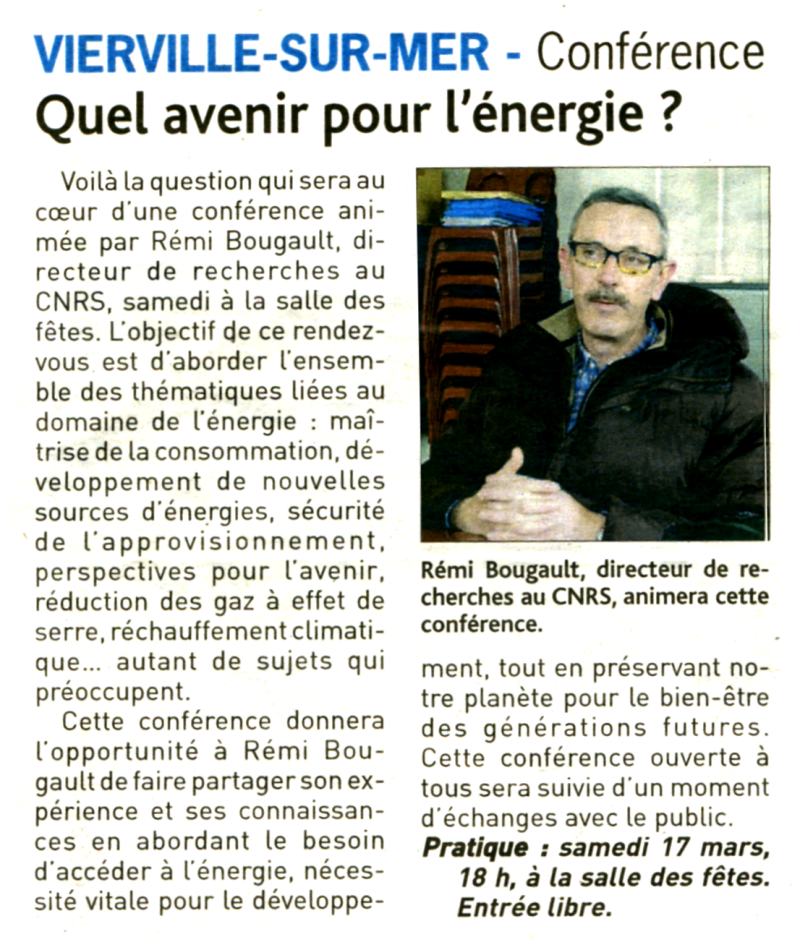
Rémi Bougault offers a conference on the future of energyRead the rewritten text
This reading version has been rewritten from the newspaper clipping. Connecting phrases and any reconstructed words are not a verbatim quotation.
Rémi Bougault, research director at the CNRS, was announced at the Vierville-sur-Mer festival hall on Saturday, March 17 at 6 p.m. for a free conference open to all on the future of energy.
The meeting was to address the control of consumption, new energy sources, security of supply, future prospects, reduction of greenhouse gases and global warming. The researcher wanted to share his experience and knowledge around an issue: ensuring access to the energy necessary for development while preserving the planet for future generations. An exchange with the public was to follow the presentation.
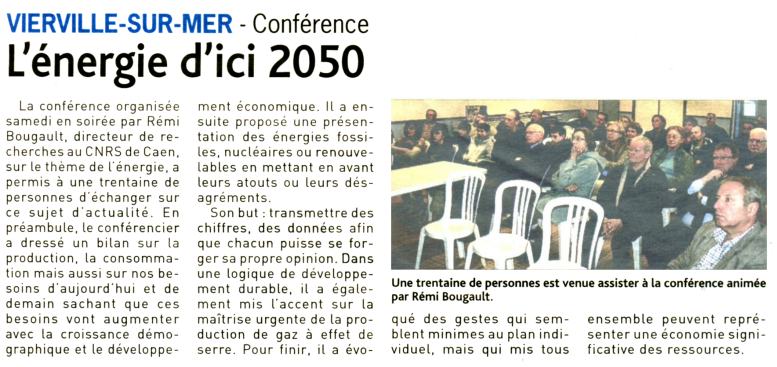
Rémi Bougault presents the challenges of energy by 2050Read the rewritten text
This reading version has been rewritten from the newspaper clipping. Connecting phrases and any reconstructed words are not a verbatim quotation.
About thirty people attended, on a Saturday evening, a conference by Rémi Bougault, research director at the CNRS in Caen, on energy prospects for 2050.
The speaker began by taking stock of production, consumption and energy needs. He recalled that these needs were expected to increase with population growth and economic development. He then presented fossil fuels, nuclear and renewable energies, exposing their strengths and disadvantages.
The objective was to give the public figures and elements of understanding so that everyone could form an opinion. With a view to sustainable development, Rémi Bougault also stressed the need to control greenhouse gas emissions. He concluded with examples of modest gestures at the individual level that, when combined, could contribute to saving resources.
Rémi Bougault presents the energy challenges of tomorrowRead the rewritten text
This reading version has been rewritten from the newspaper clipping. Connecting phrases and any reconstructed words are not a verbatim quotation.
Rémi Bougault, research director at the CNRS in Caen, hosted a conference on energy on a Saturday. Its objective was to provide data and comparisons allowing everyone to form an opinion on the issues of the following forty years.
The meeting began with an inventory of consumption, needs and production. Fossil fuels, nuclear and renewables were examined with their advantages and disadvantages. The speaker relied in particular on the Court of Auditors' figures on production costs in France and on comparisons of volumes produced.
He also addressed the need to control greenhouse gas emissions and the links between energy production and CO2 emissions. Several received ideas were discussed, in particular on the energy consumption of agriculture and the carbon neutrality of wind and photovoltaics.
Finally, Rémi Bougault presented ways to reduce consumption, such as turning off devices left on standby.
Projected, presented, discussed profusely, then refused after a public inquiry, and finally abandoned in 2002
The Omaha Mussel Park Project raises reservationsRead the rewritten text
This reading version has been rewritten from the newspaper clipping. Connecting phrases and any reconstructed words are not a verbatim quotation.
A public inquiry was opened at the town hall of Vierville-sur-Mer from April 8 to May 5 about several applications for concessions of marine crops in the Omaha sector. An extraordinary city council was to meet on Friday evening to discuss it. The project provoked strong reactions in this part of the coast marked by the Landing of June 6, 1944.
The requests concerned different facilities: deep-water flat mussel farming, rope catchment, raised concession on the edge at the tip and at the Raz de la Percée, rope farming near the boxes and rope catchment along them for flat breeding.
At the café La Plage d'or, facing the coast, a resident denounced a project that he considered contrary to the respect due to the soldiers who came to liberate the region. Another recognized the right of project leaders to earn a living, but wanted a more remote location.
Jean Dumesnil, who lived in Vierville at least six months a year, wondered about the compatibility of the project with seasonal bans on shellfish collection. He mentioned the opinions related to a poisonous algae and wondered why these risks would not affect the mold pits envisaged. He also feared a deterioration in bathing conditions and considered the establishment as an attack on the memory of the place. These are the concerns he expressed in the article, and not a health conclusion established by him.
Jean-Yves Mobe, Deputy Departmental Director of Maritime Affairs of Calvados, recalled that no decision had been made. Even after a favorable opinion from the investigating commissioner, the file still had to go before the Marine Culture Commission. He therefore considered it premature to prejudice his outcome. An elected official from Vierville indicated, however, that the eleven councillors were opposed to the project.
Mayor Jean-Marie Oxéant was reserved. He noted a difference between the initial presentation, limited to the capture of births in the artificial port, and the file finally received: the ropes had to float between two waters instead of resting on the bottom, and one hectare of breeding tables was announced on natural molds.
In favor of the widest possible use of the coastline, he did not wish to close the discussion. However, he regretted the lack of details on the installations on land: where would tractors, boats and equipment be stored, especially near the campsite and the departure of the coastal trail? He was afraid that the wind would take away equipment on the beach. The access of professionals, possible only by Vierville according to him, also raised a difficulty.
The mayor finally feared a threat to fishing on foot, an old hobby attracting hundreds of people at high tides, and future conflicts between professionals, bathers and other users. He intended to preserve the family character of the beach and called for mobilization in the public inquiry. Not to mention the emotion aroused by an economic project on this place of memory, he considered an additional activity interesting, but refused the proposed conditions. The article is signed F. Terrible.
International opposition to the proposed mussel farms off Omaha BeachRead the rewritten text
This reading version has been rewritten from the newspaper clipping. Connecting phrases and any reconstructed words are not a verbatim quotation.
After mentioning, in an edition of April 27, a proposal for mussel farms off Omaha Beach, the newspaper reported on the mobilization led by Patrick Elie. Creator of a site devoted to June 6, 1944, he opposed this installation in the name of the preservation of the historic site.
By the time the article went to press, he had received 810 emails of support. They came from the European Union, the United States, Canada, New Zealand and Australia. Internet exchanges had also raised awareness among history teachers in France.
The messages reported expressed above all a refusal based on the memory of the Landing. Their authors wanted to preserve the memory of the soldiers and invoked the presence of bodies remaining at sea near the location in question. The article restores these arguments and the indignation expressed by the opponents.
One Friday morning, Patrick Elie gave about 600 of the first reactions to the mayor of Vierville-sur-Mer, Jean-Marie Oxéant. He also opposed the project. The newspaper describes residents queuing to consult the plans and write their opposition on the complaints book.
The public utility survey was due to end the following Tuesday. At this stage of the mobilization, observations could still be filed with the town hall or sent by email.
The promoters of the mussel-farming project defend their proposalRead the rewritten text
This reading version has been rewritten from the newspaper clipping. Connecting phrases and any reconstructed words are not a verbatim quotation.
The project to farm mussels in deep waters in Omaha Beach had aroused strong opposition for several weeks. The newspaper evoked the hostility of local residents as well as many veterans and historians, petitions on the Internet and a mobilization around the public inquiry.
Pascal Guilbert, a fisherman since 1987, carried the file with Ludovic Robert. He believed that the project had been badly presented and regretted having become a rejected figure in Vierville. Settled in the region for about thirty years, he recalled that his grandmother had worked there as a baker after the landing.
He considered the location of the submerged pontoons particularly favorable. According to him, the waters were classified A, the absence of estuary, port or wastewater discharge limited the risk of pollution, and the pontoons protected from bad weather, especially north and northeast winds in winter.
Pascal Guilbert also claimed to want to preserve an area rich in young marine animals and endangered species. He accused some professional fishing boats of taking juvenile individuals by approaching the stranding limit, at 0.2 or 0.3 nautical miles. He distinguished his deep-water installation from a park visible from the shore: only a few additional buoys should, according to him, appear near the landmarks of the pontoons.
Finally, he attributed part of the opposition to private interests. He denounced fishing practices presented as pleasure but which would conceal, according to him, an illegal and untaxed commercial activity. He reproached some opponents for invoking the memory of soldiers to protect this trade and was surprised by the silence of several elected officials. These accusations are the arguments of the project leader reported by the cut.
Pascal Guilbert defends his mussel-farming project off Omaha BeachRead the rewritten text
This reading version has been rewritten from the newspaper clipping. Connecting phrases and any reconstructed words are not a verbatim quotation.
After the closing of the public inquiry on May 7, the marine aquaculture project in Vierville-sur-Mer continued to arouse opposition from French or foreign residents and correspondents, especially across the Atlantic. The municipal councils of Vierville, Trévières, Louvières and Colleville-sur-Mer had issued an unfavourable opinion.
The fisherman Pascal Guilbert, at the origin of the project, believed that it had been misunderstood or interpreted. He defended an installation that, according to him, could be an asset for the region. After submitting his idea to Maritime Affairs and Ifremer, he said he had obtained confirmation of its viability. He advanced a possible production of 40,000 tons of mussels per year at the Omaha site.
He specified that the cultivation was planned offshore and not on the beach, only buoys should be visible near the submerged remains of the Landing. His objective was not limited, he said, to the sale of mussels: he also wanted to protect the maritime resource and prevent boats from plundering the seabed. The caption of a photograph also highlights his criticism of pleasure fishing, associated with the presence of dozens of tractors on the beach.
Pascal Guilbert considered that some opponents invoked the memory of the soldiers who died in Omaha to challenge the project. At the end of the municipal opinions and observations collected during the investigation, the decision to authorize or refuse the installation was up to the prefect.
Trévières and Vierville oppose the marine culture projectRead the rewritten text
This reading version has been rewritten from the newspaper clipping. Connecting phrases and any reconstructed words are not a verbatim quotation.
The municipal council of Trévières, meeting on a Friday under the presidency of Mayor Jean-Pierre Richard, unanimously adopted a very unfavorable opinion on the marine culture project near Omaha Beach.
The elected officials first invoked the preservation of a place of memory of the Landing. In their argument, they recalled the American soldiers who died on June 6, 1944 and believed that this classified site should remain as it is. They also defended the possibility, for the inhabitants of the coast and the hinterland as well as for vacationers, to continue swimming there in summer.
The council feared that the nuisance attributed to the mussel parks would compromise seaside tourism and, with it, the tourist services and facilities of the region. He also considered these facilities incompatible with the "Wind Sports" project and with the presence of many pleasure boats on this part of the coast.
In Vierville-sur-Mer, directly concerned by the project, the eleven elected officials gathered on Friday evening also all voted for a very unfavorable opinion.
The prefect rejects the mussel-farming project off Omaha BeachRead the rewritten text
This reading version has been rewritten from the newspaper clipping. Connecting phrases and any reconstructed words are not a verbatim quotation.
After a one-month public inquiry and a major international mobilization, the prefect of the region and Calvados refused the establishment of four mussel farms in the Omaha Beach area.
The town hall of Vierville-sur-Mer had received 848 emails and 695 signatures. Associations, individuals and veterans defended the historical character of the beach where the American soldiers of the 29th and 1st divisions had landed. On June 5, a team from France 2 came to meet former GI Franck Towers, opposed to the project.
The site June 1944, a wind of freedom devoted a column to this case. Messages arrived in particular from Belgium, Switzerland, the United States and France. Robert Lenoir, a Flemish Internet user, expressed his indignation in the name of the respect due to the men who had fought and given their lives on this beach.
In a letter to Internet users dated May 10, Mayor Jean-Marie Oxéant thanked these support. He explained that the elected officials had first felt isolated, then carried by an international mobilization. He reaffirmed his refusal of a project that he considered imposed on the municipality.
Two and a half months after the investigation closed, Francis Idrac rejected the request. His decision invoked the historical and tourist vocation of the site, recognized by an order of November 22, 1946, as well as its inclusion in a major site operation devoted to the natural landscapes of the Battle of Normandy, decided on July 9, 2001 by the Interministerial Spatial Planning Committee. He considered a marine aquaculture concession incompatible with this national and international vocation. The Marine Aquaculture Committee also issued an unfavourable opinion on July 4.
Jean-Marie Oxéant welcomed this refusal with relief and satisfaction. He believed that the citizens and their elected officials had been heard, after a file that he considered unclear and a meeting without further action with one of the promoters. He wanted this decision to put an end to aquaculture projects there and allow him to devote himself to Operation Grand Site, in order to give Omaha its place in the history of the Landing.
In conclusion, the newspaper evoked the expected satisfaction of opponents, especially the families of the 3,000 soldiers it presented as dead on the beach of Omaha in June 1944.
July 2002, after public inquiry, the Prefect refuses the project
VARIOUS EVENTS
The ADMR de l'Aure takes stock of its home help in 1991Read the rewritten text
This reading version has been rewritten from the newspaper clipping. Connecting phrases and any reconstructed words are not a verbatim quotation.
The general assembly of the rural home help association of the Aure was held on a Thursday evening in Vierville-sur-Mer, in a room of the old school, under the chairmanship of Mrs. Letellier. Organized in turn in the municipalities of the sector, it brought together several mayors: Mr. Oxéant for Vierville, Mrs. Crosville for Aignerville, Miss Renet for Louvières, Mr. Mezel for Écrammeville, Mrs. Lamy for Formigny and Mr. Couillard for Bricqueville. The article also mentions Bernesq, Blay, Colombières, Mandeville, Rubercy and Trévières among the served municipalities.
President for five years, Mrs. Letellier recalled the responsibilities of the office: Mrs. Guillotte was treasurer, Mrs. Manson secretary, Mrs. Verry in charge of the ACASED, Mr. Bailleul of the SIAD, and Mrs. Denis and Leroutier of the family helpers. Ms. Deboté was newly elected to the bureau. The domestic helpers have appointed Mrs. Lesoif and Mrs. Ferron as representatives. The president called on new volunteers to support the operation and maintenance of the association, which was to celebrate its tenth anniversary in 1993.
The 1991 balance sheet reported fifty-three people assisted: thirty-three elderly people, two people with disabilities, two families with children, fifteen ACASED beneficiaries and one beneficiary of the service home. The staff had provided 8,288 hours of service. The general council's social assistance financed 34% of the services; health insurance funds and a state subsidy of 25.85% contributed to the rest.
The associative life was based on 8,943 francs of municipal subsidies, donations and local events, including a chicken party and the sale of calendars. These own resources made it possible to immediately help people in need, before taking charge of the cash registers.
Estelle Haudebourg, permanent of the federation, presented the file of family jobs, an extension of the ACASED service. A local correspondent of the federation was envisaged to bring all the ADMRs of the Bayeux constituency closer to families.
A draw of the calendars preceded the glass of friendship. The lots were to be collected at Mrs. Denis in Trévières. The winning numbers printed were: 1, 12, 17, 30, 33, 36, 39, 43, 45, 46, 69, 75, 78, 79, 86, 95, 99, 101, 109, 954, 957, 959, 960, 970, 974, 977, 983, 987, 990 and 999.
June 1992 - General Assembly of the ADMR, held in Vierville
The friendly meeting of May 1st at the party hallRead the rewritten text
This reading version has been rewritten from the newspaper clipping. Connecting phrases and any reconstructed words are not a verbatim quotation.
On Sunday, May 1, Jean-Marie Oxéant and his city council welcomed the inhabitants of Vierville to the party hall, in a family atmosphere. Created four years earlier, this meeting brought together a growing number of participants around a buffet, to get to know each other and exchange.
After thanking the assistance, the mayor presented the new Friends of the Beach office and the objectives of the association. The conversations were prolonged and the last guests did not separate until early in the afternoon.
1965, Michel Hardelay, mayor at the time of the filming of the "Longest Day". In front of the restaurant of the "Pie qui Tette", with a filmmaker?
General Eisenhower came to shoot one of the film's sequences at the tip of the Hoc. He stopped in Vierville to rest at the Casino hotel
Omaha Beach France, a short film with Jess HahnRead the rewritten text
This reading version has been rewritten from the newspaper clipping. Connecting phrases and any reconstructed words are not a verbatim quotation.
A team led by Pierre Emmanuel Danan toured for three days in Vierville to direct Omaha Beach France, an eleven-minute fiction devoted to the Landing.
The film tells the meeting of the eyes of a child and an old man on the beach of Omaha. Jess Hahn, an American actor specializing in supporting roles and living in France for twenty years, plays a veteran and, symbolically, the soldiers who died on the beach.
Eleven-year-old Sébastien Zévaco, a resident of Saint-Laurent, played for the first time. The director had preferred to choose a local child, despite the difficulty of shooting with a beginner, to give more reality to this meeting.
Pierre Emmanuel Danan presented his film as a tribute to the liberators and a way to transmit freedom. Born after the events, he wanted to thank with this work those whose commitment had allowed him to live free. The photograph of the report is signed Boudonnet.
Diamond wedding of the family Seals celled on January 19, 2013
Thérèse and Edmond Scelles celebrate their diamond weddingRead the rewritten text
This reading version has been rewritten from the newspaper clipping. Connecting phrases and any reconstructed words are not a verbatim quotation.
On the Saturday before the publication of January 22, 2013, Mayor Antoine de Bellaigue celebrated the sixty years of marriage of Thérèse and Edmond Scelles, surrounded by their family, friends and elected officials.
Born in Couvains, in the English Channel, Edmond met Thérèse, from Bonnebosq, in Saint-Laurent-sur-Mer. Dairy driver in the Trévières area, he then worked at Vanloo on the recovery of wreckage off the landing beaches. The couple married in Saint-Laurent on December 24, 1952 at 9:30 a.m., then left in 1953 for Paris and its region. During these fifteen years, Edmond was a mechanic and then a team leader.
In 1969, the couple returned to the Bessin and bought the garage and the Vierville gas station. Edmond was in charge of automotive and agricultural mechanics as well as troubleshooting. Thérèse served the fuel and managed the accounts.
When they retired in 1989, they left the Port-en-Bessin road for Grandcamp, while remaining in Vierville. They continued to actively participate in the municipality's demonstrations. The mayor praised their kindness and good humor. Edmond also showed his storyteller skills by evoking memories of 1944, when he was sixteen years old. The meeting ended around the glass of friendship, with the desire to meet again for their platinum wedding.
Annual election meeting of the MP on November 17, 2014
A public meeting announced by Isabelle AttardRead the rewritten text
This reading version has been rewritten from the newspaper clipping. Connecting phrases and any reconstructed words are not a verbatim quotation.
A brief announced an annual public meeting of MP Isabelle Attard, scheduled for Monday, November 17 at 7:30 p.m. at the town hall of Vierville-sur-Mer. It was to present its parliamentary activity of the past year, and then answer questions from citizens.
Bessin's rural heritage reaffirms its defense of landscapesRead the rewritten text
This reading version has been rewritten from the newspaper clipping. Connecting phrases and any reconstructed words are not a verbatim quotation.
About fifty people participated, on Wednesday, August 13 in Vierville-sur-Mer, in the general meeting of Patrimoine rural du Bessin. Mayor Jean-Marie Oxéant presented the municipality and its commitment to the quality of the landscapes, which he linked to the low urbanization of the coast.
President Jean Leproux took stock of a year without exceptional action. He recalled the interventions of the association to facilitate the restoration of a bridge over the Seulles, at the Manoir, and protect the surroundings of the castle of Magny and the church of Mosles.
The association had also acted against several wind turbine projects. Its president specified that his role was not to choose between wind and nuclear, nor to defend an ecological doctrine, but to preserve the character of villages and their landscapes. For the association, pylons of more than a hundred meters, visible several kilometers away, risked breaking the harmony of the Bessin. Without hoping to prevent any implantation, she wanted to limit the number and obtain strict regulations.
The second part of the evening was devoted to a conference by Gérard Pouchain on Bayeux and the Bessin in literature. He had chosen nine writers who came to Bayeux in the 19th century, who had used the city as a setting, had evoked it or had made a critical reading of it. He also recalled that Vierville-sur-Mer had served as a model village for Zola.
Association du Patrimoine Rural du Bessin met in August 2003 in Vierville
Mayors of the canton exchange on roads, health and servicesRead the rewritten text
This reading version has been rewritten from the newspaper clipping. Connecting phrases and any reconstructed words are not a verbatim quotation.
Meeting on a Friday in Vierville-sur-Mer, the mayors of the canton of Trévières examined road works, local services, safety and the future of the care offer. Senator Jean-Léonce Dupont also mentioned the reform of the communities. The report is signed by Murielle Bouchard.
The mayor of Breuil-en-Bessin announced the development of the crossroads where a fatal accident occurred on May 8. He regretted that a project awaited for more than two years had not been carried out before. Alain Cornière, mayor of Étréham, asked where the repairs of RD 123 and 206 A were. The director of the ARD de Bayeux explained that their registration for the program had been refused the previous year, but that he hoped to have them retained in the next budget.
Christelle Calenge, mayor of Écrammeville, reported eight slumps in the center of the village, one of which caused ten thousand euros in damage to a farmer. The ARD has undertaken to resume the crossings made by a concessionaire, while specifying that it is not responsible for their degradation. Another elected official warned about the state of the shoulders of the RD 124 to La Cambe; the director replied that there was no sustainable technical solution for these shoulders.
Jean-Marie Oxéant, mayor of Vierville, described the difficulties of the municipal postal agency: insufficient funds and lack of stamps. A merchant wishing to buy three hundred stamps before the season had been announced a month of waiting, leading users to Isigny or Trévières. The representative of La Poste recalled the security rules limiting the available funds, but acknowledged the anomaly concerning the stamps and promised to report it.
Captain Nicolas Le Guyader, commander of the Bayeux gendarmerie company, presented a favorable assessment of the resolution of the cases in Trévières, with several burglaries elucidated. However, he was worried about the increase in the use of narcotics, especially heroin, and the transition, in some young people, from inhalation to injection. He also designated drinking and driving as the main cause of local accidents, recalling the driver's drunken state in the Breuil-en-Bessin accident. Prevention was to continue with nightclubs, especially that of Crouay.
The mayor of Bernesq wondered about the medical future of the sector: two doctors from Trévières were considering getting closer to Bayeux and another was about to retire. Roger Jouet, former general counsel, recalled that the number of doctors had increased from two to four and was reassuring. The mayor of Bernesq nevertheless wanted to study a nursing home. Jean-Pierre Richard, general councillor, indicated that the deputy should request the classification of the canton among the priority areas. Sub-Prefect Jacques Ranchère invited him to meet with him the regional health agency to discuss Trévières and Balleroy.
Jean-Pierre Richard announced the upcoming installation of an Info Point 14 at Trévières City Hall, to gather in one place information on administrative procedures and avoid travel.
Saint-Laurent-sur-Mer and Colleville-sur-Mer had benefited that year from the surveillance of the beaches by the SDIS firefighters, desired for two years by the friendly. The elected officials thanked his president Michel Granger. Colonel Soufflet, head of the center in Bayeux, announced the renewal of the system. In Colleville, four people were put to safety in July.
Finally, Catherine Chartier, mayor of Saint-Laurent-sur-Mer, confirmed the maintenance of Les Braves sculptures on the beach for at least nine years, with a renewable decision. The mayors of the canton wanted to keep this work since its installation for the sixtieth anniversary of the Landing in 2004, but many appeals had delayed this outcome.
Meeting of the mayors of the canton of Trévières, Vierville festival hall on October 22, 2010
Fishing on foot on the coast, from Grandcamp to ViervilleRead the rewritten text
This reading version has been rewritten from the newspaper clipping. Connecting phrases and any reconstructed words are not a verbatim quotation.
The report was walking through the fishing spots of the coast. In Grandcamp-Maisy, rocks and algae attracted lovers of bouquets, fished with a landing net near the bottom and rocks. Asked on Friday, September 10, a resident explained that he had not missed any tides since August 1, the opening date he indicated in the article; some vacationers came especially for this fishing.
In Cricqueville-en-Bessin, near the Pointe du Hoc, fishermen were looking for the etrilles under the rocks. The most experienced also watched the cakes, called sleepers, or hoped to discover a lobster in its hole. The periwines were also among the catches mentioned.
In Vierville-sur-Mer, the newspaper lingered on mussels. A fisherman named Henry described them as small, very white and particularly tasty, comparable in his eyes to those of Sainte-Honorine-des-Pertes. However, he regretted that they were rarer that year.
The 2015 projects and the mayor's concerns about territorial reformsRead the rewritten text
This reading version has been rewritten from the newspaper clipping. Connecting phrases and any reconstructed words are not a verbatim quotation.
During the presentation of the wishes of the city council, on a Saturday, Antoine de Bellaigue detailed the projects planned for 2015 in front of many residents. The general counsel and the president of the Intercom were also invited and presented their wishes.
The municipality planned to improve the accessibility of the town hall, the communal hall and the post office, to build a municipal workshop and to restore in the church a bay, stained glass windows and the door of the sacristy. The burial of electrical and telephone networks as well as the installation of a charging station for electric vehicles were also on the program. The mayor insisted on the completion in 2015 of the work undertaken on the dike in 2014.
The cultural calendar announced in particular a concert of the ADTLB on March 28, the traditional meeting of May 1 and the activities of local associations.
Antoine de Bellaigue also mentioned the territorial reforms announced for 2015: the redistribution of the cantons in March and the meeting of Basse-Normandie and Haute-Normandie at the end of the year. Attached to rurality and proximity, he feared a remoteness from administrative centers and additional difficulties for small municipalities.
With your consent, Google Analytics uses cookies to measure visits and the pages viewed. You can still use the site if you decline. No Google tools are loaded before you consent.
A cookie remembers your choice for six months. You can change it at any time using the footer.